


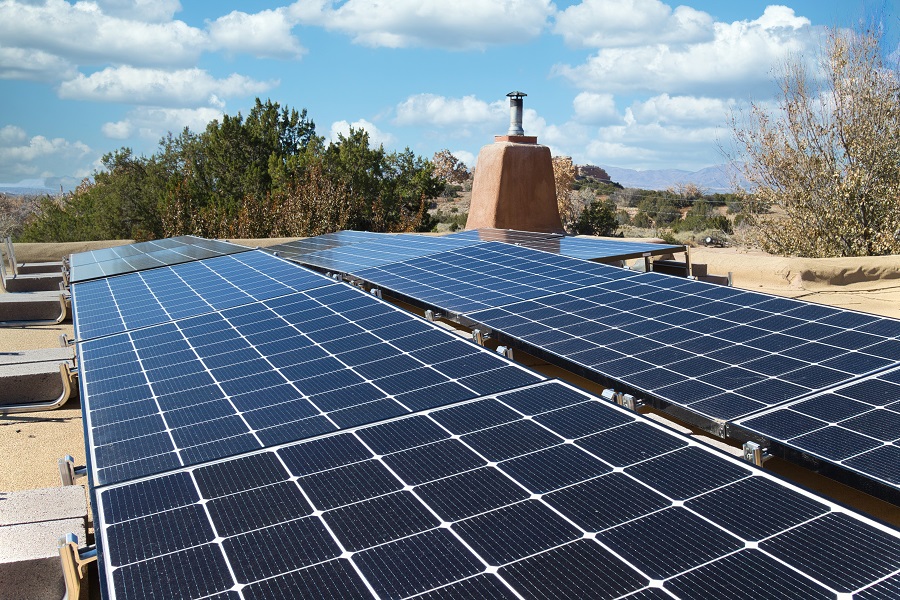
Rows of newly installed community solar panels glinted beneath the morning sun on a windy stretch of land off Seventh Street in northern Las Vegas. State officials, renewable energy supporters, and local business leaders gathered on Wednesday to celebrate what many described as a long-awaited development.
The site, known as Pino, is the latest community solar project to come online in New Mexico. It is part of a statewide effort that advocates say could expand access to renewable energy for renters, low-income residents, and small businesses.
The celebration also marked something else. It is proof that a program years in the making is finally beginning to arrive.
“It’s a tremendous growth opportunity,” said Chris Pacheco, owner of Albuquerque-based Pluma Construction, one of the companies behind the project. “Even if you are a small New Mexico company, if you branch out and partner, you can grow your company.”
Pluma Construction, Forefront Power, Standard Solar, and Solstice developed the Pino facility as one of eight community solar projects through their partnership. The community solar projects together deliver 48.4 megawatts of solar capacity across communities such as Las Cruces, Silver City, and Clovis. The Alamogordo site is the only project still pending, with completion expected later this year.
Five years ago, New Mexico passed legislation creating the state’s community solar program. Governor Michelle Lujan Grisham signed the Community Solar Act into law in April 2021. The law envisioned a system that would allow residents to subscribe to common solar arrays and receive credits on their electricity bills. It promised to broaden access to renewable energy beyond homeowners who can install panels on their own roofs.
But the rollout proved slower and more complex than many expected. Projects are delayed due to regulatory hurdles, utility coordination issues, and rising infrastructure costs. Even now, only a fraction of the projects the regulators approved are operating.
In 2023, New Mexico’s Public Regulation Commission selected 47 community solar projects, representing about 196 megawatts of capacity. Only 13 are operating as of Wednesday, Patrick Rodriguez, a spokesman of the agency, said. Officials say project momentum is still building. They expect to wrap up 39 projects by the end of 2026.
Rep. Tara Lujan, a Democrat from Santa Fe, stood before the solar panels on Wednesday. The lawmaker described the project as the kind of economic investment she says the state should prioritize. “One of many reasons why I became a legislator is to ensure that our dollars and our economy and our budget are going toward what we see up here today,” she said. Lujan gestured toward the rows of panels behind her.
Supporters of the community solar program say it offers a rare intersection of climate policy and economic relief. Under the program, subscribers receive credits that reduce their electricity costs, while the projects contribute to the state’s clean-energy goals.
But industry leaders say the state must address systemic challenges that undermine the program’s sustainability as projects near completion. For instance, the cost of connecting solar projects to the electrical grid is one major obstacle.
Advertisement
Jim DesJardins, executive director of the Renewable Energy Industry Association of New Mexico, said developers faced unforeseen interconnection costs that can run into the hundreds of thousands of dollars — or even millions. “If a developer knew ahead of time they would need a $10 million substation upgrade, they probably would have looked somewhere else,” he said. “We need to get better at sharing information.”
Industry groups are now urging utilities and regulators for greater transparency about interconnection costs during the current rulemaking process at the Public Regulation Commission.
Another battle is unraveling over the customer payment structure for community solar. Current rules allow subscribers to receive a separate monthly bill from the community solar company in addition to their regular utility bill, which critics describe as one of the program’s biggest weaknesses.
Tyler Yasa, an executive of Solstice, said the dual-billing system causes high turnover among subscribers. Many of these subscribers are low-income residents, he explained. Solstice manages subscriptions for several New Mexico projects.
Customers who fail to pay even one payment can lose access to the program, he said. Many of these customers would abandon their subscriptions rather than risk falling behind on their utility bills. “Because of how quickly we’re churning through customers, we’re going to reach a saturation point very soon,” Yasa said. “If we want this program to succeed long-term, we have to address where that default risk lands.”
Advocacy groups, including the Sierra Club and the Coalition for Community Solar Access, are pressing regulators to adopt a “consolidated billing” model. Other states like Maryland, Illinois, and New York already use this model.
Under the consolidated billing system, subscribers have their community solar credits applied directly to their utility bills. The system eliminates the need for separate invoices. Shifting from dual-billing to consolidated billing could stabilize enrollment and make the program more accessible to low-income households, according to proponents.
Despite the challenges, many supporters gathered in Las Vegas viewed the completion of the Pino project as a sign that the state’s long-delayed experiment in community solar may finally be finding its foothold.
Community solar, according to a study by the University of New Mexico Bureau of Business and Economic Research, has the potential to contribute significantly to the state’s economy. The benefits of community solar include up to $517 million in benefits, the creation of about 3,760 high-quality jobs in various sectors over the next five years, and over $2.9 million in tax revenue.
Pacheco said he hopes people will remember the community solar project for more than just clean electricity and revenue generation. But also for demonstrating what local partnerships can accomplish. “I hope this portfolio is remembered,” he said, “as an example of what can happen when local leadership and strong partnerships come together for New Mexico.”

