


U.S. Teacher Stress Levels Hit Record Highs, Surpassing Pandemic Peak, New Survey Finds

A new nationwide survey from Prodigy Education has revealed that U.S. teachers are experiencing unprecedented levels of stress—surpassing even the peak anxiety reported during the height of the COVID-19 pandemic. The findings paint a sobering picture of the American education system, exposing how mounting behavioral issues, financial strain, and a growing sense of fatigue are […]

A new nationwide survey from Prodigy Education has revealed that U.S. teachers are experiencing unprecedented levels of stress—surpassing even the peak anxiety reported during the height of the COVID-19 pandemic. The findings paint a sobering picture of the American education system, exposing how mounting behavioral issues, financial strain, and a growing sense of fatigue are pushing educators to the brink.

Nearly half—45%—of surveyed K–12 teachers say the 2024–25 school year has been the most stressful of their careers. This milestone is especially troubling when compared to the trauma-laden pandemic years, which forced educators into remote instruction, public health uncertainty, and widespread student disengagement.

The fact that stress is even higher now—when classrooms have mostly returned to normal operations—raises urgent questions about what’s happening inside U.S. schools.

One of the most pressing concerns, cited by 58% of teachers, is a sharp rise in student behavior issues. In 2024, the U.S. Department of Education reported a 21% increase in disciplinary incidents compared to pre-pandemic levels, including fights, chronic absenteeism, and classroom disruptions. As a result, teachers say they are spending more time managing behavior than delivering instruction, creating a vicious cycle of burnout.

Compounding the stress is inadequate compensation. 44% of teachers identified low pay as a top contributor to their anxiety. Despite public attention on staffing shortages, pay in many districts has failed to keep pace with inflation.
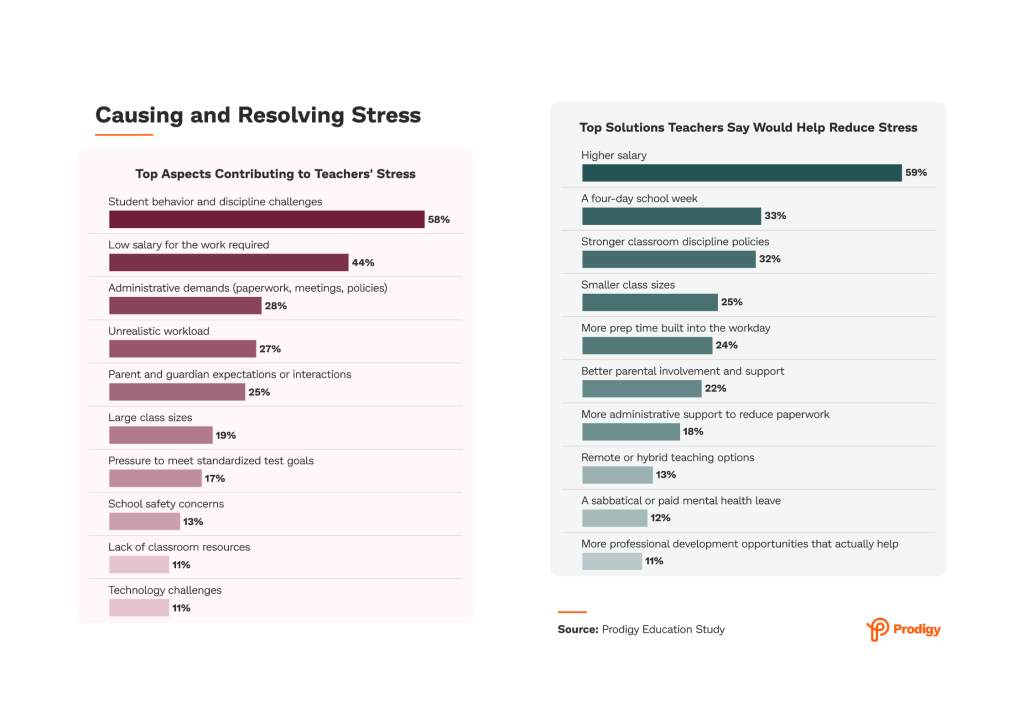
The reason behind the rising teachers stress level and what they believe would are the solutions. Data from: prodigygame.com

According to a 2023 report by the Economic Policy Institute, public school teachers in the U.S. earned, on average, 26.4% less than comparable college-educated professionals in other fields—a record-high wage gap known as the “teacher pay penalty.” This gap has widened over the past two decades, intensifying financial pressure on educators.

Administrative burdens also weigh heavily with 28% of teachers reporting stress from increasing bureaucratic demands—including paperwork, student testing, data reporting, and shifting curriculum mandates—that leave little room for creative instruction or teacher autonomy.

Other Key Findings

  • 95% of respondents reported experiencing some level of stress, with 68% describing it as moderate to very high.
  • 9% of teachers say they plan to leave the profession within the next year, and another 23% are seriously considering it. If realized, this attrition could deepen the national teacher shortage and disrupt learning for countless students.
  • Even self-care, often promoted as a solution, proves difficult. Though 78% of educators say they try to prioritize their well-being, 43% report feeling guilty for taking time for themselves. The same percentage say they’ve skipped self-care altogether due to job demands, reinforcing a culture of self-sacrifice that often goes unnoticed and unaddressed.

Beneath the data lies a profound emotional disconnect: nearly half of all educators surveyed said they feel underappreciated. While Teacher Appreciation Week—observed during the first full week of May—offers temporary recognition, many argue that true respect comes in the form of long-term, institutional support.

When asked what changes would make a real difference, teachers offered clear and consistent answers: higher salaries (59%), a four-day workweek (33%), stronger discipline policies (32%), and smaller class sizes (25%). These aren’t just abstract ideas—they mirror reforms already underway in some districts. Rural school systems in Colorado and Missouri, for example, have adopted four-day school weeks to attract and retain staff.

According to the Education Commission of the States, more than 60% of Colorado school districts and several in Missouri have moved to the four-day model, citing improved teacher recruitment and retention, reduced absenteeism, and budgetary savings. Meanwhile, teacher unions nationwide are pushing for class size caps and enhanced mental health support.

Dr. Josh Prieur, Director of Education Enablement at Prodigy Education, underscored the urgency of the report’s findings. “The fact that stress levels for so many teachers have exceeded those of the pandemic era should be a wake-up call,” he said. “Teachers need tangible, meaningful, and sustained support alongside our appreciation—not just this week, but every week of the year.”

The survey, conducted in spring 2025, includes responses from over 800 educators representing a range of grade levels and school types. Its findings echo warnings from education experts and labor organizations: without immediate action, the mounting stress crisis among teachers could destabilize an already overburdened education system.

For corrections, news tips, and any other content requests, please send us an email at [email protected].

Hot this week

UNM Steps Up to Cut Food Waste, Boost Food Access

The University of New Mexico works to turn food waste into resources that help address food insecurity on campus.

New Mexico’s Recipe for Hantavirus Risk—Climate, Deer Mice, and Country Living

More than 30 years after the Four Corners outbreak, New Mexico continues to report among the nation’s highest hantavirus pulmonary syndrome cases. Experts say the state’s ecology, climate cycles and rural living conditions have created an enduring hotspot for the rare but deadly disease carried by deer mice.

Community Solar Program Took Years to Arrive. Now the Solar Panels Are Finally Rising.

After years of delays, New Mexico’s community solar program is beginning to expand, with new projects coming online across the state. But developers and advocates say high interconnection costs and complicated billing rules still threaten the program’s long-term success.

Patient Voices Push New Mexico Lawmakers to Spotlight Healthcare Access and Affordability

New Mexico lawmakers spotlighted healthcare after hearing directly from patients, emphasizing urgent concerns about access, affordability, and workforce shortages.

Health Officials Clarify Hantavirus Risk: No Person‑to‑Person Spread

New Mexico's health officials have emphasized that the state's Hantavirus (Sin Nombre Virus) is not transmitted from person to person, which differs from the Andes virus that was responsible for an outbreak aboard a cruise ship. There have been many reports around the world about the Andes virus being transmitted by other people, and this caused people to worry about being able to contract the Andres virus from residents of New Mexico. The Andes virus is the only hantavirus known to be transmitted by another person in South America. The Sin Nombre Virus can only be contracted by contact with infected rodents, or their excrement. There are several ways to help to prevent hantavirus exposure, including disinfecting rodent nests and debris, ensuring that all points of entry into the home are sealed and practicing safe cleanup methods.

Topics

UNM Steps Up to Cut Food Waste, Boost Food Access

The University of New Mexico works to turn food waste into resources that help address food insecurity on campus.

New Mexico’s Recipe for Hantavirus Risk—Climate, Deer Mice, and Country Living

More than 30 years after the Four Corners outbreak, New Mexico continues to report among the nation’s highest hantavirus pulmonary syndrome cases. Experts say the state’s ecology, climate cycles and rural living conditions have created an enduring hotspot for the rare but deadly disease carried by deer mice.

Community Solar Program Took Years to Arrive. Now the Solar Panels Are Finally Rising.

After years of delays, New Mexico’s community solar program is beginning to expand, with new projects coming online across the state. But developers and advocates say high interconnection costs and complicated billing rules still threaten the program’s long-term success.

Patient Voices Push New Mexico Lawmakers to Spotlight Healthcare Access and Affordability

New Mexico lawmakers spotlighted healthcare after hearing directly from patients, emphasizing urgent concerns about access, affordability, and workforce shortages.

Health Officials Clarify Hantavirus Risk: No Person‑to‑Person Spread

New Mexico's health officials have emphasized that the state's Hantavirus (Sin Nombre Virus) is not transmitted from person to person, which differs from the Andes virus that was responsible for an outbreak aboard a cruise ship. There have been many reports around the world about the Andes virus being transmitted by other people, and this caused people to worry about being able to contract the Andres virus from residents of New Mexico. The Andes virus is the only hantavirus known to be transmitted by another person in South America. The Sin Nombre Virus can only be contracted by contact with infected rodents, or their excrement. There are several ways to help to prevent hantavirus exposure, including disinfecting rodent nests and debris, ensuring that all points of entry into the home are sealed and practicing safe cleanup methods.

‘You Are Not Alone’: Grief Kits Help Students Cope with Loss 

Albuquerque Public Schools received grief kits after the Rotary Club of Albuquerque and the Grief Center worked together to provide resources that help students cope with loss.

New Mexico Reopens Fight Over Toxic Oil and Gas Wastewater — Environmentalists Call It a Political Gamble

New Mexico regulators voted to revive a contentious rulemaking process that could expand the use of treated oil and gas wastewater beyond drilling sites, reigniting a fierce clash between industry advocates and environmental groups over public health, water scarcity and political influence.

Wastewater Sounded the Measles Alarm in New Mexico—Before Doctors Even Caught It

A new study shows New Mexico health officials detected measles in wastewater five days before hospitals confirmed cases, highlighting sewage surveillance as a powerful early-warning system during the nation’s largest measles outbreak in decades.

Related Articles