

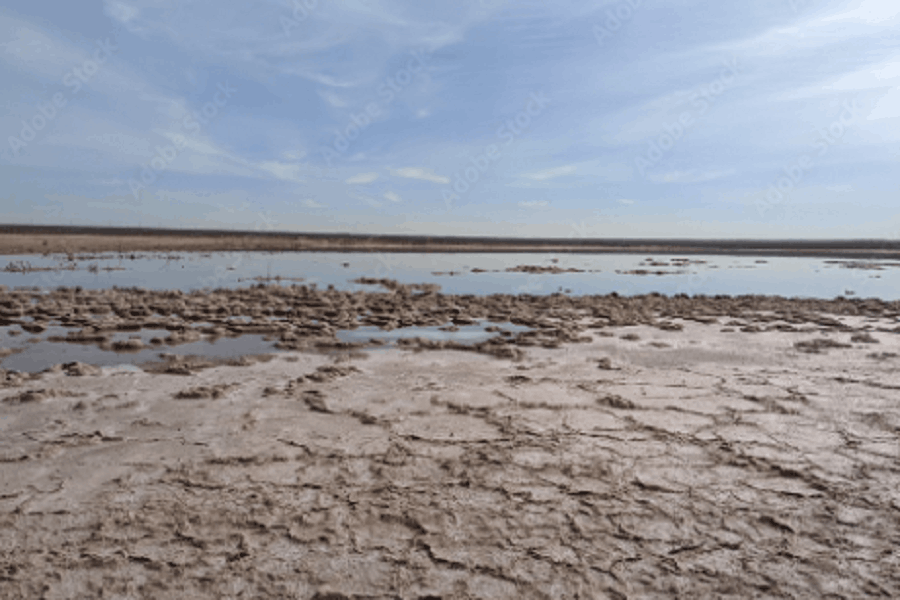
Rivers run thinner each year in the deserts of New Mexico, and wells sink deeper into dry ground. State officials are now looking to a lifeline buried far beneath the parched land: brackish water.
On Monday, New Mexico officials announced the awarding of $13 million in new contracts. The initiative aims to map, test, and treat brackish water — naturally salty water trapped deep beneath the earth. It is part of an ambitious program to prepare for a future shaped by worsening water scarcity.
The program reflects an increasing urgency inside New Mexico, where climate change, prolonged drought, and long years of groundwater overuse are reshaping the very question of how communities will survive in the years ahead.
Brackish water: NM’s most important resources
New Mexico’s scientists and water planners estimate that available freshwater supplies could decrease by as much as one-fourth in the coming years. To prepare for the worsening water crisis, Gov. Michelle Lujan Grisham has placed the development of brackish water at the center of the state’s comprehensive 50-year water action plan.
Officials believe the underground water could become one of New Mexico’s most important resources, but the state has yet to tap into it. According to the state Environment Department, over 1 trillion gallons of brackish water may lie beneath the state.
“By advancing brackish water desalination, resource mapping, and real-world demonstration projects, we are building the technical foundation needed to unlock new water sources statewide,” Environment Secretary James Kenney said in a statement. “These investments move New Mexico closer to a future where every community has access to reliable, drought-resilient water supplies.”
The contracts announced on Monday represent the final portion of a $40 million fund approved by the Legislature in 2025. The lawmakers have added more allocations from the last two legislative sessions; they have now directed more than $75 million toward the Strategic Water Supply program.
Applications in manufacturing, dust suppression, and cement production are part of the funding support experiments that would use the salty water without expensive treatment. Other projects focus on desalination technologies, which could make the water suitable for farming or human consumption.
Two companies from Albuquerque received the largest awards. The state awarded $9.1 million to WSP to drill test wells, analyze, and map the extent of brackish water reserves across New Mexico. Officials say these activities will help determine which areas are most suitable for future extraction and desalination.
New water infrastructure
Another company, Indewater, got $3.7 million. The company will develop a mobile desalination unit for rural and tribal communities. New Mexico will eventually own the portable treatment plant, which is intended to help officials rapidly evaluate desalination’s potential as a drinking‑water supply in communities where groundwater is becoming increasingly salty. A smaller grant of over $270,000 went to Massachusetts-based Harmony, which will install a filtration system at Menefee Farms in Lake Arthur, providing drinkable water for livestock.
Officials frame the projects as not mere experiments. They are New Mexico’s attempts to build an entirely new water infrastructure before the worsening water crisis becomes catastrophic.
“These contracts give us the data, tools, and experience needed to make long-term, science-based decisions about New Mexico’s water future,” State Engineer Elizabeth Anderson said in a statement. “Understanding where and how we can responsibly develop brackish water resources is essential to easing pressure on our freshwater systems.”
What hangs in the balance will have its ramifications beyond New Mexico. Across the American Southwest, states are experiencing shrinking reservoirs, decreasing snowpack, and heightened competition over the Colorado River. Water managers are increasingly looking at desalination and alternative water supplies as critical tools amid a changing climate.
Difficult questions
But the promise of brackish water also comes with hard questions. Desalination remains energy-intensive and costly. Environmental advocates warn that large-scale extraction could create new ecological hazards if poorly managed. Rural communities and tribal communities, many of whom are already struggling with aging infrastructure and unsafe drinking water, could experience disparities in access to technology.
Despite that, New Mexico officials argue that the alternative is no longer sustainable, and the wait for freshwater systems to collapse further. The future of water in a state where drought is a permanent condition may now depend on learning how to drink what was once thought undrinkable.