

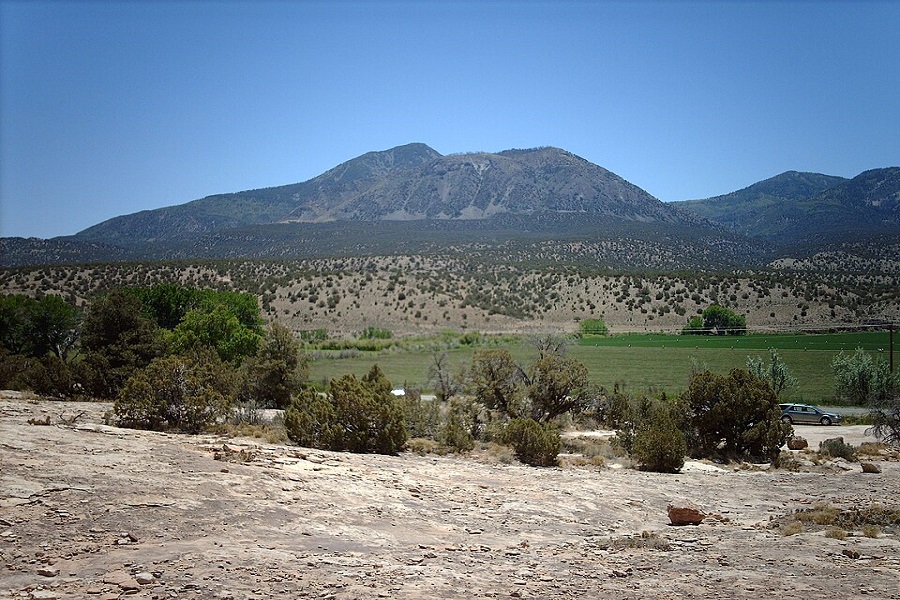
The Ute Tribe on the high desert of the American Southwest, where sandstone cliffs meet arroyos, is working to build a massive renewable energy hub. Over the next 18 months, more than 270 megawatts of solar panels and 180 megawatts of battery storage will rise on tribal land in neighboring New Mexico.
On paper, the timeline defies the current political gravity in Washington. The Trump administration’s “Big Beautiful Bill” had eliminated federal tax credits for renewable energy projects nationwide. President Trump has publicly attacked solar technology as “ugly.” Interior Secretary Doug Burgum, at the same time, ordered that the routing of all federal wind and solar permits go through his immediate office—industry advocates called the directive an addition of 68 layers of bureaucratic red tape.
According to Sean Gallagher, a policy analyst for the Solar Energy Industries Association, the administration’s actions amount to a de facto moratorium, endangering about 36 percent of all planned U.S. electricity capacity through 2030.
However, the Ute Mountain Ute project, known as Foxtail Flats, has survived.
About 100 people attended the recent groundbreaking ceremony, where tribal leaders and project partners held shovels and smiled for the cameras. The project squeaked through by the slimmest of margins, securing the necessary federal signatures on its permits last summer, only days before the administration’s policy pivot froze the rest of the industry.
“We’re going through some challenging times right now, especially with the solar projects,” Alston Turtle, a member of the Ute Mountain Ute tribal council, told the crowd in attendance. “But we’ve got to continue to move forward in the vision that we see is right.”
The tribe’s 933-square-mile reservation is in southwestern Colorado. But its borders extend into New Mexico and Utah. Over the last three-quarters of a century, the tribal budget relied mainly on oil and gas development, which at one point bankrolled over half of its annual operations.
The finite nature of fossil fuels, combined with the sharp economic pain of oil’s boom-and-bust cycles, however, prompted the shift. At the same time, the local effects of climate change have become almost impossible to ignore. At the center of the 933-square-mile reservation sits the sacred mountain known as Sleeping Ute Warrior. The mountain’s natural springs, which traditionally sustained juniper forests and vital ceremonies, are vanishing.
“Just in the 30 years I’ve worked here, I’ve seen so many of those springs dry up,” said Scott Clow, the head of the tribe’s Environment Department. “They’re going to have a Sun Dance up there next month, and the spring next to the Sun Dance grounds is dry. It’s bone dry.”
The resilience of Foxtail Flats is the result of a 15-year plan. In 2015, backed by resources from the U.S. Department of Energy, the tribe partnered with Sandra Begay, a Navajo mechanical engineer who, at the time, worked for Sandia National Laboratories. Begay urged the tribal council to view energy shift not as a series of quick wins. She framed the transition as a generational commitment of the tribe capable of weathering shifting political tides.
“Time with tribes is different,” the Navajo engineer said. “You’re dealing with tribal elections, politics, the emphasis on money or no money. That’s a part of the process you have to get people to understand: Can you think 10 years in the future?”
The tribe began the renewable energy project small, installing residential rooftop solar panels before constructing a one-megawatt array to power its highway casino. The success of those early micro-projects eventually caught the attention of utility-scale developers.
Geography was also in the tribe’s favor. The Foxtail Flats array will be built on tribal land, across the border in New Mexico, situated near a newly decommissioned coal-fired power plant. The site lies at an optimal energy crossroads, possessing an intact network of transmission lines capable of carrying electrons to users in Texas, Arizona, Utah, California, and Colorado.
Even with geographic advantages, the financial engineering behind the renewable energy project remained uncertain until the final permits were signed. “The biggest fear was the financing collapsing to get this project going,” said Matt Heavner, a board member for Public Utilities in Los Alamos County, which has won the contract to buy more than half of the project’s generated power. “We worried about federal subsidies going away, and the financing required for this project not making the cut with investors.”
The tribe has found lucrative buyers hungry for its power as energy demand surges across the West. Beyond regional public utilities, Meta has signed on as a primary customer, intending to use the solar array to power a massive new data center under construction near Albuquerque.
Hundreds of other tribal and commercial renewable projects remain stalled in federal review. But the Ute Mountain Ute project represents a rare win in a regulatory freeze.
Begay advises those caught in the current regulatory freeze to be patient. She viewed the administration’s policy posture as a temporary season. “Their land is not going away. Their authority to use that land is not going away,” she said of the native communities seeking a foothold in the green economy. “You just wait until the time is right, when those customers really want new electrons.”

