

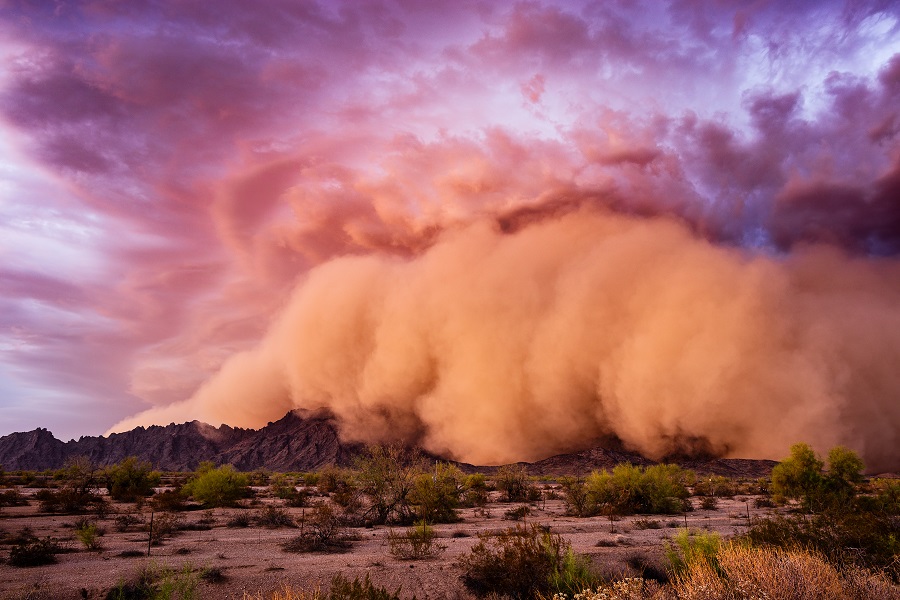
Dust storms are becoming a growing hazard across New Mexico and much of the United States, threatening public health, transportation safety, and renewable energy production as changing weather patterns contribute to more frequent and severe events, scientists say.
With most of New Mexico being desert, the state, according to World Atlas, places fourth among 10 U.S. states in dust storm frequency. The trend mirrors a broader rise in severe dust storms across the Southwest over the past three decades, according to researchers.
The World Meteorological Organization’s annual Dust Bulletin reported global sand and dust storm activity in 2025 and warned of impacts on air quality, human health and ecosystems.
Daniel Tong, an associate professor of atmospheric science at George Mason University, said dust storms have become more frequent nationwide. Tong developed a windblown dust emissions model used by the National Oceanic and Atmospheric Administration to forecast dust storms in North America and worldwide.
“We are seeing this increasing trend over the U.S.,” Tong said. “It has already a lot of alarming impacts on human health, transportation safety and renewable energy generation.”
Besides New Mexico, states experiencing the highest number of severe dust storms include California, Illinois, Kansas and Oklahoma. NOAA recorded 50 dust storm events in New Mexico between January and March 2025.
Globally, North Africa, the Middle East and China experienced the highest levels of sand and dust storm activity last year.
Tong said dust storms carry more than soil particles. Depending on local conditions, they can transport pollutants and hazardous materials. “A dust storm is like a soup,” Tong said. “Anything of the right size at the right time and location can be part of the dust storms, including heavy metal, radioactive materials from the past, the nuclear tests.”
Reduced visibility during dust storms also poses a major risk to motorists. In 2025, an 11-vehicle chain-reaction crash on Interstate 10 near the Arizona-New Mexico border killed three people after blowing dust sharply reduced visibility along a stretch of highway where drivers typically can see for miles.
Tong said even relatively small dust storms can be dangerous because they often develop rapidly with little warning. “You might think the big dust storms are more worrisome, but the smaller dust storm can be equally worrisome because they come out of nowhere as a surprise,” he said.
Scientists note that the dangers of wind-driven dust have long been recognized. The Dust Bowl of the 1930s, which devastated the southern and central Great Plains, was fueled by prolonged drought and poor farming practices.
Researchers say today’s increase in dust storms underscores the need for improved forecasting, public awareness and measures to reduce the health and safety risks associated with increasingly arid conditions.

