

A young New Mexico National Guardsman has finally been laid to rest 84 years after his death in the Philippines. Why did it take so long for his body to be brought home?
Sgt. Melvin E. Jones, who was 22 when he died on 28 July 1942, was buried with full military honors this week at Portales Cemetery. His remains lay unidentified in a mass grave, marked only as “unknown” beneath a white cross in the Philippines.
Born in Clayton, New Mexico, in 1919, Jones served with Battery E of the 200th Coast Artillery Regiment. The unit was deployed to the Philippines months before the attack on Pearl Harbor.
American and Filipino forces, after months of fighting against the Japanese on Bataan, surrendered on 9 April 1942. Jones and thousands of others were forced on the notorious 65-mile Bataan Death March.
Those who survived the Death March were sent to the brutal Cabanatuan Prison Camp in Luzon, where overcrowding, starvation, and disease ran rampant.
More than 2,500 prisoners died there. Jones, weakened by malaria, was one of them. He was buried in Common Grave 215 alongside other fallen comrades, in a mass pit marked by little more than a number.
After the war, American Graves Registration teams recovered the remains. But the cemetery sat in a high water table, leaving bones badly degraded and making identification extraordinarily difficult.
Efforts to identify the remains in the late 1940s and early 1950s relied on dental charts and basic anthropology. The identification of the remains ultimately stalled, so that in 1951, officials concluded as “unidentifiable” those nearly 1,000 who died in Cabanatuan prison.
Jones’s remains were interred as an unknown at the Manila American Cemetery. His name was added to the Walls of the Missing, a memorial to those who perished during the war but has not been properly recovered.
That was where the story stood as families waited, technology lagged, priorities shifted. The sheer volume of wartime losses, combined with the chaos of mass graves, left hundreds of New Mexico soldiers and other Americans in limbo.
But in 2014, the Defense POW/MIA Accounting Agency launched the Cabanatuan Project to systematically re-examine the unidentified remains armed with the advances in DNA analysis, including next-generation sequencing capable of working with highly degraded samples.
The remains from Common Grave 215 were carefully exhumed and sent to a laboratory in June 2018. Scientists sorted the commingled bones, compared DNA with family reference samples, and cross-checked historical records. Then on 23 September 2025, the remains that belonged to Sgt. Melvin E. Jones was identified. And on 15 September 2026, he was finally home.
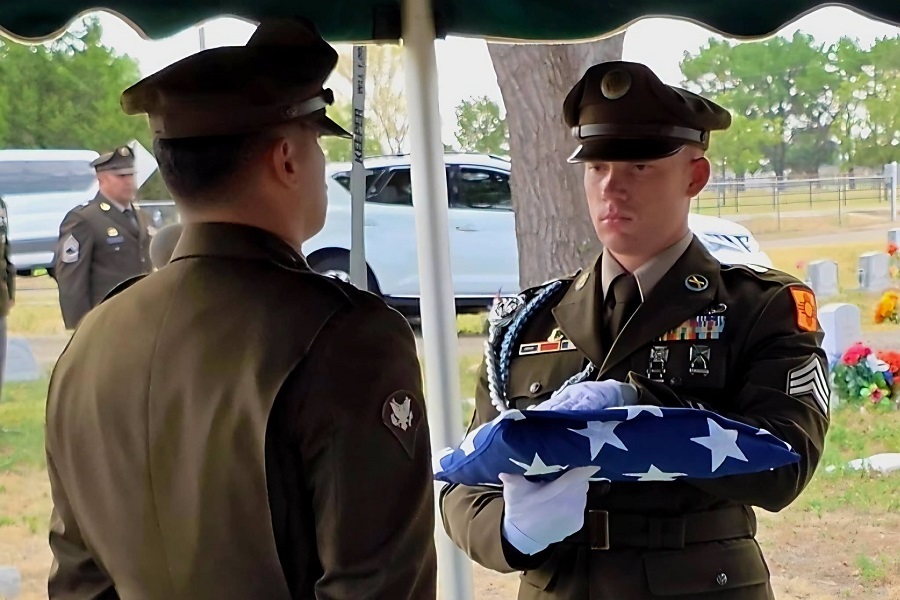
During the ceremony, New Mexico National Guard members folded the flag and presented it to relatives, including his 91-year-old nephew. Brig. Gen. Nathaniel Carper declared, “Sgt. Jones gave his life in service to our nation, but time does not diminish his sacrifice, nor does it diminish our responsibility to honor him and his family.”