The University of New Mexico (UNM) once again beams with pride after securing recognition for excellence through its program. The James and Gail Ellis School of Business Leadership will receive the 2026 New Mexico Excellence in STEM Award for its Rural Student Connectivity Project (RSCP).
The school’s Corporate and Community Engagement (CCE) office leads the RSCP. This initiative equips rural student success with technology access, career preparation opportunities, and community engagement programs to support their success.
A $1.1 million grant from the U.S. Department of Education and U.S. National Science Foundation funded RSCP in 2022. The project aims to bridge the technology gap in rural communities across New Mexico.
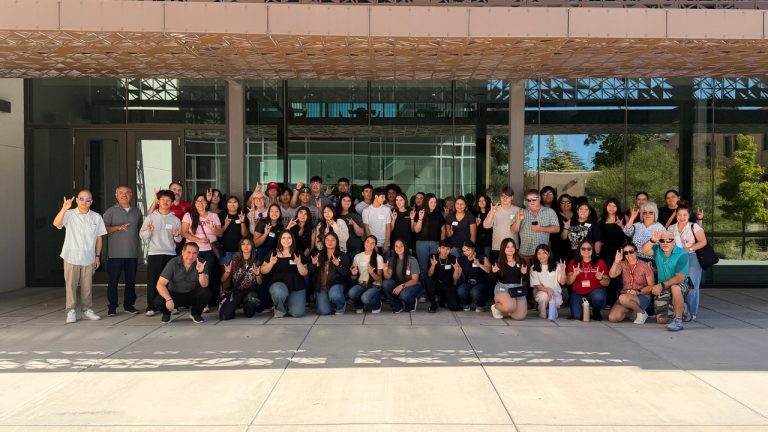
RSCP conducts outreach to rural communities across the state. It brings students to campus twice each year for immersive experiences focused on higher education access and career development. Participants also gain access to technology resources, paid summer internships, and family-focused programs that support student success.
“The Rural Student Connectivity Project (RSCP) represents our commitment to ensuring that rural New Mexico students—especially Native American and multigenerational Hispanic youth—have equitable access to college, careers, and STEM opportunities,” said Rob DelCampo, senior executive director of Corporate and Community Engagement (CCE).
“This program is not just about exposure; it is about building confidence, engaging families, creating real-world pathways through internships, and showing students they can succeed while staying connected to their communities. Being recognized with the STEMY Award is incredibly meaningful because it affirms the importance of this work and highlights the power of investing in rural students to build a stronger, more inclusive STEM future for New Mexico,” added DelCampo.
About the STEMYS and Related Updates
The New Mexico Excellence in STEM Awards (The STEMYS) recognizes individuals who make a significant impact in STEM education. It honors students, teachers, volunteers, and other New Mexicans who make a significant impact in STEM education. It highlights contributions in science, technology, engineering, and math across the state.
The Air Force Research Lab Tech Engagement Office and Q Station host the STEMYS.
The STEMYS will honor recipients at a ceremony on June 5 at Q Station. City of Albuquerque Economic Development Department serves as this year’s Presenting Sponsor of the event.
A fast-moving massive wall of dust barreled across central New Mexico on Tuesday afternoon, prompting the National Weather Service to issue a dust advisory for parts of Bernalillo and Sandoval counties. Strong winds threatened to turn highways around Albuquerque into near-blind corridors where drivers could lose visibility in seconds.
Weather forecasters spotted the dust storm around 12:35 p.m. It stretched from approximately 15 miles east of Mesita to near Sandia Park, moving north at about 20 miles per hour. Forecasters expected winds exceeding 40 miles per hour to whip desert soil into the air.
The weather advisory covered much of the Albuquerque metro region, including Rio Rancho, Bernalillo, Corrales, Los Ranchos de Albuquerque, Paradise Hills, Cabezon, Vista Hills, and the Intel corridor in Rio Rancho. Forecasters advised all drivers along Interstate 40 between mile markers 135 and 168, Interstate 25 between mile markers 220 and 259, and Highway 550 near Bernalillo to prepare for sudden drops in visibility — an instant, life-threatening driving hazard.
The weather system came amid dry ground conditions and gusty afternoon winds, which are common across New Mexico in late spring. During this period, prolonged drought and parched soils can quickly trigger sweeping, low-visibility sandstorms.
Meteorologists urged motorists to slow down immediately if visibility is low and to avoid stopping in travel lanes. Dust storms in the Southwest have a history of triggering multi-vehicle pileups when drivers continue at highway speeds despite near-zero visibility.
The advisory may move through relatively quickly. But forecasters warned that localized wall of dust could continue into the afternoon, while the winds will move across the Rio Grande Valley.
New Mexico Wildlife Center has brewed their unofficial jumpstart for summer in an event last Sunday, May 24.
The free event in Española with a rare opportunity for people to witness birds, animals, and reptiles and learn about them with wildlife center guides. A center member said their mission is vital in keeping the state’s wildlife alive.
“They’re not extinct but they don’t live here anymore. And we’re part of a program that’s trying to get these animals back into New Mexico,” the member said.
They have unveiled black-footed ferrets last Sunday.
This is a perfect for kids and families who wish to spend quality time together. Students interested in wildfire will definitely enjoy this kind of tour.
“This is the only place in New Mexico where you can see black-footed ferrets on display. They’re one of North America’s rarest mammals,” the member said.
The Wildlife Center is open Tuesday to Sunday, from 9 A.M. to 4 P.M. The animal encounter programs, where you can watch or touch animals, happens daily.
The center is open at 11:30 A.M. on Memorial Day.
This will be a great help among people who want to spend quality time on Memorial Day and learn more about wildlife in out state.
Thousands converged at Balloon Fiesta Park for the 33rd Annual New Mexico Wine Fest, transforming the sprawling grounds into a weekend of local wine, live tunes, and craft culture.
The annual festival is now part of the state’s late-spring social calendar. It offers guests the opportunity to sip their way through more than 200 local labels produced by wineries across New Mexico. Organizers say the event welcomes everyone, both seasoned wine enthusiasts and curious first-timers.
“We have a lot of newbies that come in and want to learn more about wine, so we try and get them into, you know, whether it’s sweet or dry,” said Sandra Chavez of Black’s Smuggler Winery.
The scene on Sunday reflected that mix: education and leisure. Visitors hopped between tasting booths, lingered by the stage for live musical performances, and wandered through a market of local artisans under a clear sky. The wine fest drew steady foot traffic throughout the day.
The festival has become less about connoisseurship. It is more about ritual — an annual gathering where wine provided the atmosphere for community conversation, and an easy afternoon.
Those who missed Sunday’s wine fest still have one more chance. The Wine Fest continues through Memorial Day Monday, a final opportunity to sample, stroll, and sip before the event closes for the year.
At the level of the Albuquerque Museum, an exhibition entitled The Other Route 66 opens in Albuquerque on June 6, 2026. This exhibition focuses on a century of people, identity, and place, it looks through the lens of Route 66.
It is important to note that Route 66 is not just a road. It is a representation and history of a place that helps to build community, migration, and identity in New Mexico. Likewise, it influences communities throughout the US. Moreover, the contributions made by various groups will be featured in this exhibition.
On the opening day of the exhibition, attendees will be able to participate in the following activities:
Live Music at 11:00 AM – 12:30 PM from Paul Pino and the Tone Daddies. They will perform original songs about New Mexico culture and history. Additionally, their music mixes together elements of Rock, Country, and Regional Standards.
Discussion at 2:00 PM – 3:00 PM with Candacy Taylor, author of Overground Railroad: The Green Book and Roots of Black Travel in America. She will discuss the Green Book’s influence on Route 66. Furthermore, she will talk about the history of Black Travel in America.
Community participation by connecting Albuquerque citizens & visitors through culture.
These three aspects will represent the exhibition’s theme of being more than just a road (Route 66). It also highlights the cultures and the people living those cultures along that road in Albuquerque. Indeed, that will become the medium for telling a cultural story.
To summarize, The Other New Mexico Route 66 (Exhibition First Day) will be a performance combined with an academic function. It will mark the century of the last century’s migration and identity of Route 66. In addition, by using the Albuquerque Museum as the vehicle, they will continue to tell a story (Living Story) of our community (Albuquerque) and of our Culture (Route 66).
The 3D Hummingbird Workshop in Santa Fe allows anyone who works with stained glass the opportunity to create a scale model of a hummingbird using the traditional Tiffany method. The instructor guides participants through the process in a two‑hour session.
This is an important headline because it showcases artwork, culture, and hands-on learning. This is also a great opportunity to involve local communities and visitors in New Mexico’s artistic heritage.
Attendees can choose from dozens of art glass types. They learn to cut and shape the glass pieces. Then they join them together to create a finished ornament. The workshop is open to everyone age 12 and older and welcomes beginners.
There are several advantages of taking this 3D Hummingbird Workshop. You’ll learn methods of making stained glass that have been used for hundreds of years. In addition, you’ll have something special to take home with your name on it. Most importantly, you’ll get to submerge yourself in the culture and history of Santa Fe’s art scene.
Additionally, you will develop skills, be creative, and appreciate the value of handcrafted work.
The workshop’s title emphasizes that it offers more than a class on stained‑glass creation; it delivers a cultural experience. Participants connect with New Mexico’s artistic traditions and craft a lasting item they will cherish.
To sum up, by connecting the past to the present through new ideas, the 3D Hummingbird Workshop offers participants an opportunity to experience contemporary stained-glass art across time and space. They also connect with their artistic heritage and family. Additionally, they leave behind a beautiful ornament to remember their experience in Santa Fe and to return in the future.
Counties say the state’s police accountability law has strained their public coffers. But civil rights advocates say the real crisis is the behavior that necessitated the law in the first place. The conflicting narratives emerged five years after New Mexico lawmakers passed one of the nation’s most aggressive police accountability measures.
The legislation, signed by Governor Michelle Lujan Grisham in 2021, felt more like a wake-up call for county commissioners, sheriffs, and local budget officers across the state’s rural communities. The legislation is now reshaping how New Mexico governs police misconduct, indemnifies for civil rights violations, and defines accountability itself.
Civil rights attorney Maureen Sanders said the law will “give you an appropriate way to bring claims when foster kids are injured by the Children, Youth and Families Department, or an individual’s 1st Amendment rights are violated by a county commissioner.”
The law abolished one of the most powerful legal defenses protecting government officials: qualified immunity. That doctrine, over the years, often protected police officers and other public employees from lawsuits unless plaintiffs could prove an identical factual and legal scenario the courts previously ruled unlawful.
New Mexico is the second state in the nation, after Colorado, to abolish the doctrine at the state level. Now, county governments claim they are paying the price.
The New Mexico Association of Counties, which operates a risk-sharing insurance pool for local governments, says premiums allocated for law enforcement liability coverage have increased dramatically since the law took effect. County premium contributions more than doubled between 2020 and 2026 — rising from $16.6 million to $34.4 million, according to the association.
Inflation, staffing shortages, and increasing demands on public safety systems already burden county offices, fueling the anxieties behind those figures. A single large settlement can destabilize entire budget plans, particularly in small rural counties that measure budgets in millions rather than billions. Officials warn that escalating liability exposure may eventually force difficult trade-offs: fewer deputies, delayed infrastructure projects, reduced emergency services, or higher local taxes.
In other words, the lawsuits may not represent a new problem. It represents visible consequences.
But civil rights attorneys and reform advocates dispute whether the Civil Rights Act alone directly caused the insurance increase. Nationally, liability insurance premiums for law enforcement agencies have been climbing amid a nationwide crisis of confidence in law enforcement, multimillion-dollar settlements and rising jury awards. They say that county-level financial data, by itself, cannot prove the link.
The law itself contains limits. The statute allows plaintiffs to sue public bodies rather than individual employees and places a cap on damages. But even with those protections, counties say the cumulative financial pressure is intensifying. And the political consequences may be only beginning.
New Mexico Governor Michelle Lujan Grisham joined hundreds of graduates from Western New Mexico University (WNMU) as they marked a new chapter in their lives. On May 8, graduates crossed the stage during WNMU’s spring 2026 Commencement before a standing-room-only audience at Ben Altamirano Stadium.
In her speech to graduates, families and faculty, Grisham highlighted the transformative power of the New Mexico Opportunity Scholarship. She also emphasized the state’s commitment to accessible education.
“The last time I stood on this campus, I signed our state’s historic Opportunity Scholarship into law. Returning as your Commencement speaker, I get to witness for myself what that law made possible. This year’s graduates are proof that when New Mexico invests in its people, its people deliver,” the governor said.
Elaborating on her message, Grisham urged graduates to use their degrees to strengthen the state’s workforce. She specifically highlighted the university’s role in training the next generation of educators.
She emphasized that the Class of 2026 has shown resilience throughout their journey. Grisham said this attitude prepares them to solve modern challenges in a “dynamic, interconnected world.”
Spotlights on the Graduates
The ceremony celebrated students earning degrees and certificates across various academic levels. The university will officially confer degrees and certificates after completing a final audit of academic records. Preliminary figures showed the following highest degrees awarded:
Masters – 138
Grad Cert – 28
Bachelors – 197
Associates – 104
Certificates – 8
Fast Track Certificates – 42
More than 200 graduates attended the ceremony in person. The university recognized the remaining graduates in absentia as part of its distance-learning community. Many joined the celebration via livestream from across the country and the world.
During the ceremony, the university honored several faculty and students for outstanding achievements:
Excellence in Teaching: Wenjie Wang, Ph.D.
Excellence in Research: Andrea Nica, Ph.D.
Excellence in Professional Service: Stephanie Fanselow, Ph.D.
Best Online Course Design: Becky Brandsburg-Herrera, Ph.D.
Best Online Course Delivery: William Lane, Ph.D.
ASWNMU Outstanding Teacher Award: Gregory Robinson Guerra, Ph.D. (presented by the Associated Students of WNMU)
Academic Honors and Special Recognitions
The Commencement also honored students receiving top academic honors. Taylor James received the Outstanding Senior Award, while Elena Rodriguez received the Excellence in Graduate Studies Award.
Additionally, the university awarded bronze medallions to 162 baccalaureate students who graduated with academic honors. These students achieved a GPA of 3.5 or higher, earning recognition for their accomplishment.
Continuing the celebration, Interim President Chris Maples, Ph.D., praised the graduates for their perseverance. He also highlighted the impact they will have on the region.
“The Class of 2026 represents the resilience and intellectual curiosity that define the Mustang spirit. As these graduates move forward to lead in their respective fields, they carry not only a degree but also the responsibility to serve their communities with the same dedication they showed in the classroom. We are incredibly proud to celebrate their achievements alongside Gov. Grisham on this historic day,” Maples said.
The event marked the final spring commencement before incoming President Jose Coll, Ph.D.,assumes office.
Albuquerque police started an investigation regarding two overnight pedestrian crash that left one man dead and the other one seriously injured.
According to police, officers first responded to the site at about 9:45 P.M. Friday, near Gibson Boulevard SE and Washington Street SE for a crash involving pedestrian.
Police said a vehicle travelling west on Gibson Boulevard and then left the scene. Officer later found the vehicle.
The man had suffered serious injuries and went to a local hospital for treatment.
After the 9:45 P.M. incident, they once again responded on another crash at about 12:40 A.M., Saturday near Central Avenue SE and Pennsylvania Street SE.
According to them, a vehicle travelling south on Pennsylvania Boulevard struck a man just south of Central Avenue. The driver then told officers it appeared there was clothing in the road and tried to avoid it before feeling an impact.
The driver stopped and called 911, according to police.
Police took the man to a local hospital, where doctors later pronounced him dad. The police had not identified him.
When driving, please remain vigilant and adhere to the traffic rules implemented by our traffic enforcers.
The crisis linked to fentanyl came silently in Mountainair town, where the wind carries dust across empty lots and neighbors still notice when someone misses work.
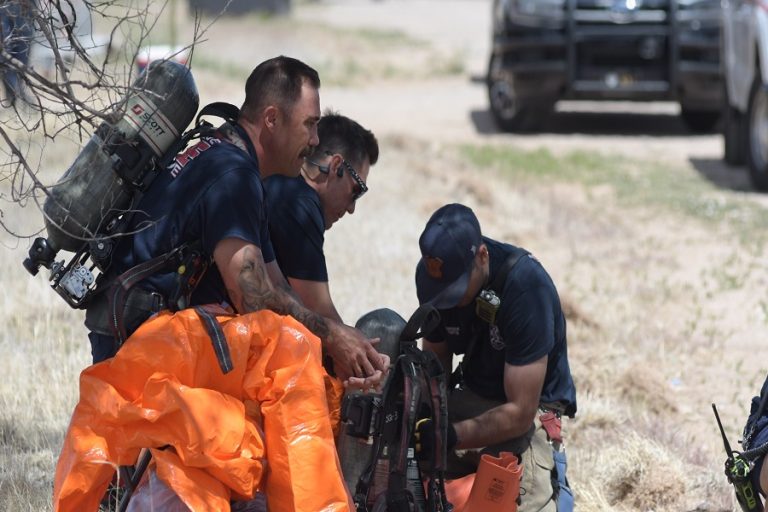
It started with a welfare check. Worried after someone failed to show up for work, a co-worker drove to an unelegant home tucked along a rural road about 90 miles east of Albuquerque. Inside, four people lay unresponsive. Two were already dead, and a third died later at a hospital. Then, 18 of the emergency responders would find themselves hospitalized after experiencing dizziness, nausea, and symptoms of exposure.
This week in Mountainair, the scene was shocking even in a state long familiar with addiction and overdose. But it also revealed something bigger: how fentanyl has changed New Mexico into one of the most fatal battlegrounds of America’s opioid epidemic.
Fentanyl, meth, and more
Initial findings from the New Mexico State Police revealed that multiple powdered narcotics were present in the home. Investigators found fentanyl, para-fluorofentanyl — a synthetic analog sometimes called P4 fentanyl — and methamphetamine.
Police identified two of the dead as 51-year-old Mika Rascon and 49-year-old Georgia Rascon. A third victim has yet to be publicly identified. Officials say there is no proof that drugs were being manufactured inside the home. Law enforcement has not filed any charges.
But the Mountainair deaths have become less of a local tragedy. They are becoming more of a symbol of a state grappling with an era where fentanyl has saturated the illicit drug supply.
New Mexico has been battling addiction. Northern communities like Española became synonymous many years ago with heroin dependency, deep-seated poverty, and a legacy of overdose trauma. But fentanyl has changed the magnitude of the crisis entirely.
The synthetic opioid is up to 50 times more potent than heroin, alongside low-cost production, transport, and blending capabilities. It appears increasingly not only in heroin but in fraudulent prescription pills, cocaine, and methamphetamine — sometimes without users knowing.
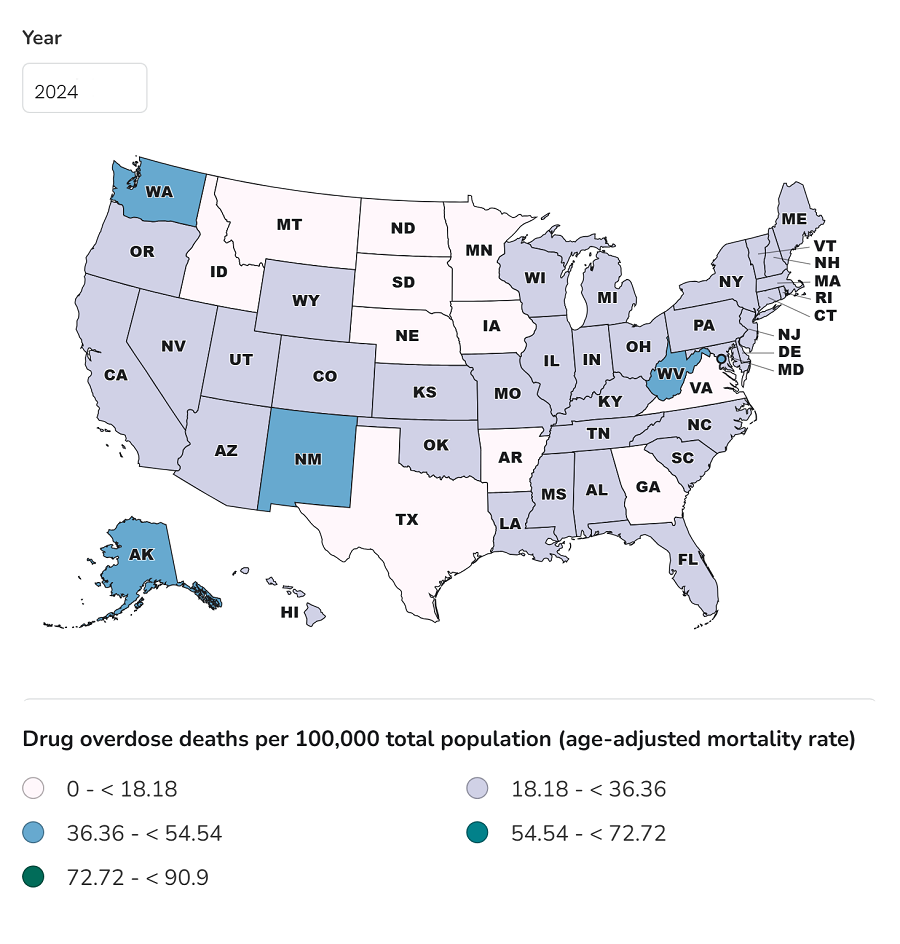
By 2023, fentanyl was tied to about 6 in 10 of overdose deaths in the state, according to the New Mexico Department of Health. The state documented 948 overdose deaths that year, one of the highest per-capita rates nationwide.
Map: CDC
Geography of the epidemic changing
The geography of the epidemic has also changed. What was previously confined to metropolitan centers and legacy opioid hotspots has spread into rural towns like Mountainair, a town with a population of barely 800, and emergency infrastructure is strained, and treatment facilities are limited.
“This tragedy also highlights the dangers associated with illicit narcotics, especially fentanyl, and the horrible impact it has caused in communities across our state,” the New Mexico State Police chief, Matt Broom, said during a news conference.
The Mountainair deaths fueled public fear. But the incident exposed a more complex reality surrounding fentanyl: the deepening anxiety among frontline personnel over accidental exposure. Authorities said EMS personnel wore protective gear as they entered the house. They initially suspected a gas leak. Soon afterward, more responders began experiencing symptoms, leading to mass hospitalization and decontamination protocols. Most of them were later released from the hospital.
Videos showing EMS personnel collapsing after encountering suspected fentanyl have gone viral online, stoking fears that merely touching or inhaling trace amounts can cause an overdose. But toxicologists and addiction researchers have repeatedly disputed those claims.
Airborne exposure to fentanyl can trigger an overdose?
Medical studies and guidance from organizations including the American College of Medical Toxicology and the American Academy of Clinical Toxicology said there is little evidence that casual skin contact or brief airborne exposure to fentanyl can trigger overdose in first responders. Experts contend that many reported incidents are likely due to panic reactions, anxiety responses, or exposure to other factors present in the environment.
However, the danger of fentanyl itself is real, particularly when ingested or inhaled in large quantities.
At the University of New Mexico Hospital, Dr. Steve McLaughlin said fentanyl is likely to be mainly responsible for the Mountainair deaths. “Fentanyl is particularly dangerous because it requires only a tiny amount to cause an overdose,” he told the Albuquerque Journal.
Questions linger in the desert air
What transpired inside the Mountainair home may prove less important than what it symbolizes. A rural state already burdened by poverty, trauma, and strained behavioral health infrastructure is grappling with a synthetic narcotic of such devastating potency that it holds the entire community under its shadow. The scene of a single overdose in a place like Mountainair can overwhelm an entire emergency system in just a matter of minutes.
And despite signs that overdose deaths may be decreasing across the nation, New Mexico’s crisis remains deeply embedded. Public health officials increasingly view the epidemic as not only an issue of criminal justice. It is also a nexus of systemic poverty, mental health issues, homelessness, and the collapse of long-term addiction care.
The street outside the house in Mountainair is quiet again. The emergency lights are gone. And the yellow tape indicating an ongoing police investigation has come down. But the questions about fentanyl, and about whether rural America is prepared to weather this era of synthetic narcotics, are lingering in the desert air.