


Retire Near Albuquerque—Without the Hustle: 5 Places That Strike the Right Balance

From desert lakes to historic pueblos, these towns near Albuquerque offer retirees a slower pace without losing access to essential services.

There’s a quiet appeal to live near a city. But not in it. A cluster of small places around Albuquerque offers exactly that: access to hospitals, urban conveniences, and an international airport, without the hustle of big-city life.

For retirees, it’s a practical choice to stay close enough for care and connectivity, but far enough to enjoy space, slower days, and oftentimes, lower housing costs. These New Mexico towns offer that balance that comes with a bonus: each place brings its own distinct identity—shaped by history, landscape, and culture.

Here are five places near Albuquerque where retirement feels less like a retreat and more like a reset.

Los Lunas, New Mexico Municipal Building
Los Lunas, New Mexico municipal building, constructed 1992, located at 660 Main Street NW. The left wing is the police station and municipal court, and the right wing is the administration building and includes the council chambers. (Wikimedia Creative Commons)

Los Lunas: Close to the city, rooted in tradition

Only a 25-minute drive south, Los Lunas is a place of convenience that doesn’t overwhelm character. Its location in the Rio Grande Valley connects it to Albuquerque, while housing is relatively accessible.

Healthcare is accessible through the Los Lunas Health Center. And the Los Lunas Museum of Heritage and Arts keeps the anchor of the town’s cultural life. Dining in Los Lunas reflects heritage—Teofilo’s Restaurant serves classic New Mexican cuisine, where history is intertwined with everyday living.

Moriarty, NM - USA: The Sunset Motel with Whiting Gas Station on historic Route 66. Sunshine, clear, blue sky.
Moriarty, NM – USA: The Sunset Motel with Whiting Gas Station on historic Route 66. Sunshine, clear, blue sky. (Gerald Zaffuts/ Adobe Stock)

Moriarty: Big skies, small-town pace

An hour east along Interstate 40, Moriarty is a quieter, more spacious alternative. The town’s horizon feels wide—and so does the pace of life.

Flying enthusiasts will find a unique draw at the U.S. Southwest Soaring Museum. The area reflects the reputation for glider flying. Meanwhile, the Moriarty Historical Society and Museum is the lifeline for local stories. Places like Buttercrust Pizza keep things modest and familiar for day-to-day comfort.

Sunset in the mountains, the road to the sky in El Malpais National Monument, Grants, New Mexico, USA.
Sunset in the mountains, the road to the sky in El Malpais National Monument, Grants, New Mexico, USA. (Naya Na/ Adobe Stock)

Grants: Affordable, with a strong sense of history

Drive west, and you’ll find Grants. It is the place where affordability meets a deep connection to the past. Uranium mining and Route 66 traffic once shaped the town, and it has held onto its identity.

Cibola General Hospital serves the town’s healthcare needs, while places like the Cibola County History Museum and the New Mexico Mining Museum provide cultural attractions. Bluewater Lake State Park offers a scenic escape beyond the town limits—proof that New Mexico’s landscapes are not all about desert.
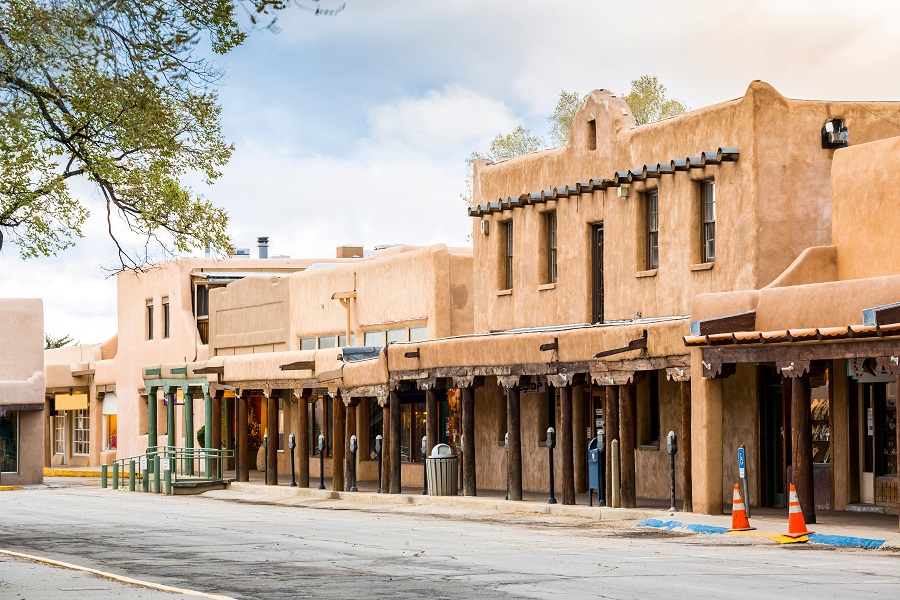
Buildings in Taos, which is the last stop before entering Taos Pueblo, New Mexico.
Buildings in Taos, which is the last stop before entering Taos Pueblo, New Mexico. (Adobe Stock)

Taos: Culture-rich, but at a premium

The town of Taos sits at the other end of the spectrum. It is more expensive—but is unmatched in cultural depth and natural beauty.

The very core is Taos Pueblo, a living Native American community with more than a millennium of continuous living. A stone’s throw away is the Kit Carson Home and Museum, which reflects the region’s history.

Retirees have options like Taos Enchanted Village. It provides independent and assisted living in a walkable, art-filled environment. The village is ideal for those willing to pay more for a richer setting.

Blue Hole, Santa Rosa
The wooden sign informs about the Blue Hole, the famous deep pool. Santa Rosa, New Mexico. (Adobe Stock)

Santa Rosa: Where the desert meets water

There are surprises in Santa Rosa. About two hours east of Albuquerque, it’s a budget-friendly option. Yet, it is the most unique.

It is known as the “City of Natural Lakes.” The town sits on a rare cavernous landscape. Its standout is the Blue Hole, a deep, crystal-clear sinkhole popular with divers because of its visibility and the temperature is steady.

Guadalupe County Hospital provides medical care. And Route 66 nostalgia lives on in local spots such as La Villa Iconic Burgers and Boba.

Finding your balance

Retirement near Albuquerque isn’t a one-size-fits-all choice—it spans a range of choices.

If proximity is a major consideration, Los Lunas and Moriarty offer easy access to the city. Affordability and history are priorities? Grants and Santa Rosa are strong contenders. And for art lovers and drawn to heritage, and mountain views, Taos is the right place, at a higher price to pay.

The common factor of these places is simple: you don’t have to give up access to gain peace. You can have both.

For corrections, news tips, and any other content requests, please send us an email at [email protected].

Hot this week

UNM Steps Up to Cut Food Waste, Boost Food Access

The University of New Mexico works to turn food waste into resources that help address food insecurity on campus.

New Mexico’s Recipe for Hantavirus Risk—Climate, Deer Mice, and Country Living

More than 30 years after the Four Corners outbreak, New Mexico continues to report among the nation’s highest hantavirus pulmonary syndrome cases. Experts say the state’s ecology, climate cycles and rural living conditions have created an enduring hotspot for the rare but deadly disease carried by deer mice.

Community Solar Program Took Years to Arrive. Now the Solar Panels Are Finally Rising.

After years of delays, New Mexico’s community solar program is beginning to expand, with new projects coming online across the state. But developers and advocates say high interconnection costs and complicated billing rules still threaten the program’s long-term success.

Patient Voices Push New Mexico Lawmakers to Spotlight Healthcare Access and Affordability

New Mexico lawmakers spotlighted healthcare after hearing directly from patients, emphasizing urgent concerns about access, affordability, and workforce shortages.

Health Officials Clarify Hantavirus Risk: No Person‑to‑Person Spread

New Mexico's health officials have emphasized that the state's Hantavirus (Sin Nombre Virus) is not transmitted from person to person, which differs from the Andes virus that was responsible for an outbreak aboard a cruise ship. There have been many reports around the world about the Andes virus being transmitted by other people, and this caused people to worry about being able to contract the Andres virus from residents of New Mexico. The Andes virus is the only hantavirus known to be transmitted by another person in South America. The Sin Nombre Virus can only be contracted by contact with infected rodents, or their excrement. There are several ways to help to prevent hantavirus exposure, including disinfecting rodent nests and debris, ensuring that all points of entry into the home are sealed and practicing safe cleanup methods.

Topics

UNM Steps Up to Cut Food Waste, Boost Food Access

The University of New Mexico works to turn food waste into resources that help address food insecurity on campus.

New Mexico’s Recipe for Hantavirus Risk—Climate, Deer Mice, and Country Living

More than 30 years after the Four Corners outbreak, New Mexico continues to report among the nation’s highest hantavirus pulmonary syndrome cases. Experts say the state’s ecology, climate cycles and rural living conditions have created an enduring hotspot for the rare but deadly disease carried by deer mice.

Community Solar Program Took Years to Arrive. Now the Solar Panels Are Finally Rising.

After years of delays, New Mexico’s community solar program is beginning to expand, with new projects coming online across the state. But developers and advocates say high interconnection costs and complicated billing rules still threaten the program’s long-term success.

Patient Voices Push New Mexico Lawmakers to Spotlight Healthcare Access and Affordability

New Mexico lawmakers spotlighted healthcare after hearing directly from patients, emphasizing urgent concerns about access, affordability, and workforce shortages.

Health Officials Clarify Hantavirus Risk: No Person‑to‑Person Spread

New Mexico's health officials have emphasized that the state's Hantavirus (Sin Nombre Virus) is not transmitted from person to person, which differs from the Andes virus that was responsible for an outbreak aboard a cruise ship. There have been many reports around the world about the Andes virus being transmitted by other people, and this caused people to worry about being able to contract the Andres virus from residents of New Mexico. The Andes virus is the only hantavirus known to be transmitted by another person in South America. The Sin Nombre Virus can only be contracted by contact with infected rodents, or their excrement. There are several ways to help to prevent hantavirus exposure, including disinfecting rodent nests and debris, ensuring that all points of entry into the home are sealed and practicing safe cleanup methods.

‘You Are Not Alone’: Grief Kits Help Students Cope with Loss 

Albuquerque Public Schools received grief kits after the Rotary Club of Albuquerque and the Grief Center worked together to provide resources that help students cope with loss.

New Mexico Reopens Fight Over Toxic Oil and Gas Wastewater — Environmentalists Call It a Political Gamble

New Mexico regulators voted to revive a contentious rulemaking process that could expand the use of treated oil and gas wastewater beyond drilling sites, reigniting a fierce clash between industry advocates and environmental groups over public health, water scarcity and political influence.

Wastewater Sounded the Measles Alarm in New Mexico—Before Doctors Even Caught It

A new study shows New Mexico health officials detected measles in wastewater five days before hospitals confirmed cases, highlighting sewage surveillance as a powerful early-warning system during the nation’s largest measles outbreak in decades.

Related Articles