

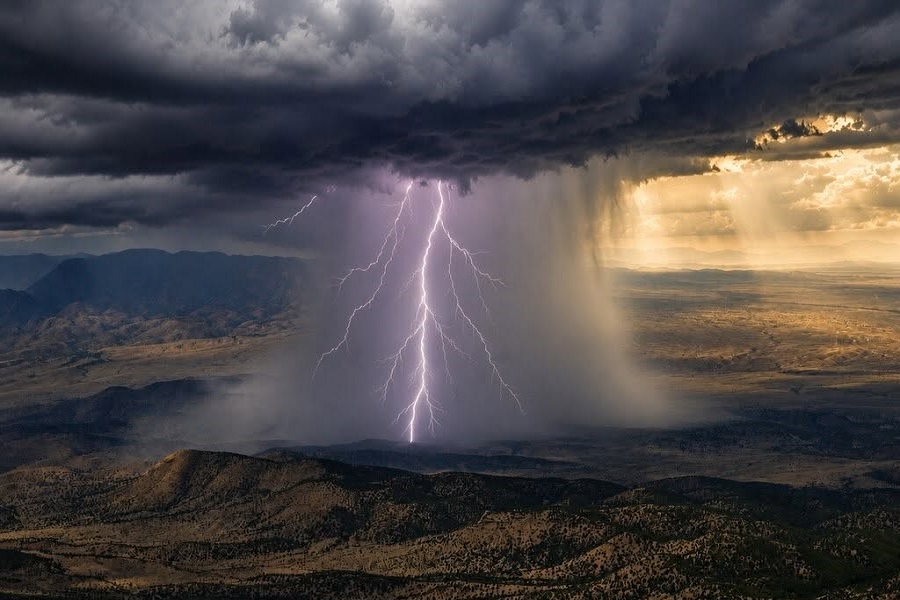
Lightning, with its blinding bolts, rips through trees, sets forests ablaze, and leaves cities in darkness, is nature’s most terrifying show. Now, in what could be a game-changing study, scientists at New Mexico Tech claim they’ve ultimately cracked the mystery behind its raw, destructive power.
In an article published in Reviews of Geophysics, the researchers turned the equations meant for regular power cables into a model that shows why lightning bolts shoot skyward at blistering speed, and why their energy fizzles out as they rise.
The researchers discovered that everything comes down to the ‘return stroke,’.that massive flow of current racing back up the channel after a strike, creating the dazzling flash and what was known as the thunderclap.
Physics professor Dr. Caitano da Silva worked alongside Saulo Orizaga, a mathematician, and two bright students to rework the Telegrapher’s Equations. Their model pictures the lightning channel as two cylinders, a blazing inner core carrying the current and a wider outer shell holding the charge.
The researchers, in their collaborative summation, told their publisher, American Geophysical Union that, “We model the lightning channel as two concentric cylinders: a thin core that carries the current and a wider sheath that stores the associated charge.”
The results, according to researchers, do not only match decades of data. It also cracks mysteries that puzzled scientists why the current wave crawls at just a fraction of light speed, why it weakens as it climbs, and why its power scatters as it travels.
Two young researchers, Jacob Wemhoner, a PhD student at the time, and Logan Baeza, an undergrad, helped drive the project. Wemhoner had even built a lightning-snapping camera called SOPAPILLA. His camera could capture 1.4 million frames per second, more than twice as fast as earlier studies.
These young researchers’ work has already won recognition from top journals and secured them prestigious posts. “These two Techies are proof that lightning can strike twice,” da Silva quipped.
Lightning wrecks infrastructure, sparks wildfires, and even changes the chemistry of our atmosphere. The New Mexico Tech team may have given us a key tool to predict by figuring out what drives a bolt’s fury, and maybe one day tame nature’s deadliest strike.
Their calculations run way faster than complex computer simulations but still deliver real insight, matching up with decades of field measurements. It has now formed the backbone of New Mexico Tech’s graduate course, Physics of Lightning.
Baeza said, “Our framework can be used in adjacent fields as well, not just lightning physics. It models the process using language that’s accessible and not too highly technical.”
This study suggests that, after all, the secrets behind one of nature’s terrifying forces might just come down to equations first written for regular power cables. It is proof that even the most spectacular natural phenomena can be cracked by science.

