

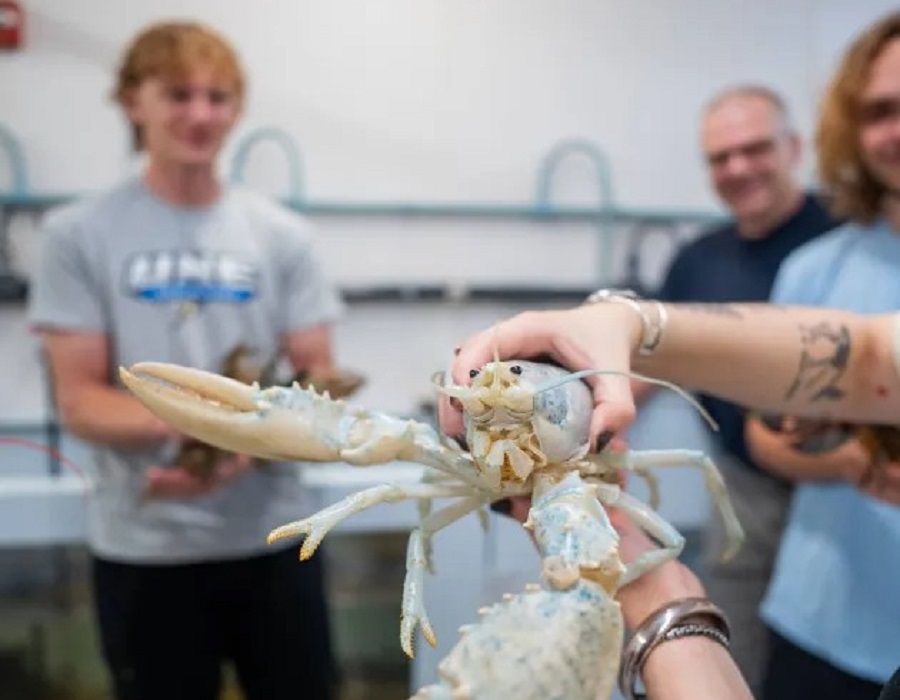
Casper, the ghostly white lobster whose near-total lack of pigment has made him a scientific celebrity.
The lobster is pure white, almost ethereal, and so extraordinarily rare that the odds of seeing a lobster like him have been estimated at just one in 100 million.
Donated by the Maine State Aquarium in Boothbay, Casper is now living at the University of New England’s Arthur P. Girard Marine Science Center in Biddeford. University researchers are studying what makes lobsters develop such unusual colours.
Unlike the familiar American lobster, which is typically mottled brown or greenish-grey and turns bright red when cooked, Casper has an almost entirely white shell that can develop a faint blue tinge depending on his diet. And the lobster is exceptionally rare.
White or so-called ‘ghost’ lobsters are thought to be even scarcer than the blue, orange, yellow, purple, calico and split-coloured lobsters that occasionally appear in fishing traps.
For example, orange lobsters are estimated to occur only once in every 30 million specimens. But Casper is rarer still.
“Animals like Casper capture people’s attention because they are so rare and beautiful,” said Professor Markus Frederich, lead researcher and director of the Invertebrate Physiology Lab at UNE. “But for us, they also provide an amazing opportunity to ask fundamental biological questions.”
Casper has joined the University of New England’s growing collection of unusually coloured lobsters that include orange Peaches and the blue-and-purple pair Currant and Fig, which forms part of a research project launched in 2024 to investigate the biological and genetic mechanisms behind lobster coloration.
Researchers used gentle, non-invasive techniques in examining the genetic material of the rare lobsters and analysing more than 15,000 genes in an effort to determine why some develop dramatically different shells from the usual brown.
The research received an extraordinary boost when Peaches produced offspring displaying a rainbow of colours, offering scientists a rare opportunity to study how unusual colour traits may be passed from one generation to the next.
Students are also deeply involved in the project, helping to care for the lobsters and analyse their DNA.
So far, researchers have not identified a clear genetic difference that explains the unusual colours. The investigation, however, continues.
Casper’s ghostly appearance could be a serious disadvantage in the wild, with his paleness would be far easier for predators to spot against the seafloor than its darker relatives – a potential explanation why so few survive long enough to be caught by fishermen.
However, Casper is safe in his new home, for now, giving scientists an extraordinary opportunity to investigate one of nature’s most unusual colour mysteries.
The ghostly crustacean may look like an oddity, but for researchers, he could be a key to understanding how colour evolves in one of the ocean’s most familiar creatures.

