

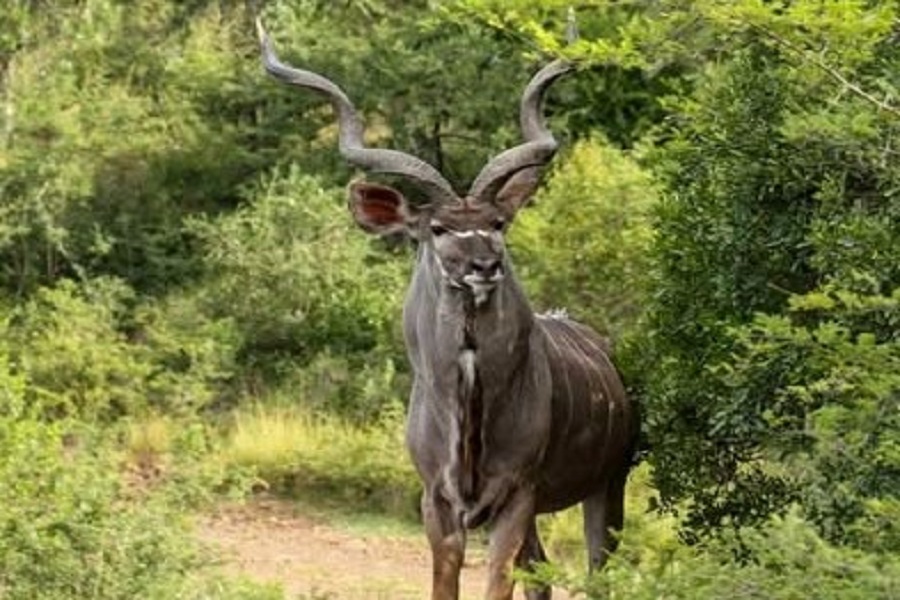
Even decades after African antelopes were introduced to New Mexico for the purpose of hunting, they could soon be seen roaming well outside the state’s boundaries. Since climate change is altering the American West, these hardy animals are now in a position to move into new habitats situated hundreds of miles from their present range.
The gemsbok are powerful antelopes adapted to life in the desert and are native to southern Africa. They have shown that they can cope well when they are introduced to New Mexico during the 1960s and 1970s, have spread over 100 kilometres from their original release sites, and flourished in the dry areas similar to their native habitat.
A study carried out at the University of Illinois Urbana-Champaign indicates that by 2100 the habitat suitable for gemsbok could see a substantial expansion. Their range might extend from New Mexico through into Texas, Arizona, Utah and California. They could possibly even reach southern Washington and Montana.
This introduced species is tolerant of both heat and drought. But it is worth questioning how it might impact the native wildlife, plants, and livestock as the Southwest becomes hotter and drier.
The Journal of Mammalogy featured the research.
Public reports
Researchers used public wildlife-sighting reports to estimate where gemsbok might survive as the climate changes.
Nathan Alexander, the lead author who began this project as a doctoral student at the University of Illinois and is currently a postdoctoral scholar at Southern Illinois University, stated that the team made use of observations posted on websites such as iNaturalist. Those reports were put together by the Global Biodiversity Information Facility, which is an international repository of biodiversity data.
The researchers employed a statistical model known as Maxent to identify the environmental conditions associated with gemsbok sightings.
They examined factors such as temperature shifts, rainfall, plant cover, terrain ruggedness, and human population density. Then, they used that information to identify places with similar conditions under future climate scenarios.
The maps indicate the areas in which habitats could become suitable for gemsbok. It does not mean, however, the antelopes will definitely end up reaching or setting up populations in all of those areas.
Isolated habitats could become connected
A major finding is that parts of suitable habitat, currently divided by land or climate barriers which gemsbok cannot readily cross, could combine to form bigger, connected areas as the conditions change, and this increased connectivity would make it easier for gemsbok to extend beyond their present range.
Kieran Andreoni, who at present serves as conservation director for the Southern Plains Land Trust in Colorado and was involved in this research when he was a master’s student at Illinois, pointed out that western Texas, western New Mexico, and Arizona are particularly important areas to keep an eye on. He also mentioned that some parts of California, for example Death Valley, could be possible habitats.
If the habitats in question are separated by a considerable distance, then natural barriers can stop animals from moving between them. However, if the areas are linked together, this results in the creation of new routes by which animals can spread and establish themselves in new locations.
Even if the climate and vegetation are suitable the gemsbok may not spread; their actual expansion will also be determined by their movement patterns, reproduction, access to habitat, and other ecological factors.
Desert adaptations could give gemsbok an advantage
Gemsbok are native to the Kalahari Desert and to other dry regions of southern Africa, where survival involves having to contend with scarce water and intense heat. The structure of their bodies and the way they behave make them particularly well adapted to dry environments since they obtain a large part of their water from the plants they eat and therefore do not need to drink as frequently.
Adult gemsbok may weigh about 450 pounds, or 204 kilograms, and it is particularly noteworthy that they are able to meet most of their water requirements without having to drink frequently.
Bob Schooley, who is one of the co-authors and heads the Department of Natural Resources and Environmental Sciences in Illinois, stated that these antelopes provide a clear example of animals that are adapted to conditions which are expected to become more common in the Southwest.
These adaptations could enable the gemsbok to survive in areas where some other large herbivores are coming under increasing environmental stress.
Just because gemsbok can tolerate harsh climates does not mean that they will flourish in all areas; local plants, competition for food, extreme weather, and other factors will still determine where they can live.
Few natural predators could complicate the picture
In Africa the gemsbok evolved in conjunction with large predators like lions and hyenas. Lions and hyenas are not present in the American Southwest. Although mountain lions and coyotes will hunt gemsbok, they are not likely to have the same effect on gemsbok populations.
The fact that gemsbok have a tolerance to drought and are subject to comparatively little predation may account for their ability to survive and spread, which in turn causes concern regarding their effects on ecosystems outside of their present range.
Since they are large herbivores, gemsbok could compete with cattle and native wildlife for food and their feeding habits could also lead to changes in plant communities, particularly in areas where both water and plants are already scarce.
How big these possible effects are is still uncertain. The habitat maps indicate only where gemsbok could possibly live, not how many will go there or the amount of damage they might cause.
What eventually takes place will be determined by the growth of the gemsbok population, by the state of the habitat, by the interactions with other species, and by the responses of wildlife management.
A warning about changing ecosystems
The study indicates that climate change may cause changes in the areas where both indigenous and non-native species are able to live.
An animal that was introduced for the purpose of hunting might once again have the opportunity to spread as the environment changes. In the case of the gemsbok, the characteristics which enable them to survive drought could allow them to live in areas that are much further afield from those in which they were first released in New Mexico.
Researchers predict that by 2100 the American West could have a great deal more connected habitat for these African antelopes.
It has not yet been determined whether the gemsbok will really spread that far. But this possibility could mean that conservationists and land managers must prepare for ecological changes before a species expands and becomes more difficult to control.