

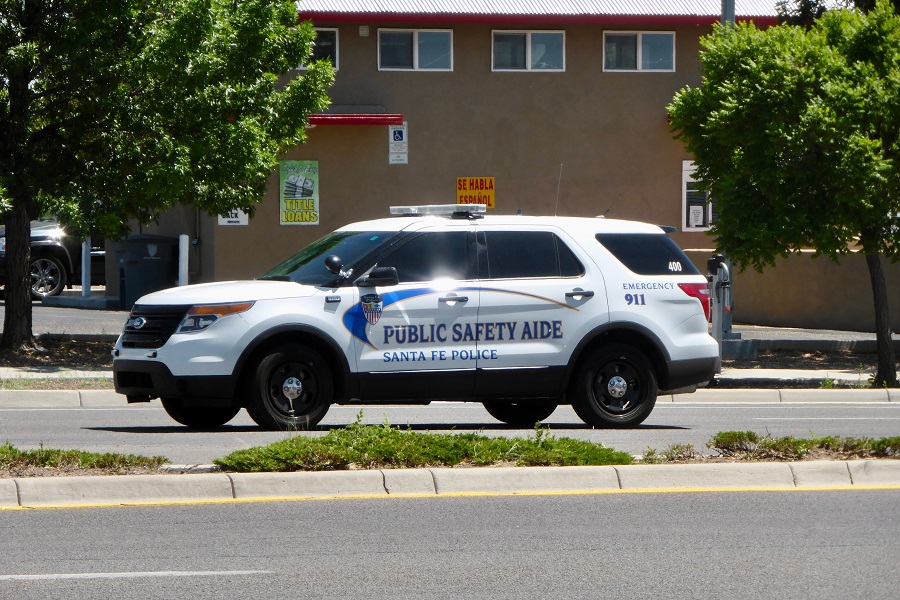
Santa Fe has positioned itself as a city of art, culture, and adobe charm — an environment fostering intentional living and cultural richness. But for many of the police officers sworn to protect the city, living there is no longer within reach due to skyrocketing housing costs.
So every morning before dawn, a quiet migration starts as squads of police officers leave subdivisions in Rio Rancho. They head north on Interstate 25 toward Santa Fe, commuting about 50 miles to patrol neighborhoods they themselves find the area financially out of reach.
One of them is Santa Fe police Officer Patrick Pinson.
Pinson and his wife started looking for a home in Santa Fe in 2017. The couple hoped to stay close to the city where he worked and where their family life was beginning to take root. Instead, they found out what many teachers, firefighters, and city employees already knew: the housing market had soared beyond the reach of middle-class workers.
Homes in Santa Fe were selling for $250 to $300 per square foot, Pinson said. The price is more than double the cost in Rio Rancho at the time. “The biggest houses we could afford were pretty much the same thing we were living in before,” he said. Pinson described cramped homes of roughly 900 to 1,000 square feet that no longer fit a growing family. So they left.
Today, Pinson is part of a pattern reshaping Northern New Mexico’s law enforcement landscape: officers live far from the communities they police.
Data from the Santa Fe Police Department show that only 39 of its 159 officers live within city limits. Another 22 live in Santa Fe County. But 49 police officers — the largest share — live in Sandoval County, home to Rio Rancho, the state’s fastest-growing city.
The trend goes beyond city police. At the Santa Fe County Sheriff’s Office, nearly 3 in 10 of sworn deputies also live in Rio Rancho. The decision to live outside Santa Fe comes down to math.
Rio Rancho offers spacious housing in modern developments and lower crime rates. And the prices are still within reach on a public servant’s salary. On some streets, police vehicles from several jurisdictions line driveways each night. “Just within about 100 yards of my house, there are three state police officers, myself, and there’s some Santa Fe County,” Pinson said. “There’s a really high concentration of law enforcement in Rio Rancho due to the affordability.”
The city has adopted that identity.
Paul Wymer, who took office as the new mayor, says the influx of officers is not a peculiarity of regional economics. He frames it as an advantage for his city. Police cruisers parked in neighborhoods, he said, creating a sense of security and reinforcing Rio Rancho’s reputation as one of the safest communities in the state. Crime rate in Rio Rancho has dropped by 16 percent over the past two years. “I think it’s the safest community in the state,” Wymer said. “I’ve heard that directly from police officers.”
But the migration raises deeper issues for Santa Fe. Civic leaders across the country have argued that officers living within the communities they serve helps strengthen public trust, deepen relationships with residents, and create a stronger sense of accountability. Officers who coach Little League, patronize local businesses, and engage with residents beyond official duties can become part of a city’s social fabric, not simply its enforcement arm.
That extended commutes undermine their ability to remain connected locally.
Michael Garcia says the city is not only losing tax revenue when workers move elsewhere. “I want folks being engaged with our police and fire daily,” Garcia said. He described a vision in which first responders are visible not only during crises but also daily in schools, volunteer programs, and youth sports.
But solving the problem may prove more difficult in a city where cost accessibility has become a defining political issue.
Garcia says the city is exploring incentives to encourage officers to live locally. These incentives range from housing stipends to revised assistance programs for down payments. Also, city leaders are reluctant to sanction employees already priced out of the local economy..
Many officers appear resigned to the commute for now. Every weekday, streams of headlights move along I-25 between Albuquerque and Santa Fe, a stretch of road notorious for crashes and congestion. Pinson said he has learned to live by the routine: cruise control set at 75 miles per hour, taking time to relax off-duty while inching through traffic toward home.
However, the drive can take up to two hours when road incidents close lanes. “It’s kind of frustrating,” he admitted. Still, he says the hassle is worth it.
Pinson’s family has the space they needed in Rio Rancho. The community offers the sense of security they wanted. Returning to Santa Fe, he said, is no longer realistic. “We haven’t really considered it,” Pinson said. “We’re very content where we’re at.”

