

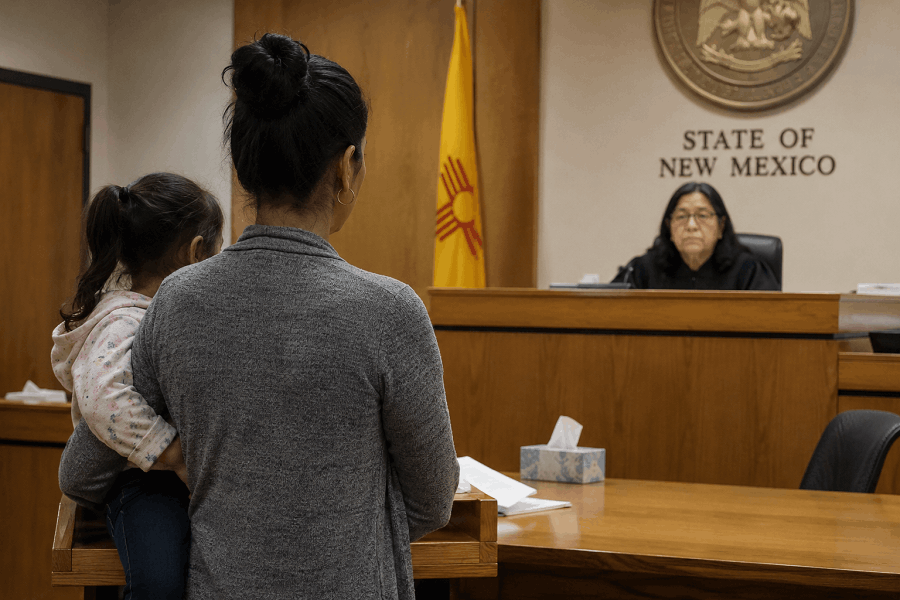
A mother living in rural New Mexico seeking child support can find herself facing a custody battle. But she has to face a life-changing choice: engage with the legal system alone or give up altogether.
There are counties where no lawyer is available to take her case. No legal assistance office nearby. No affordable attorney within driving distance. So she enters family court without a lawyer, carrying legal papers she barely understands, standing across from a system built in a language that is alien to her.
The consequences could be disastrous. C. Shannon Bacon of the New Mexico Supreme Court said mothers risk losing their homes, missing child support, or needing guardianship with no one to guide them.
For many residents in New Mexico, especially in isolated and historically underserved communities, geography is tied to access to justice. Justice Bacon said nearly 9 in 10 litigants in family court across the state represent themselves — a figure that mirrors attorney shortages and deep rural poverty. “These are folks who don’t have those skills, having to go in and represent themselves,” Bacon said.
Now, state leaders are initiating an intervention. They will be sending lawyers directly into underserved communities where they are needed most. Through the Community Governance Attorney Program, the University of New Mexico School of Law trains students and financially supports them to practice in some of the state’s most underserved regions. These areas include acequias, land grant-merced communities, and colonias. Many of these communities trace their histories back many centuries and remain culturally distinct, however, economically vulnerable.
The program, established in 2019, is under the New Mexico Higher Education Department. It offers tuition assistance, fees, and financial allowances for up to two third‑year law students annually. Graduates in return pledge to practice law in rural New Mexico communities, where legal representation is often scarce or absent.
The state also pays half of each attorney’s salary during their first two years of service. This incentive officials hope will encourage young lawyers to remain in New Mexico rather than leave for the metropolis.
“By supporting the state’s future attorneys in public service, we are building much-needed legal capacity in communities while keeping skilled workers in New Mexico,” said Stephanie M. Rodriguez. “This program is critical for strengthening access to legal counsel to underserved communities across New Mexico.”
The legal needs go far beyond family court. Many rural communities across the state face disputes involving land use, water rights, governance, and administrative law. These issues are interwoven with New Mexico’s complex history of Indigenous, Hispanic, and frontier settlement. Residents of Colonias and land grant communities often struggle to get lawyers who are experts with the unique structures that govern communal lands and traditional water systems.
State officials have recognized that the nation’s legal aid shortfall extends beyond criminal defense and urban legal aid clinics. The crisis is also unfolding quietly in rural courtrooms where ordinary Americans must argue high-stakes cases without lawyers. After all, justice is not simply blind in much of rural New Mexico. It is often far away.

