

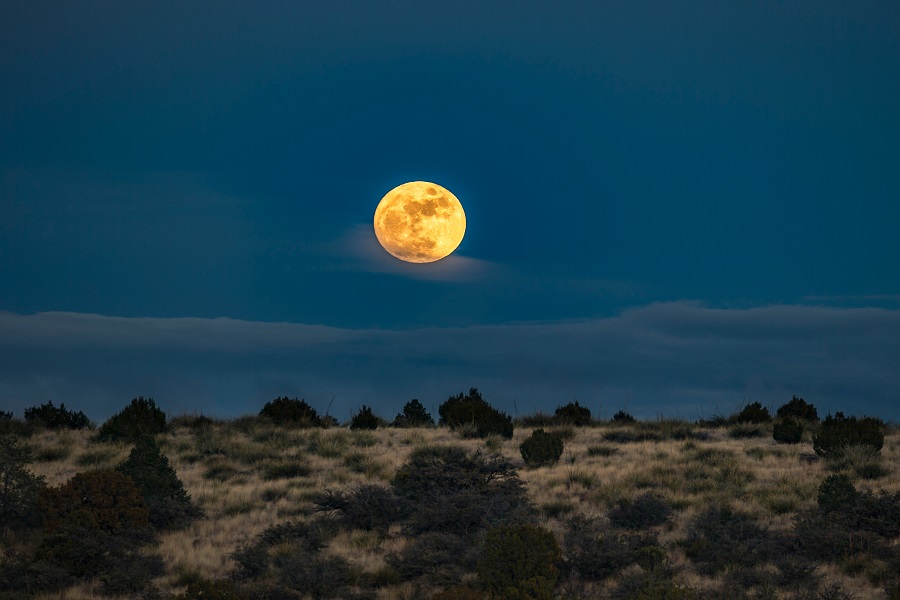
New Mexico’s dark skies will dazzle with a celestial show as the Strawberry Moon — the first full moon of astronomical summer — reaches its peak illumination.
The moon will be completely lit around 5:56 p.m. MDT on June 29, offering prime viewing as it rises in the southeast near sunset, weather permitting.
Despite the name, the moon won’t be strawberry-red. The moniker comes from North American Indigenous traditions, particularly Algonquin tribes in the Northeast, marking the short season when wild strawberries ripened and were ready for harvest. According to the Almanac, other nations, including the Ojibwe, Dakota, and Lakota, had similar seasonal cues in the June skies.
Different cultures connected the full Moon to the berries ripening on their land.
The Creek in the southeastern United States named it the “Blackberry Moon.” The Shawnee of Ohio and Pennsylvania called it the “Raspberry Moon.” The Haida of Alaska use “Berries Ripen Moon.” Each name signals a local harvest when the Moon turns full; the berry is ready. Europeans called the same moon the Rose Moon, Hot Moon, or Mead Moon. They linked it to midsummer blooms, heat, and honey harvests.
The name reflects a time of abundance, making lunar cycles as practical markers for gathering berries and other early summer bounty before colonial almanacs popularized the term.
New Mexico’s high-elevation arid land, dry climate, and minimal light pollution make it one of the perfect places in the country to experience the event. Several International Dark Sky Association sites offer exceptional viewing:
- Capulin Volcano National Monument is a Gold-Tier Dark Sky Park in northeastern New Mexico. It regularly hosts public star parties with telescopes and ranger talks, especially during the summer.
- Cosmic Campground is the first International Dark Sky Sanctuary in the U.S., near Alma. It delivers Bortle Class 1 darkness with 360-degree views and telescope pads.
- Clayton Lake State Park is another Gold-Tier site, offering monthly events and its own observatory telescope.
- Valles Caldera National Preserve and Chaco Culture National Historical Park combine dazzling night skies with cultural and geological significance. The site sometimes features astronomy programs linked to ancestral Puebloan observations.
Astronomy enthusiasts suggest heading to wide horizons far from Albuquerque and Santa Fe for the best moonrise photos. Apps like Stellarium or timeanddate.com can locate exact local rise times. The moon’s low position on the eastern horizon at dusk can create dramatic silhouettes against New Mexico’s mesas and volcanoes, offering rare opportunities for both photographers and families.
Perseid meteors are still weeks away; Strawberry Moon offers an accessible entry to summer skywatching in a state popular for its celestial heritage. Clear skies and a blanket are what skywatchers need.

