

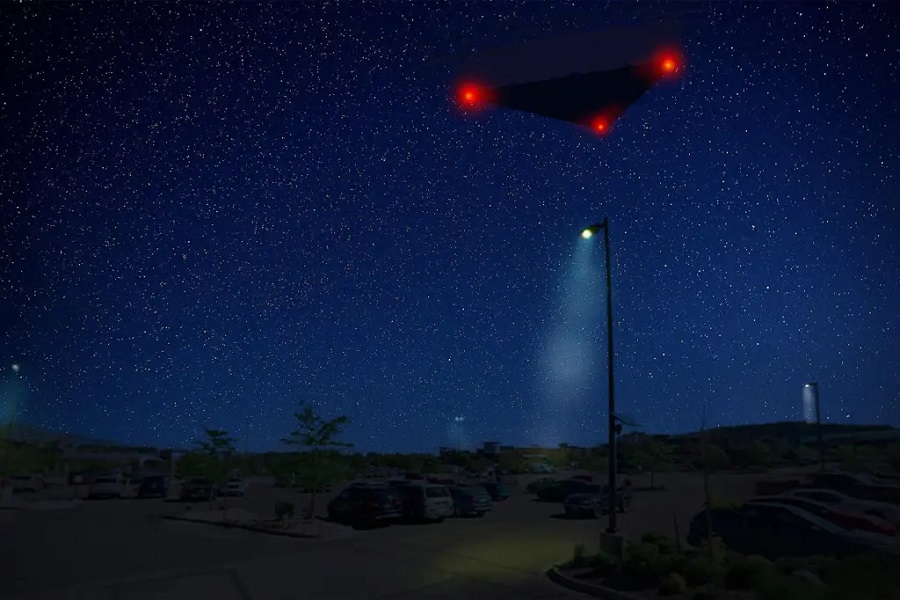
The topic about UFOs has been relegated to the sidelines of public conversation. They were late-night stuff for radio shows, conspiracy theories, and grainy photographs. But the conversation has shifted in recent years.
With military pilots increasingly encountering unidentified objects, the Pentagon began investigating these sightings and classified them as unexplained aerial phenomena (UAP). On its part, NASA has also researched such sightings. And Congress conducted hearings over claims that the U.S. government may have known about UFOs more than it has publicly admitted.
After all the official scrutiny, one question persists: Are we seeing evidence of aliens visiting the Earth? Or are we simply encountering things we do not understand yet?
This is where Dr. Hugh Ross, an astrophysicist and Christian apologist, gives a provocative answer.
As a professional astronomer. Ross said he found himself dealing with reports about UFOs at astronomy organizations and universities. After investigating these reports, he found out that about 99 percent could be explained by natural phenomena, hoaxes, or secret human technology. And he called the remaining 1 percent as “residual cases,” which refers to reports that cannot be satisfactorily explained by conventional knowledge.
In an interview, the astrophysicist said some of these incidents represent genuine phenomena. His claim is extraordinary. But Ross’s 99-percent/1-percent assessment is his own assessment. It is not a position by NASA, the Pentagon, or his peers in the scientific community.
If UFOs are real, are aliens also real?
The current scientific debate is increasingly moving away from the old-fashioned question of whether people are seeing “UFOs.” Instead of UFO, NASA now generally refers to it as UAP or Unidentified Anomalous Phenomena, which covers observations that cannot initially be identified as aircraft or known natural phenomena.
The puzzle lies in what happens next. A strange light could be a satellite. Reports of a seemingly impossible object may be a balloon, or a strange shape may be an artifact created by a camera or infrared sensor. And something that appears to be moving at high speed may be a consequence of perspective.
In fact, the Pentagon’s All-domain Anomaly Resolution Office (AARO) has resolved dozens of reports as ordinary objects, including balloons, birds, drones, satellites, and aircraft.
NASA has reached an almost identical position. The space agency says it has not found credible evidence of extraterrestrial life and has found no evidence that UAPs are extraterrestrial. It emphasizes that many reports contain scant reliable data to allow thorough scientific determination.
Those findings do not preclude the possibility that aliens exist. It simply means that we do not currently have verified evidence that they are E.T.
The mystery is alive
Cases continue to baffle investigators because they initially seemed so difficult to explain. The Nimitz encounter in 2004 off the coast of Southern California is one example.
During military exercises, U.S. Navy personnel claimed they encountered an unusual object. The infrared footage from the encounter, popularly known as the “Tic Tac” video, was eventually released to the public.
The Pentagon later allowed the release of the video, and its significance is not that it proves an alien spacecraft was present. It doesn’t. Instead, it illustrates why UAP investigations have drawn serious government attention as military personnel encounter something they cannot immediately identify.
Advertisement
This predicament also appears in the famous “Go Fast” video that was recorded by a Navy F/A-18 in 2015. At first, it appears to show a small object racing across the ocean. But AARO published a detailed analysis in 2025, concluding with high confidence that the object did not move at an anomalous speed.
AARO said the alleged rapid movement could be explained by motion parallax caused by the observing aircraft’s movement.
“Unexplained”
The problem with the so-called “unexplained” is where the UFO debate becomes particularly contentious. There is a vast difference between “We don’t know what this is,” and “We know it is extraterrestrial.” The former is an observation, while the latter is a conclusion.
AARO’s review found no evidence that any U.S. government investigation, academic peer-reviewed study, or official review had confirmed a UAP as deep space technology. Most investigated sightings, the agency concluded, were ordinary objects or phenomena that had initially eluded explanation.
The agency has nonetheless acknowledged that some cases remain unresolved. And that admission matters. Unresolved is not equal to debunked. But neither does unresolved mean extraterrestrial.
AARO’s current reporting data illustrates this point. Of all the closed cases through June 15, 2026, balloons and satellites have accounted for the overwhelming majority of identified outcomes. In other cases, the agency attributed them to drones, birds, aircraft, and various natural or sensor-related explanations.
Meanwhile, hundreds of reports are difficult to analyze because investigators lack sufficient high-quality information.
That is an evidentiary problem. It is not an extraterrestrial issue.
Strange cases
In truly strange cases is where Ross departs from the conventional scientific interpretation. He said that the small residual category of reports cannot be dismissed as mistakes or hoaxes.
Ross goes further. He argued that some reported UFO sightings apparently involve nonphysical phenomena. He pointed to alleged patterns in encounters that are inconsistent with terrestrial spacecraft and conventional physics.
But this is where his interpretation becomes controversial. He said there is no established scientific evidence that shows an unexplained UAP as a supernatural entity. There is no scientific evidence establishing that UFO encounters are manifestations of demons.
Ross, however, approaches the question from a Christian worldview. He pointed out that some reported extraterrestrial encounters have similarities to accounts usually associated with demonic activity, such as altered states of consciousness, trances, and forms of automatic behavior.
He said these similarities are not incidental. They could be part of a larger claim that some reported “alien” encounters may actually have a supernatural explanation. That is his interpretation, but not an established scientific finding.
Startling parallels
And this may be the most intriguing part of the debate. UFO literature through the years has had some people describe experiences involving paralysis, strange voices, altered consciousness, vivid visions, and an eerie sense that another presence was in the room.
Some paranormal traditions describe similar experiences. Similarity, however, does not prove a common cause.
Hallucinations, sleep paralysis, neurological conditions, psychological stress, and cultural expectations may produce extraordinary experiences that the person experiencing them can feel them rea. That is the reason why scientists are adamant to connect these strange experiences to extraordinary explanations.
Advertisement
After all, the human brain is good at constructing coherent stories from incomplete information. Sometimes it sees a spacecraft where there is a mere satellite. Sometimes it mistakes an unusual light for an E.T. And sometimes there really is something in the sky that we cannot explain.
Bigger question
The UFO debate led to a bigger and intriguing question: Is there life elsewhere in the universe?
The universe contains an enormous number of stars and planets, and scientists actively search for signs of life beyond Earth. NASA itself describes the search for extraterrestrial life as a major scientific endeavor. But the possibility that life exists somewhere else is very different from evidence that extraterrestrials have traveled to our world considering that mere distances between stars are immense. And if there is any civilization capable of crossing the yawning vast distances would require space vehicles capable of travelling near the speed of light.
It doesn’t mean, however, the UFO riddle is dead. Far from it because there is a significant shift in the conversation as governments and scientists are investigating UAPs, which they did not openly admit in the past.
What about Ross’s 1 percent claim? The scientific community does not say this 1 percent could be aliens, demons, and secret physics. This simply means that it has yet to be discovered.
Editor’s note: Statements attributed to Dr. Hugh Ross in this article are presented as his views. It is in no way an established scientific conclusion. NASA and AARO have not found credible or verifiable evidence that a UAP is extraterrestrial.

