
Home Blog Page 56

Opened with Hope, Closed in a Month: New Mexico Indian Market Shuts Down Due to Vendor Shortage

0

Only weeks after its debut, the New Mexico Indian Market—launched with promises of affordable space and cultural visibility for Indigenous artists and entrepreneurs—has gone dark. The vision of a vibrant hub for Native creativity unraveled quickly. Too few vendors registered to sustain the costs of keeping the doors open, forcing organizers to close down the market almost as swiftly as it began.

Located on 98th Street near Central Avenue, a stone’s throw away from a busy commercial corridor and adjacent to other markets like El Mesquite, the market represents an ambitious attempt to create a permanent weekend destination for Native vendors in Albuquerque. Kevin Wilson, owner of Native Boba Tea Co., and Aizeen Pallares co-founded the market. It was launched in early May 2026 with more than two dozen vendors selling jewelry, clothing, food, and other goods.

Wilson had spent over a year looking for locations. He described the market as an effort to build “a home on the weekends” for Indigenous entrepreneurs, distinct from sporadic events like Pueblo feast days or pop-up setups in places like Gallup. “It’s not common for us to have a space to call our own,” he said.

By late June, however, the number of vendors had dwindled after an initially promising start. Organizers pointed to mounting fixed costs — including insurance, portable restrooms, and facility fees — that became a hurdle to sustaining the effort without a critical mass of participants. The market operated its final day on Sunday, June 28, before it shut down for good.

A Long-Sought “Solid” Space

The closure comes as a let-down to vendors who saw the market as a unique, reliable outlet in a city where opportunities for stable sales are fleeting. Colleen Persson, owner of Sno Den, expressed emotion over the shutdown. “They kind of made it safe for us, where we’re secure,” she said. Persson noted the challenges small businesses are navigating when events are unpredictable or spaces become unavailable.

Pallares highlighted the market’s goal during the opening. The market aims to provide stability so vendors wouldn’t have to scramble for the next pop-up. “You don’t have to be struggling,” she said. “When is the next event? Do they have space? How much is going to be the fee?” The model offers affordability and consistency, operating Saturdays and Sundays from 7 a.m. to 4 p.m.

This initiative stood apart from New Mexico’s established and prestigious Indigenous art scenes, particularly the Southwestern Association for Indian Arts (SWAIA) Santa Fe Indian Market. That event is now in its second century, drawing over 1,000 artists from hundreds of tribal nations to the historic Santa Fe Plaza each August. It generates significant tourism income and serves as a career-making platform for many participants.

Smaller or newer markets want to replicate that draw, particularly in Albuquerque, where competition from rival markets, the pull of online sales, and seasonal events often splinter vendor participation.

Broader Picture for Native Artists and Entrepreneurs

The dilemma the New Mexico Indian Market faces reflects historical economic conditions for many Indigenous artists and small business owners. Major events like Santa Fe’s provide high visibility, but whole-year or consistent local opportunities remain scarce. Past disruptions, such as widespread cancellations during the COVID-19 pandemic, highlighted the vulnerability of artists who depend heavily on in-person markets or, in some cases, the bulk of their revenues.

Factors probably contributing to the vendor shortfall in Albuquerque could include the timing, spring into early summer, competition from other rival markets, the burden of operating a small business amid inflation or high supply costs, and the challenge of building sustained foot traffic in a new location. Wilson said strong initial customer support did not translate into regular vendor commitment.

The market location in an area with existing commercial activity was a deliberate decision. Organizers initially hoped to foster a sense of community and kinship alongside commerce. But drawing enough sellers to cover overhead proved difficult.

What Lies Ahead for Ventures Similar to the Indian Market

In the market’s final weekend, Wilson and others expressed sadness. They remain open, however, to the possibility of future efforts. The closure highlights the small margins and logistical bottlenecks involved in sustaining dedicated spaces for Native vendors outside major tourist hubs or traditional festivals.

Vendors like Persson framed the closure as a loss of a dependable income stream and a sense of security. The questions remain about how best to support Indigenous entrepreneurship in New Mexico.

The brief run of the New Mexico Indian Market serves as a model of both aspiration and precariousness. Creating sustainable markets for makers in a state rich with Native artistic traditions, from Pueblo pottery and Navajo weaving to modern jewelry and food business ventures, is both an economic and cultural challenge.

What Every Parent Should Know About Teens’ Hidden ‘Finsta’ Accounts

Technology experts urged parents to learn about “finsta” accounts, the secondary social media profiles some teenagers create to share content with a smaller circle of friends.

A “finsta,” short for “fake Instagram,” is usually a private account that exists alongside a teen’s primary profile. Unlike public accounts, Finstas limit access to selected followers, making it difficult for parents and guardians to monitor activity.

Experts say many teens use Finstas to post content they would not share on their main accounts. The posts are often harmless, but private accounts can expose young users to harms such as cyberbullying, inappropriate content, or unwanted contact with strangers.

Digital safety professionals recommend that parents focus on open communication rather than relying solely on monitoring tools. Children are more likely to recognize potential risks and make safer choices when trust is fostered and responsible online behavior.

Social media continues to play an increasing role in young people’s lives, experts note. They advise parents to stay informed about new features and how they may affect communication and safety. Ongoing involvement in a child’s online engagement helps provide guidance and support.

Technology professionals underscore that awareness, communication, and digital education remain the most effective tools for protecting children online. They encouraged families to stay engaged in their children’s digital activities while promoting responsible and respectful use of social media.

High Winds and Elevated Wildfire Risk Return to New Mexico Sunday and Monday

Strong winds and increased wildfire danger are expected to return to parts of New Mexico on Sunday and Monday, with forecasters warning that gusty conditions and low humidity could drive rapid fire growth.

Southwest winds are expected to strengthen over the weekend, bringing warmer, drier conditions across much of the state. Forecasters warn that dry air moving into the region will further lower the humidity, creating conditions ripe for rapid wildfire spread.

The National Weather Service and KOB Weather said winds could gust up to 30 mph for extended periods, raising the risk of ignition in areas where vegetation moisture is already low. Officials caution that hazardous fire weather will persist, with fuels primed to burn with the combination of gusty winds and dry air.

Forecasters expect blowing dust to reduce visibility along open highways and isolated stretches of road. Officials urge drivers to use caution and show consideration for other motorists during high winds.

Residents in affected areas are also being advised to avoid activities that could spark a fire, such as using propane or gas‑powered cooking appliances and other equipment that poses a wildfire risk. With heightened fire danger across New Mexico, officials warn that even small ignition could spread quickly under dry, windy conditions.

Critical fire weather is likely to return as New Mexico heads into summer, with hot, dry conditions intensifying wildfire risk. Despite recent rainfall in some areas, forecasters warned that rapidly drying fuels coupled with strong winds could spark fast‑moving blazes.

Authorities advised residents to monitor local forecasts, fire weather watches, and Red Flag Warnings. They stressed that taking precautions and avoiding unnecessary fire risks will be key to reducing the chance of wildfire starts during windy conditions.

Fires Burn Across New Mexico and the West as Record Temperatures and Drought Ignite Crisis

0

Smoke columns rise from lightning-sparked blazes and stray sparks that have found ready fuel across New Mexico’s parched land. Record temperatures, scant snowpack, and low humidity have primed the region for what forecasters warn could be one of the most active fire seasons in years. Flames burn with an intensity from the Jemez Mountains to the Gila Wilderness and eastward into the grasslands that shows stark climatic shifts gripping much of the American West.

The McCauley Springs Fire, east of Battleship Rock in the Santa Fe National Forest’s Jemez Ranger District, erupted on June 24. It has grown to approximately 716 acres with only 25 percent containment as of Sunday. Crews numbering by the hundreds, including highly-trained firefighters and aircraft, are using a mix of direct and indirect tactics amid difficult terrain and fuels consisting of timber, grass, understory, and wood litter. A temporary forest closure is in effect, and officials ordered evacuations for nearby communities, such as Sierra de los Pinos.

In the south, the Sacaton Fire in the Gila Wilderness, ignited by lightning on June 21, has shown increased activity. Smoke is visible along U.S. Route 180. Though mapped at around 69 acres and contained in some reports, it burns in rugged, snag-filled terrain from a previous burn scar, complicating efforts to suppress the fire.

Latest fires, including the Beehive Fire, which burned over 1,800 acres before containment efforts, the Ox Fire, Foster Fire, Trough Fire, and Sawmill Fire, spanned central and northern New Mexico. Many of these blazes were traced to scattered thunderstorms, but little moisture. Red Flag Warnings have been more frequent, ushering the dangerous alignment of wind, heat, and aridity.

A Season Shaped by Drought and “Snow Drought”

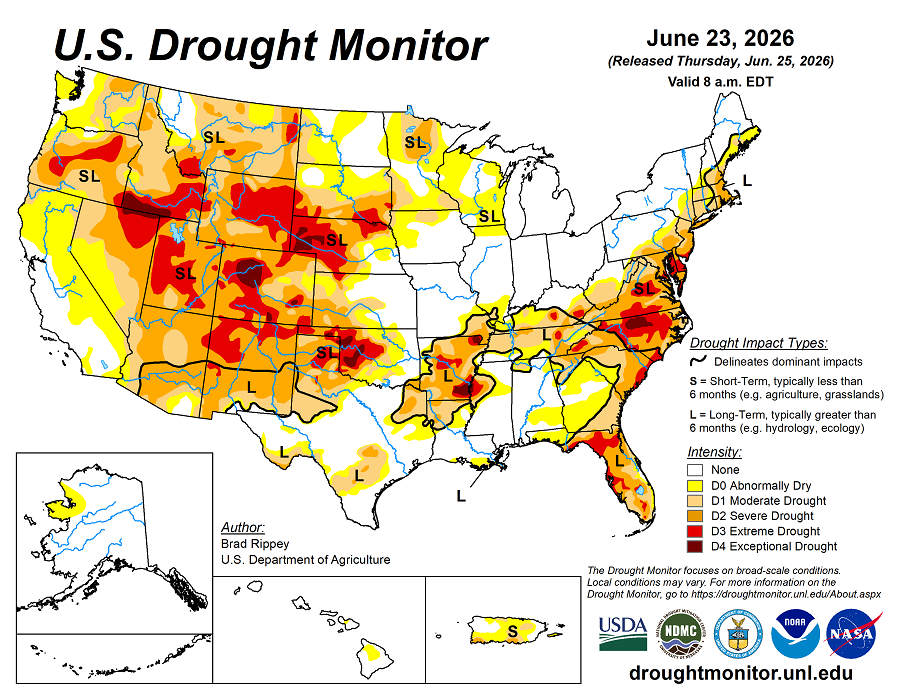
These events come against a backdrop of persistent drought and one of the warmest winters on record across the West. Much of the state started the year with a severe snow drought, leaving mountain snowpacks below normal levels despite late-season storms. Scientists from NOAA and the Desert Research Institute have highlighted how this decreases spring runoff, dries soils and vegetation much earlier, and intensifies wildfire risk—especially in eastern New Mexico’s grasslands, where sparks can spread quickly under hot, dry, windy conditions.

With data through June 23, the U.S. Drought Monitor shows raging drought across much of the West, with pockets of extreme (D3) to exceptional (D4) conditions in parts of the Four Corners region and beyond. Hot, dry weather has increased irrigation demands and wildfire threats. Amid this condition, poor to very poor assessments of rangeland and pastures in states like Arizona, Colorado, and Wyoming.

National Interagency Fire Center outlooks for June through July expect above-normal fire potential across much of the Southwest, including New Mexico. The forecast said warmer- and drier-than-average conditions, fuels, and the potential for dry thunderstorms before the monsoon fully arrives are the underlying factors. Probabilities favor high temperatures coupled with strong evaporative demand are stressing vegetation, even if some monsoon rains materialize.

Earlier, the Seven Cabins Fire in Lincoln County burned nearly 32,000 acres before full containment in mid-June. It was one of the larger events that underscored the high ignition rate. Data through early June from State Forestry already showed an unusually high number of lightning-sparked fires compared to recent years. The total acres burned, however, remained relatively modest up to that point due to aggressive initial attack.

Broader Western Context: Heat, Fuels and a Changing Climate

The challenges go far beyond New Mexico’s borders. In Utah, the Iron Fire near Eureka easily burned over 37,000 acres of grass and chaparral after igniting on June 19. Multiple large fires have charred tens of thousands of acres across the region, under hot, dry weather. Less snowpack from a historically warm winter has complicated risks, with earlier melt and reduced moisture carrying into summer.

Experts link these events to climate change.

A study published in Environmental Research Letters found that in years when snowpack melted earlier in the West, wildfires generally burned more areas. But during years with low snowpack, fires tended to be more acute and caused greater damage to the natural landscape.

Daniel Swain, a climate scientist at the California Institute for Water Resources, said, “The main impact [of low snowpack] this year might be with respect to fire conditions, particularly in the mountain areas.”

Human and Ecological Toll

Wildfires in the West are not abstractions. These events threaten homes, cultural sites, including those of the ancestral lands of Pueblo communities near the McCauley Springs Fire, watersheds, and wildlife habitat. Post-fire conditions heighten risks of flash flooding when monsoon rains eventually arrive, a recurring event in New Mexico burn scars.

State and federal officials have enforced fire restrictions across New Mexico since early April. The restrictions include banning campfires, fireworks, and open burning on non-federal lands to descalate human-caused ignitions, which account for a large portion of problematic starts.

Outlook and Adaptation

Meteorologists suggest warm anomalies and high evaporative demand will continue, keeping risks high in other parts of the West. Though the coming monsoon could bring ease by increasing humidity and precipitation—potentially moderating fire activity in New Mexico by late July or August.

In the long term, officials stress the need for forest thinning, prescribed burns, community preparedness, and addressing the drivers of a hotter, drier West. The immediate focus, at the moment, is containment, public safety and monitoring the volatile mix of fuels, weather, and ignition sources that shape this fire year.

Forecasters observed, amid the snow drought briefing early on, that when conditions align with hot, dry winds, even one spark in combustible fuels can lead to rapid growth. This year, that alignment has already tested firefighting crews and residents across New Mexico and the West.

Estancia’s Water Shortage Reaches Breaking Point, Issues State of Emergency

0

Estancia has declared a state of emergency to solve worsening water shortage after years of low supply have reached a breaking point.

Officials said the town has been hauling in water from outside communities to fill local tanks. “They’re constantly hauling all day long, putting water inside our Well 4, which is our backup system,” Estancia Mayor Pro-Tem Albert Lovato said.

The issuance aims to stabilize water distribution as crews continue hauling water to meet household needs.

What Is In The Resolution?

Estancia’s governing body cited challenges that threaten the community’s water supply, including maintaining reserves and pressure needed for drinking water and fire protection. The resolution states that current operations under existing conditions risk, water shortages, service interruptions, inadequate fire suppression, and other threats to public safety.

The declaration gives Estancia’s mayor, town clerk, public works supervisor and other officials authority to impose emergency measures. Those include mandatory water conservation restrictions, limits on nonessential use, emergency procurement of equipment and contractors, and immediate repairs and infrastructure improvements.

Town leaders said the declaration also serves as a formal request for assistance from state and federal agencies to help address the worsening water crisis.

How Did The Issue Sparked?

The issue began with a water main break last month, significantly draining their tanks. However, just this Wednesday, the situation became critical, and the town officials realized they had to issue an emergency resolution.

“We got information that our level was at eight feet, which is almost an emergency,” Lovato said. “Once we realized it was at that level, that could very easily go down and be completely dry,” he added.

What Happens If Governor Approves?

If approved by the governor, the emergency declaration would allow the town to use state funding to haul additional water into local tanks to keep wells from running dry.

“Currently, we haven’t run out of water as far as coming out of the faucet,” resident Nathan Dial said. “But the pressure and rate is extremely slow. It used to be about 3 to 5 gallons a minute, 90 pounds of pressure. I’m guessing we’re probably at 1 to 2 gallons a minute with 30 pounds. So just enough to sustain a household.”

Dial said the town has already asked residents to stop all nonessential water use, including washing cars and watering grass. Still, he observed that the tap continues to weaken.

“I noticed the pressure about four weeks ago, and each day it’s a little less, a little less, a little less,” Dial said. “I have a misting system for my animals, and the water pressure is so low that it won’t kick on.”

“I have a misting system for my animals, and the water pressure is so low that it won’t kick on,” he added.

The Issue Didn’t Show Up Today

According to some residents, this issue has been ongoing for years. Estancia Deputy Clerk Roy said the pump has been pumping at too much capacity at 150 gallons per minute.

“Our pump is pumping at too much capacity, 150 gallons per minute right now, so it’s not allowing the well to replenish the water fast enough,” he said.

Meanwhile, the town submitted a request in August 2024 to the Water Trust Board for a state loan of a little over $4.5 million to fund a new well. The request was approved in September 2025.

However, when the conditions changed this Wednesday, they rushed the request. “We got an expedited timeline to receive that funding, hopefully by the middle of August to do the new well,” Hubbard said.

The new well will be smaller, but more efficient, running 24/7 at a lower gallon per minute to replenish tanks.

If things go out of hand, the town has an emergency plan where they’re ready to supply residents with bottled water while asking them to utilize their use.

Free Wellness App Gives New Mexico Teens Mental Health Tools — Right in Their Pocket (No Therapist Waitlist Needed)

0

Starting Sunday, a new kind of support will arrive on the phones and laptops of local adolescents in Taos County. Teenagers ages 13 to 18 will be able to log in to Navi, a wellness app designed to guide them through the ups and downs of mental wellness.

State officials say this launch is only the beginning. Taos serves as the pilot site for a larger plan to make Navi available in every county of New Mexico — all 33 counties — in the months ahead. The platform provides tools for stress management, emotional check-ins, and access to resources that many young people might experience difficulty finding.

The launch comes at a time when communities across the state are looking for new ways to reach adolescents facing anxiety, depression, and the lingering effects of isolation. They started in Taos. Officials hope to learn how teens use the wellness app and what features they need most before expanding statewide.

“We are starting in Taos because the community has endured unimaginable loss,” said Nick Boukas, director of the Behavioral Health Services Division at the New Mexico Health Care Authority. “This launch is about giving young people something they can use right away — and about listening closely as we expand to other communities across the state.”

A State Grappling With Youth Mental Health

New Mexico’s challenges are hard. The state has long logged near the bottom in terms of youth mental health. Forty-four percent of New Mexico high school students reported feeling either sad or hopeless, 23 percent said they engaged in self-harm, and 10 percent had attempted suicide, according to the 2021 Youth Risk and Resiliency Survey. Rural and tribal communities often face additional barriers, such as long travel distances to providers, provider shortages, cultural stigma, and limited internet access.

On the national level, the youth mental health crisis has increased in recent years. According to research published in Pediatrics, nearly 40 percent of high school students, in some surveys, reported chronic sadness or hopelessness. In New Mexico, factors such as poverty, historical trauma in Indigenous communities, and the wide expanse of its frontier landscapes compound the issue. Traditional services, including those of therapists, school counselors, and inpatient programs, are stretched thin or simply unavailable in many counties.

Now, Navi comes along. A team that includes co-founder Julia Belt developed the wellness app. It offers brief, evidence-informed activities focused on emotional regulation, stress management, and help-seeking. Teens can formulate simple action plans for everyday challenges like school pressure or conflict with a friend. The platform includes safety features that connect users to crisis resources and works offline for areas with poor internet connectivity. It is available in English and Spanish on any device. Most importantly, it is not diagnostic and avoids generative AI.

Local teenagers helped in developing it through a pilot and a youth advisory board to ensure the language and content resonate. Officials planned to form a network of 100 to 200 youth ambassadors to drive outreach.

Tech as Bridge — and Its Limits

New Mexico’s experiment fits into a larger push for digital mental health interventions, especially in underserved areas. Studies on similar digital mental health interventions (DMHIs)— from single-session interventions to app-based cognitive behavioral techniques — have produced positive results in reducing symptoms of depression and anxiety, enhancing accessibility, and reaching youth who are unlikely to walk into a clinic.

In rural areas, digital solutions offer a bypass of long wait times and transportation barriers. One study found that adolescents in rural areas of the United States completed digital single-session interventions at rates comparable to urban peers. It also reported similar benefits in depression symptom reduction. Offline service, like that of Navi, addresses the “digital divide” that persists in places like New Mexico’s frontier counties.

Mental health experts have cautioned, however, that wellness apps are no silver bullet. For one, engagement can decline without human connection. Another, cultural appropriateness matters in diverse populations, including the state’s Native American communities. They also warned that privacy concerns, especially for minors, require strong safeguards. And while short-term feasibility and acceptability are high, long-term clinical outcomes and cost-effectiveness require further study, particularly in low-resource or culturally specific contexts.

Digital tools may increase inequities if they rely on smartphones or data plans that not every family can afford. The same concern could be raised if they fail to integrate with existing community resources like tribal healers or school programs. New Mexico’s approach — pairing the app with an event bringing together community organizations and young people in a shared design — attempts to mitigate some of these risks.

Broader Context: Behavioral Health Reforms

The Navi launch is one initiative of New Mexico’s overall behavioral health strategy. The state expands Certified Community Behavioral Health Clinics and invests in rural access. It represents a national recognition that waiting for crises to escalate is not the path to sustainability. Health officials hope to shift from reactive intervention to proactive wellness by meeting teens “in the moments they need — not weeks later.”

The appeal is almost immediate for families in Taos, where loss has touched many. A parent might see Navi as one more tool in a limited arsenal; a teen scrolling late at night might discover a guided breathing exercise or action plan to calm overwhelming emotions.

Measuring What Matters

Success will depend on sign-ups, steady use, and real impact. State officials plan to monitor engagement and generate feedback as the program will be available to all 33 counties.

Several questions remain, however. Will rural and tribal youth adopt it at scale? Can it significantly reduce hopelessness or help-seeking delays? How will the wellness app complement in-person care?

In the mountain desert, where distances are the longest and providers are few, Navi is a bet on technology’s reach tempered by community wisdom. The wellness app offers a small, portable compass for a generation coming of age under the weight of adolescence and the distinct pressures of life in a state most often overlooked.

The promise of the wellness app, for now, is simple: a digital lifeline, opening quietly on a Sunday, meant to meet young New Mexicans where they are — online, and oftentimes in need of someone to listen.

NMSU Biomedical Research Building to Undergo Expansion – Here’s Why it is Needed

0

Students and researchers at New Mexico State University have something big to look forward to. NMSU is undertaking a major expansion of its Biomedical Research Building. The project aims to significantly enhance the university’s research capabilities in areas crucial to public health. 

The National Institutes of Health and State of New Mexico are supporting the project through combined funding. According to NMSU, the investment will drive biomedical innovation and education in the region. 

To recall, in October, the New Mexico Board of Finance and Administration approved $16.3 million in capital expenditures to double the building’s size. Voters and the NIH initially funded the project through a 2020 general obligation bond and a grant. 

NMSU has developed the Biomedical Research Building in multiple phases. Phase I involved constructing the building’s shell. Phase II completed the interior buildout. The facility is now fully operational and supports ongoing research activities.

Phase III is currently underway. It will expand the building to accommodate growing research needs.

“This expansion marks an important step forward in strengthening NMSU’s biomedical research infrastructure,” said Berta Zubiate, university architect at NMSU. “By building on the success of the first two phases, we are creating a space that will support more advanced, collaborative and impactful research.”

Why the Expansion Is Needed

Workers started the expansion in November 2025 and plan to complete it by March 2027. The project will add specialized research environments, including a vivarium, aviary, and insectary. These facilities are essential for studying infectious diseases, cancer, and aging.

“These types of research environments are critical for advancing scientific discovery,” Zubiate said. “They allow researchers to better understand disease progression and develop new treatments that can improve lives, particularly in communities like those along the U.S.-Mexico border.”

The facility will serve a wide range of researchers and students. This includes those in the College of Agricultural, Consumer, and Environmental Sciences, as well as the Departments of Chemistry and Biology in the College of Arts and Sciences. 

The shared space is expected to foster interdisciplinary collaboration across multiple scientific fields. University leaders say the expansion aims to modernize and centralize research operations.

“Currently, many of these research activities are dispersed across campus,” Zubiate said. “This project brings them together into a purpose-built facility that meets evolving scientific and regulatory standards.”

The expansion aligns with NMSU’s land-grant mission by supporting research that addresses health disparities in border and minority communities. It will also create enhanced training opportunities for students pursuing careers in STEM and biomedical fields.

“This is about more than just adding space,” Zubiate added. “It’s about creating opportunities – for discovery, for collaboration and for the next generation of scientists.”

AI is Saving the Electric Grid from the AI Boom: Inside Sandia Labs’ Game-Changing Voltage Tech

0

Sandia National Laboratories has long honed technologies for nuclear deterrence and national security. Now, a quieter revolution is underway: teaching the electric grid to think for itself.

Artificial intelligence is driving an explosion in data centers, and renewable energy soars across the grid. With this, voltage — the steady pressure that keeps power flowing cleanly — has increasingly become a fragile resource. Conventional mechanical fixes, like capacitor banks that switch on and off, have struggled to keep pace with rapid, unpredictable swings in demand and supply. Enter Sandia’s AI-driven controls, coordinating batteries, solar inverters, and other distributed resources for stability in real time.

Recent laboratory demonstrations have detailed this new initiative. The work addresses a national challenge that is very visible in New Mexico and other states like Texas: how to power the AI boom without sacrificing reliability for everything else. Data centers, voracious and sometimes spiky in their electricity needs, are reshaping grid planning. At the same time, utilities are increasingly integrating variable solar and wind, while aging infrastructure faces threats from severe weather conditions and potential cyberattacks.

From Simulation to the Field

Sandia’s effort, at its core, is a distributed energy resource management system (DERMS), enhanced with artificial intelligence. Instead of relying solely on expensive new hardware, the system uses advanced functions embedded in modern inverters. These devices connect solar panels, batteries, and other resources to the grid.

Engineer Rachid Darbali-Zamora, the project’s key figure, explained the underlying philosophy of the work. “The way we generate electricity and the loads being placed on the grid are evolving, but the backbone of the grid that connects these is staying the same,” he explained. “We need more control to ensure everything can be integrated… in a more reliable manner. A key goal is keeping voltage within operating limits as conditions change from second to second.”

The team started in simulation, and they moved to Sandia’s Distributed Energy Technologies Laboratory. There, they leveraged power hardware-in-the-loop testing that connects real commercial inverters and batteries to a real-time digital simulator of grid conditions. This allowed the team to stress-test the AI against communication delays, equipment limits, and sudden disruptions without risking the live grid itself.

Field demonstrations followed at two sites in Lubbock, Texas, where Sandia’s Scaled Wind Farm Technology (SWiFT) facility and the Texas Tech University GLEAMM microgrid, and a data center. Side-by-side tests — controller on one day, off the next — demonstrated quantifiable gains. Voltage deviations have strengthened, bringing performance closer to utility goals and enhancing power quality for sensitive loads.

Miguel Jimenez-Aparicio, a researcher and team member, observed that the field data aligned with lab results: “These demonstrations prove that AI can meaningfully improve how microgrids and distributed resources operate.”

National Security Meets Everyday Reliability

The implications go beyond commercial utilities. It could even be leveraged during a national emergency, such as war. Senior manager Charlie Hanley emphasized the defense angle: “In scenarios of national conflict or war, adversaries will target energy infrastructure… The Sandia-developed DERMS system helps to defeat such adversarial attacks through the application of agile and secure technologies.”

This aligns with Sandia’s expansive portfolio. Separate projects have developed brain-inspired neural networks capable of distinguishing between physical grid faults, say, like storm damage and cyberattacks, running on economical hardware already in the field. Its dual-use capabilities are critical because grids become more digitized and highly interconnected.

New Mexico itself provides a testbed. The state is home to large data center proposals, ambitious renewable targets, and national laboratories whose missions largely rely on reliable power. Wider U.S. energy trends raise the stakes, with data centers poised to claim a far larger share of electricity in the years ahead, while peak demand risks outstripping supply in some regions.

Path to Adoption of AI-Controlled Electric Grid

Sandia’s strength is its pragmatic approach. It used existing inverter hardware, enabling utilities to avoid massive capital outlays for traditional upgrades. The AI coordinates devices intelligently while respecting the electric grid’s physical limits, necessary for real-world deployment.

“The technology could strengthen power resilience and help protect critical defense and national security infrastructure during disruptions and attacks,” Sandia National Labs, in its social media post, wrote.

The project has advanced through the Department of Energy’s Energy I-Corps program, working with utilities and microgrid operators to hone the technology’s operational needs. It is now in Phase III, focusing on commercialization and further deployments. This fits into Sandia’s broader AI-for-grid efforts that include work on resilience metrics, renewable integration, and predictive analytics. The laboratory also participates in consortia such as the Open Power AI Consortium, seeking to scale these tools across the industry.

Challenges

Experts caution that AI is no cure-all. Grid modernization requires regulatory changes, investment in sensors and communications, and a scrutiny of the cybersecurity of the AI systems themselves. Aggregated loads across data center clusters, according to a study on Spatial Load Correlation in AI Data-Center-Dominated Power Systems, could pose fresh risks to grid stability, such as simultaneous voltage and frequency swings.

Questions remain about adaptability across diverse utility territories, integration with traditional systems, and equitable access — ensuring that rural or low-income regions benefit alongside tech hubs. Still, Sandia’s progress signals change. As Darbali-Zamora put it, AI helps “make sense of all the moving pieces on a modern distribution grid and do it in real time.”

Electricity demand is surging, and the demand for the grid to do more is even greater; intelligent controls may prove necessary. It started in a New Mexico lab, and the AI-controlled electric grid could help keep the lights on and the servers humming across the country.

Rain Failed to Stop This 708-Acre NM Wildfire—And Dangerous Winds Are Next

0

Rain has done little to slow the McCauley Springs Fire, which held at 708 acres with zero containment as of Friday, as crews faced weather-related challenges on the ground.

While moisture can aid firefighting, officials said dry, windy conditions expected Saturday will quickly erase any benefit. Lightning also remains a threat, with the potential to spark new blazes.

Tiffany Davila from the Southwest Complex Incident Management Team 3 also explained thunderstorms can bring outflow winds. “Outflow winds can be very dangerous. They could shift the fire direction, expand or increase the fire activity and behavior. So they’re really monitoring the weather closely,” Davila said.

Despite all these, the fire is burning in a rugged terrain, so as firefighters try to directly target the fire, it’s tough to navigate.

Highway 4 remains closed near mile markers 27 and 40. Meanwhile, evacuations remain in place with “Go” status for Sierra de los Pinos and Jemez Falls Campground. Officials said an evacuation center for residents is open at Jemez Mountain Baptist Church in La Cueva, while Los Alamos County remains under “Ready” status.

Meanwhile, the Santa Fe National Forest also closed off the McCauley Springs Fire area in the forest. Although crews want to emphasize that the rest of the forest is open.

Smoke remains visible from Albuquerque, U.S. 550, Jemez Springs, and nearby communities, and it may affect parts of Highway 4.

Lightning Sparks Fresh Wildfires in NM Mountains Despite Tightened Restrictions

0

Multiple small fresh wildfires broke out in the Zuni Mountains following scattered thunderstorms on June 26, a day after the Santa Fe National Forest recently enforced Stage II fire restrictions. But lightning-induced fires continue to challenge local crews.

Firefighters successfully contained the Foster Fire in the Zuni Mountains using direct extinguishment. Officials reported low fire behavior, with the blaze burning a quarter of an acre. Crews also contained the nearby Rose Fire, which was held to one-tenth of an acre, using direct extinguishment.

The U.S. Forest Service, Cibola National Forest Crew-32, and aviation support responded to both scenes to achieve full containment.

Fresh Wildfires Start Near Tres Piedras, Beehive

Firefighters are actively battling fresh wildfires.

A new wildfire broke out near Tres Piedras. Officials estimate the fire is between 3 and 4 acres. The fire exhibited moderate behavior, with 2-to 4-foot flame lengths and isolated burning.

The fire was spotted during a routine detection flight ordered to survey the forest following lightning activity on June 16.

Officials are still investigating the cause of the fire. The said there are currently no evacuation orders or immediate threats to structures.

Firefighting crew remains on the scene of the Beehive Fire, which has burned some 80 acres with zero containment. With less intense fire behavior, crews plan a burnout between Forest Road 80 and Willow Tank to clear fuels and protect nearby private property.

Officials expect to assign between 65 and 75 personnel to the incident tomorrow. A Type 1 Black Hawk helicopter will support the deployment.

The Beehive Fire was first reported around 1 p.m. on June 25, north of U.S. Highway 64 in the Tusas Valley, about 15 miles west of Tres Piedras. Some areas of the forest received widespread, prolonged rain, but the immediate fire area received only minimal precipitation.

Despite widespread, prolonged rain in some areas of the forest, the fire area received minimal amounts.

Update As Of June 26 on Beehive Fire

Firefighters still remain on scene of the fire, which has grown to an estimated 80 acres with 0% containment.

With less intense fire behavior, tonight’s activities include a burnout operation between Forest Service Road 80 and the Willow Tank to reduce fuels between the fire and private land.

Update As Of June 27 on Beehive Fire

Firefighters are on the scene this morning, working toward containing the fire, which remains at 80 acres with zero percent containment.

They have been taking advantage of moderate morning temperatures and creeping fire behavior to burn fuels on the north flank along Forest Service Road 80 and on the east flank, continuing last night’s work along a private property boundary. Meanwhile, a Type 3 helicopter has been ordered to assist.

By 12:45 p.m., a recent aerial survey showed that the fire is 400 acres. This includes the acreage treated during last night’s and this morning’s strategic burnout operations and unburned areas within planned control lines.

Update as of June 27 on Beehive Fire

The Beehive Fire rapidly grew this afternoon, pushed by winds and strong gusts under a Red Flag Warning. It is estimated 1,864 acres with zero percent containment and even reaching the Lamy Peak area.

Crews are now working in coordination with water-dropping helicopters to pick up spot fires and establish anchor points for building control lines. Six dozers have already been ordered, two of which are scheduled to arrive tonight, and we will begin constructing control lines tomorrow.

There is no evacuation at the moment, however heavy smoke has been impacting Highway 285 between Tres Piedras and Colorado border. Authorities urged the drivers to take caution and slow down.

Due to the complexity of the case, Carson National Forest Fire managers have ordered the Northern New Mexico Type 3 Incident Management Team to manage the fire.

The transition of authorities will take place over the next two days.

Update as of June 28 on Beehive Fire

Around 200 crews are on the scene since morning, continuing to work to build control line off Forest Service roads and from natural barriers.

With no infrared flight last night, the fire’s estimated size remains at 1,684 with zero percent containment. The National Weather Service forecasts another Red Flag Warning between 11 a.m. and 8 p.m. followed by a Fire Weather Watch on Monday.

Meanwhile, the fire has grown to an estimated 2,236 acres with zero percent containment. Most of the growth was on the fire’s flanks while its head did not significantly progress, remaining in the Lamy Peak area.

Helicopters and air tankers worked on the fire when winds allowed while dozers and ground crews focused on building control lines. A night shift will patrol the area this evening, focusing on structures on nearby private properties.

Even the affected area is big, there is no Red Flag Warnings or other active watches, warning, or advisories forecasted for that area at this time.

Update As Of June 29 on Beehive Fire

An overnight infrared flight gave Beehive Fire managers more accurate look at the fire current size, which is 3,121 acres. There was no significant growth overnight.

The Northern New Mexico Type 3 Incident Management Team took command of the fire management today at 6 a.m. Meanwhile, crews are back on scene, using direct extinguishment strategy, stopping the flames at the fire’s edge, as much as possible, focusing on protecting private land within the forest.

The containment remains at zero percent. While there is no Red Flag Warning today, winds forecast are to be 20-25 mph. with gusts up to 35 mph.

Meanwhile, fire managers are asking drivers to take caution and slow down when in the area, as heavy smokes are occurring along highways 64 and 285. While, hikers on the Continental Divide National Scenic Trail may want to consider skipping the section between Hopewell Lake and the Rio Grande National Forest.