

NASA’s Transiting Exoplanet Survey Satellite (TESS) has discovered its first exoplanet through gravitational microlensing, a technique the spacecraft was never designed to use. A University of New Mexico astronomer says the breakthrough could reveal a hidden population of distant planets buried in TESS data.
The discovery, published Tuesday in The Astrophysical Journal Letters, marks the first time TESS has found an exoplanet by detecting the distortions of space-time caused by gravity instead of observing a planet passing in front of its host star. “When TESS launched, no one expected it to be capable of finding this kind of planet,” said Diana Dragomir, a professor of physics and astronomy at the University of New Mexico and a co-author of the study.
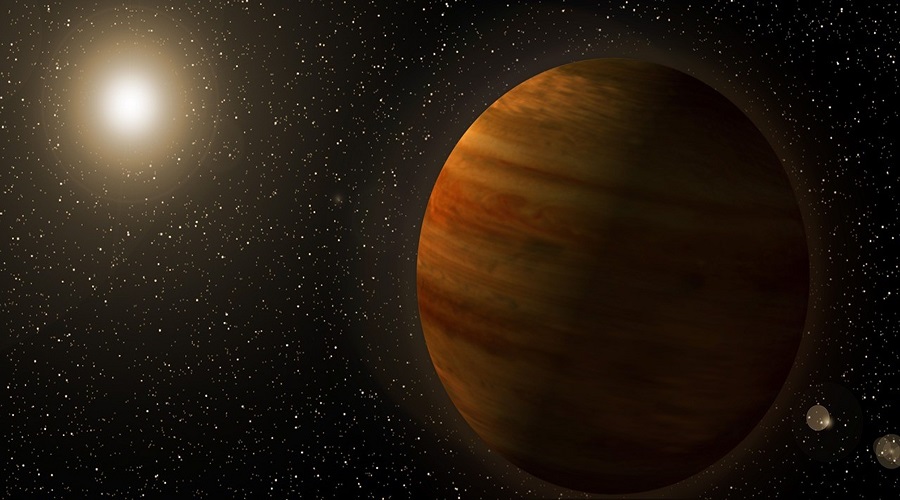
The newly discovered monster exoplanet, Gaia23bra b, is a super-Jupiter about 1.6 times Jupiter’s mass. It orbits an orange dwarf star at a distance comparable to Jupiter’s orbit around the Sun, which is nearly 40,000 light-years from Earth — way beyond the approximately 150-light-year distance where TESS has made most of its exoplanet discoveries.
It would have been extremely unlikely to discover the exoplanet using the transit method that has made TESS one of NASA’s most successful planet hunters.
Instead, astronomers discovered the monster exoplanet through gravitational microlensing, which occurs when the gravity of a foreground star bends and magnifies the light of a more distant background star. The brief period of brightening can reveal planets orbiting the foreground star. “The discovery implies that there are probably other so-called microlensing planets hiding in TESS’s data that we hadn’t previously thought to look for,” Dragomir said.
In 2023, the European Space Agency’s Gaia spacecraft detected an unusual brightening event. Researchers later searched archived TESS observations and found that the satellite had been observing the same region of the sky with much denser time coverage. “Gaia’s observations were too sparse to pick up on the planet,” said lead author Mallory Harris, a doctoral student at the University of New Mexico. “The TESS spacecraft happened to be monitoring the same area of the sky during the event, and its denser time coverage showed extra features in the light curve caused by a planet.”
More than 6,000 exoplanets have been confirmed, with nearly three-fourths discovered through the transit method. Microlensing has detected fewer than 5 percent of known planets, but it excels at finding those orbiting farther from their stars—systems that resemble the architecture of the solar system.
“Transits and microlensing are complementary because they each reveal a category of planet the other may not be able to detect,” Dragomir said. “Transits give us the size of a planet, and in concert with other methods we can determine its mass and density. Microlensing gives us masses and orbital distances for planets we’d otherwise never see.”
Dragomir said the discovery suggests TESS could play a bigger role in studying planetary systems across different parts of the Milky Way, complementing NASA’s Nancy Grace Roman Space Telescope. The state space agency has scheduled the launch of the telescope in August and will conduct the largest microlensing survey. “Since TESS looks elsewhere in the galactic plane, it can naturally find microlensing planets in other parts of the galaxy, as demonstrated by this first microlensing planetary system,” she said. “That means it could help us study planets in regions with different conditions.”
NASA scientists say TESS observations and Roman’s future survey, when combined, could help researchers better understand how planetary systems form and evolve across the galaxy. The findings could shed light on whether environments outside the crowded galactic center are more favorable for the emergence of a potential Goldilocks zone.

