

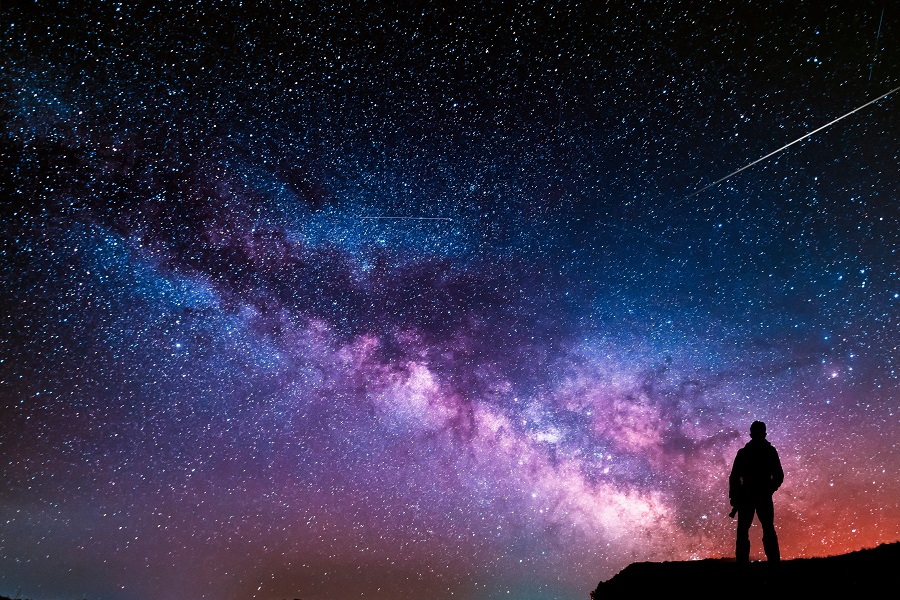
New Mexico’s August sky is a gift for skywatchers. Celestial spectacles such as the Perseid meteor shower, a partial lunar eclipse, bright planetary displays, and views of the Milky Way will dazzle in one of North America’s darkest skies.
Perseid Meteor Shower
Perseid meteor shower is one of the year’s most active meteor displays. It will peak during the night of Aug. 12-13. The peak period coincides with a new moon, creating a dark canvas that allows viewers at remote locations to see 50 to more than 80 meteors per hour.
It is best to watch this celestial spectacle after midnight through dawn when the constellation Perseus rises higher in the northeastern sky. A location away from the glare of urban lights is ideal for maximum viewing satisfaction.
‘Blood Moon’
The partial lunar eclipse will be visible across New Mexico on the evening of Aug. 27. Only a narrow illuminated edge of the moon will be seen while most of the lunar surface takes on a reddish hue commonly associated with a “blood moon.”
The eclipse will reach maximum around 10:12 p.m. MDT and conclude before midnight across most of the state.
Bright Planets and the Milky Way
In the western sky after sunset throughout August, Venus’ presence can hardly be ignored. The solar system’s second planet will reach its maximum eastern elongation around the middle of the month.
On Aug. 11-12, as many as six planets may be visible before sunrise, although some of the fainter ones will require binoculars. Saturn will remain visible throughout the night, while Mars, Mercury and Jupiter will appear in the predawn hours.
August is one of the best months to observe the Milky Way. During the first half of the month, the galaxy’s bright central region will be prominent in the southwestern sky after darkness falls, especially during the moonless period surrounding the new moon.
Top Viewing Locations
New Mexico has several internationally recognized dark-sky destinations, namely:
- Capulin Volcano National Monument is a Gold Tier International Dark Sky Park known for summer astronomy programs and telescope viewing.
- Chaco Culture National Historical Park sits beneath some of the darkest skies in the Southwest.
- Cosmic Campground in the Gila National Forest is the first International Dark Sky Sanctuary established on U.S. National Forest land. It offers nearly unobstructed 360-degree views.
- Clayton Lake State Park, New Mexico’s first designated dark-sky park, features dinosaur tracks and an on-site observatory.
- Valles Caldera National Preserve and Salinas Pueblo Missions National Monument periodically host ranger-led astronomy programs.
- The Taos area and Rio Grande Gorge offer guided stargazing events during the summer.
Skywatchers can also find good viewing conditions in rural areas far from the glare of Albuquerque’s city light, Las Cruces, and Santa Fe.
Some Skywatching Tips
Skywatchers should allow 20 to 30 minutes for their eyes to adjust to darkness. They may also use a red flashlight to preserve night vision. A reclining chair or blanket, warm clothing, snacks, and binoculars are essentials to make the experience more satisfying.
Apps such as Stellarium and SkySafari can help identify planets and constellations. But viewing the Perseid meteor shower and lunar eclipse require no specialized equipment.
Visitors should check park advisories, weather forecasts, and road conditions before traveling.

