

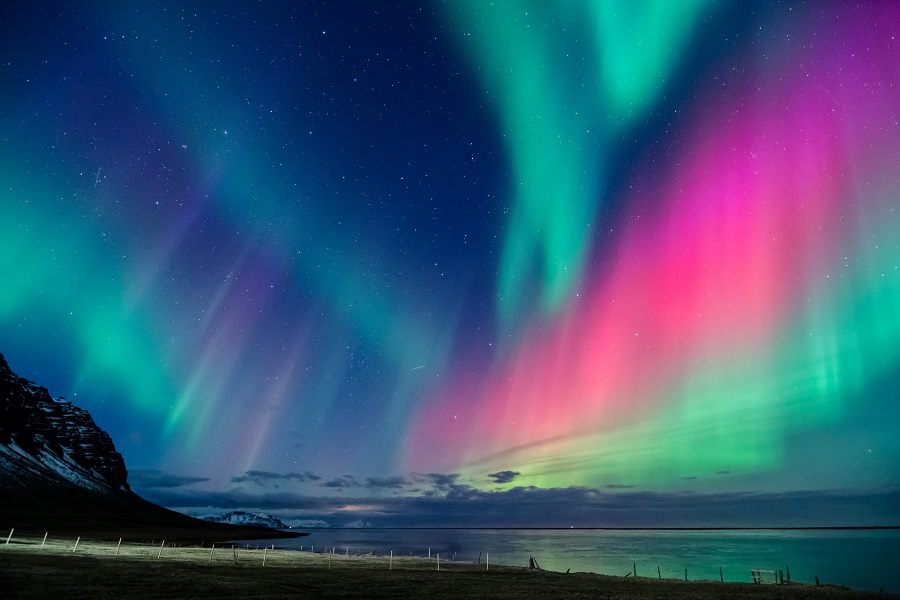
The northern lights made an unusual appearance Friday night across New Mexico and much of the Southwest, treating skywatchers to a rare Independence Day display triggered by intense solar activity.
A series of powerful solar eruptions released multiple coronal mass ejections (CMEs) toward Earth, igniting a strong geomagnetic storm that pushed the aurora borealis unusually far south. The charged particles interacted with Earth’s magnetic field, creating the rare celestial show visible in parts of New Mexico, Arizona, Utah, Colorado, and other Southwestern states.
Residents in rural areas, away from city lights, reported vivid greens, purples, and reds dancing across the night sky, often posting photos and videos on social media. The event surprised skywatchers in the far south as the northern lights rarely appear in the region.
Space weather forecasters tracked the incoming CMEs. Moderate to briefly strong geomagnetic storm conditions were observed overnight. Forecasters at NOAA Space Weather Prediction Center said conditions are expected to continue through July 5. But the intensity of the storm exceeded initial projections, allowing the aurora to reach latitudes typically too low for such displays.
Similar outbursts in recent years have occasionally brought the lights into the northern United States. But the appearance of this far south is not common.
The timing of the display of the northern lights added a patriotic flair for many observers celebrating the holiday.
Scientists observe that auroras occur when solar particles collide with gases in Earth’s upper atmosphere, causing them to glow. Strong geomagnetic storms, on a scale from G1 (minor) to G5 (extreme), can widen the visibility zone dramatically.
No immediate reports of disruptions to power grids or communications are available, though such storms can occasionally disturb satellite operations and high-latitude infrastructure. The celestial display slowly faded in the early morning hours as the geomagnetic conditions eased.

