


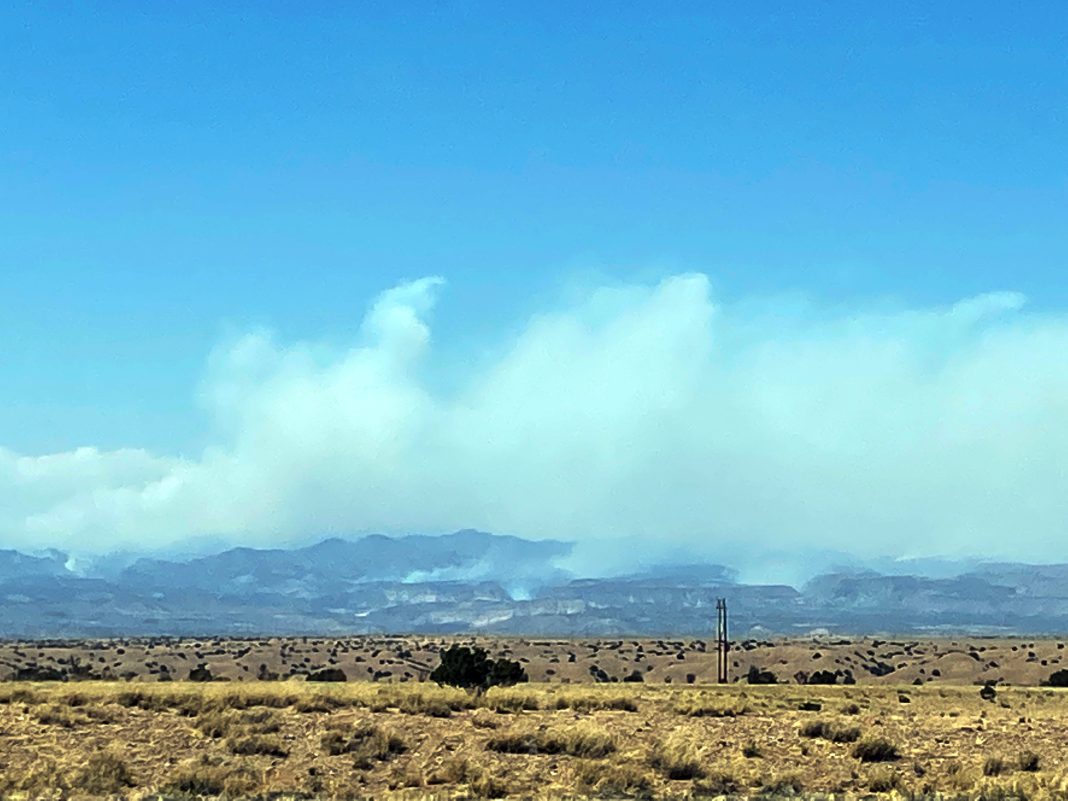
The Center for Fire Resilient Ecosystems and Society (FiRES) at the University of New Mexico (UNM) has committed to continuing to help communities across the state become more resilient to wildfires.
FiRES, an interdisciplinary center, conducts research and community outreach to help communities address the negative impacts of fires. A team of UNM faculty experts is working with state officials and policymakers for the initiative.
According to UNM News, the FiRES Center will continue to expand partnerships, engage communities, and lead projects to mitigate wildfire damage.
The team is partnering with Sandia National Laboratory scientists to improve the efficiency of wildfire smoke modeling. Current models run slowly, so collaborative researchers are working to improve efficiency to enable faster smoke predictions. This partnership was made possible through the center’s connections and ongoing conversations.
Some additional projects the team is currently pursuing include landscape-scale risk modeling, fuel moisture monitoring, and improving post-fire reforestation methods.
“The effect of these fires on our communities, ecosystems, and watersheds will depend on the choices we make in land management today. So, the center’s team is working toward solutions for living in a fire-prone landscape,” said the center’s Director Matthew Hurteau.
Reports show that New Mexico has been getting hotter and drier with each passing year. This winter, record-breaking warm temperatures across the state could significantly affect this spring’s wildfire season.
How the UNM FiRES Center Started Its Work
Hurteau, a biology professor in the Biology Department at UNM, officially established the center in 2024. Although he started the connecting and research work much earlier. The center envisions a future where communities and ecosystems in New Mexico and the western U.S. are resilient to wildfire.
“Our state is highly flammable,” said Hurteau. “There are people working to alleviate this, and I wanted to bring them all together to increase the efficiency and effectiveness of our discussions and solutions.”
The FiRES team includes multiple UNM departments, including biology, economics, communication and journalism, pharmaceutical sciences, and computer sciences. Team members also represent internal medicine, geography, environmental studies, and the Earth Data Analysis Center. They also collaborate with Sandia and Los Alamos National Laboratories, as well as the U.S. Fire Service.
“I wanted the FiRES Center to be a hub that connects all the folks working on fire research, not just at UNM, but beyond the UNM boundaries as well,” said Hurteau.
The Center conducts fundamental and applied research to develop next-generation tools for fire and vegetation management. It assesses the economic impact of fires, the benefits of fire-resilience management, and the effects of air quality on public health.
UNM FiRES Center’s Commitment to Sustainable Solutions for Communities
Apart from being ecological problems, fires affect the economy, public health, water supplies, and communities. The faculty are passionate about working in the community to help identify sustainable solutions.
“We take the role of a public university very seriously and want to be of service and work with the community as much as we can,” Hurteau said.
Advertisement
For one, Chris Marsh led NM’s Legislative Finance Committee on a burn-area tour discussing post-fire reforestation and watershed recovery. Marsh is a research assistant professor in the biology department. The tour highlighted where state investments would be needed after wildfires.
In addition to tours, the faculty participates in legislative panels. They help share and analyze the impact of wildfires on watersheds, ecosystems, and community resilience.
How a Passion Sparked a Meaningful Impact
Hurteau’s passion for this work stems from firsthand experience after moving to Flagstaff, Ariz., from Vermont. He recalled that in his first winter there, 1996, the climate shifted toward hotter, drier conditions. This change resulted in a severe fire season. The town watched as air tankers constantly circled, evacuations occurred, and several homes were lost.
This experience sparked his interest in developing a way to assist communities affected by wildfires. He started by studying forestry. He then pursued wildland fire training and certifications, during which he learned that land management is a tool.
With firsthand wildfire experience, he wanted to unite people from all aspects of wildfire work to promote communication and knowledge sharing. Hurteau ultimately formed a think tank of New Mexican experts to address pressing issues facing the state and communities.
According to UNM News, the team’s work remains important today and directly impacts the state’s future.

