

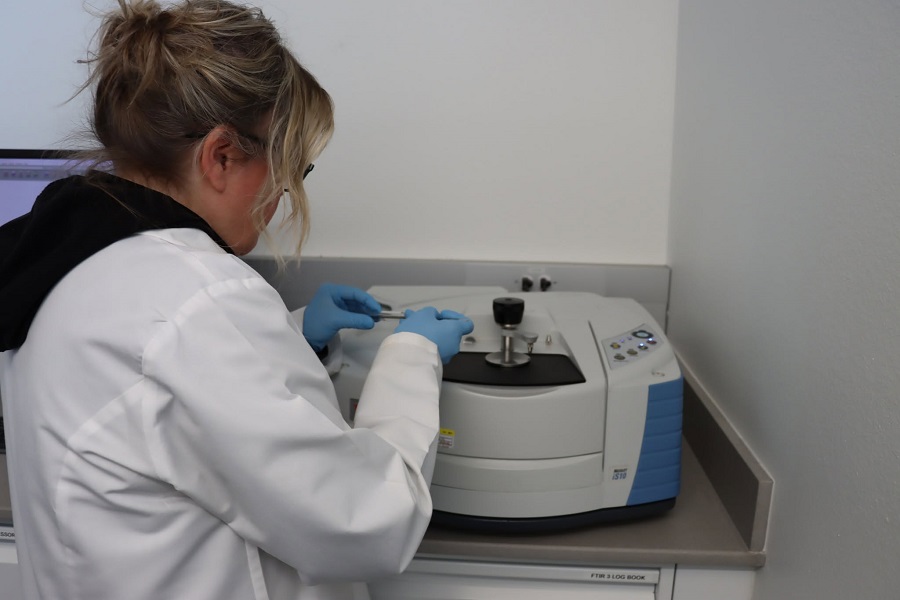
New Mexico’s criminal justice system places great reliance on machinery in forensic laboratories to discover what a piece of evidence contains. Some of these machinery, however, are nearing the end of their useful lives.
The Forensic Laboratory of the New Mexico Department of Public Safety is asking for $1.4 million in funds from the federal government to replace the outdated scientific equipment at its Santa Fe, Hobbs and Las Cruces facilities.
The request consists of six new gas chromatography-mass spectrometry (GC-MS) instruments, four high-performance liquid chromatography systems, and six Fourier-transform infrared spectrometers (FTIRs). This equipment is part of the scientific chain that connects physical evidence to investigations, prosecutions and court proceedings.
Dr. William Watson, who is the laboratory’s quality assurance manager, pointed out that even though certain basic forensic technologies have not changed much over the years, those machines do not last indefinitely, some of them going back as far as 2008.
Because of their technical knowledge, laboratory scientists have been able to get the older equipment to function. Still, Watson pointed out that there is a stage when extending an instrument’s economic life amounts to a false economy. “We must never compromise quality for the sake of economy,” Watson said. “That would be false economics.”
When the machine can no longer be trusted
GC-MS machines are essential in the field of forensic chemistry since they are capable of identifying and analysing substances by separating out the chemical compounds and studying their molecular signatures.
As alternatives other than these there are high-performance liquid chromatography systems, which are used for analysing chemical composition and purity, and FTIR instruments that identify materials by the way in which they absorb infrared light.
Some existing FTIR equipment still works. But discontinued manufacturer support creates another problem: an instrument can remain functional while becoming increasingly difficult to repair, maintain, or validate.
That is important since forensic laboratories are subject to strict accreditation requirements.
Just because an instrument is old does not mean that it is automatically unreliable. It can stay in service as long as it keeps producing technically valid results and meets the required performance standards.
Once the laboratory can no longer show that the instrument is working properly — or if the important components and support from the manufacturer cease to be available — it becomes more and more difficult to justify having the instrument kept in casework.
It is there that a malfunction of equipment can turn into an issue for the justice system.
A failed machine can mean more than a repair bill
Forensic evidence is never found by itself.
The police investigators could be waiting for the laboratory results. The prosecutors might need those results before bringing their case. The defence attorneys might also need access to the same scientific evidence. Finally, the courts rely on the reliability of the testing which underpins the evidence presented at trial.
Consequently, a sudden failure of equipment can cause delays that go well beyond the laboratory itself.
By replacing the instruments before they fail, the laboratory is able to install, verify and test the new equipment while the older machines are still available as a safety backup.
Advertisement
It’s not that simple just to unpack a new machine and plug it in.
Before they are used in actual cases, new instruments have to be installed and thoroughly validated. It may be necessary to amend the laboratory procedures and employees might need further training.
The time required for that preparation is another reason why officials would like to replace the equipment before a crisis makes them have to make the decision.
DNA equipment faces an even faster clock
The DNA technology used in the laboratory poses a different challenge.
In the field of thermal cyclers, quantitative PCR instruments and genetic analyzers, technological developments change more quickly; after manufacturer support has ended, the equipment still has to satisfy the demanding performance requirements.
If it can’t, then it has to be taken out of service.
The investment that has been proposed is therefore not merely a matter of obtaining newer versions of the machinery that is already in the laboratory; it is about preserving a scientific infrastructure which is able to produce defensible results over the long term.
Even hydrogen is part of the upgrade
The laboratory is also examining ways to improve safety.
GC-MS equipment needs a carrier gas; since stopping the use of helium the laboratory has employed pressurised hydrogen tanks.
The authorities are experimenting with a different method: using hydrogen generators that produce the gas only when it is required, rather than depending on large pressurized cylinders.
A test generator is already operating in Las Cruces without reported problems.
It would therefore decrease the laboratory’s need for stored hydrogen while at the same time modernising another section of the equipment system.
The cost of waiting
The main point of the laboratory is simply that the replacement of equipment is inevitable. Failing to carry out the replacement does not cause the cost to vanish; it might instead transform a planned investment into one that has to be made urgently.
Forensic laboratories also have a rather special duty, since their role is to provide evidence which is scientifically valid and capable of withstanding examination by all the parties taking part in the justice process. It means that the laboratory should be able to justify its instruments, its methods and its results.
The fact that $1.4 million is being proposed is really concerned with that chain of trust; even though a crime laboratory works mostly out of sight, its work can affect whether evidence is admitted, the way a case is investigated and what a jury is eventually asked to believe.
It is therefore more a question of protecting the scientific basis underlying the state’s justice system than it is about purchasing new, impressive machines for those laboratories.