

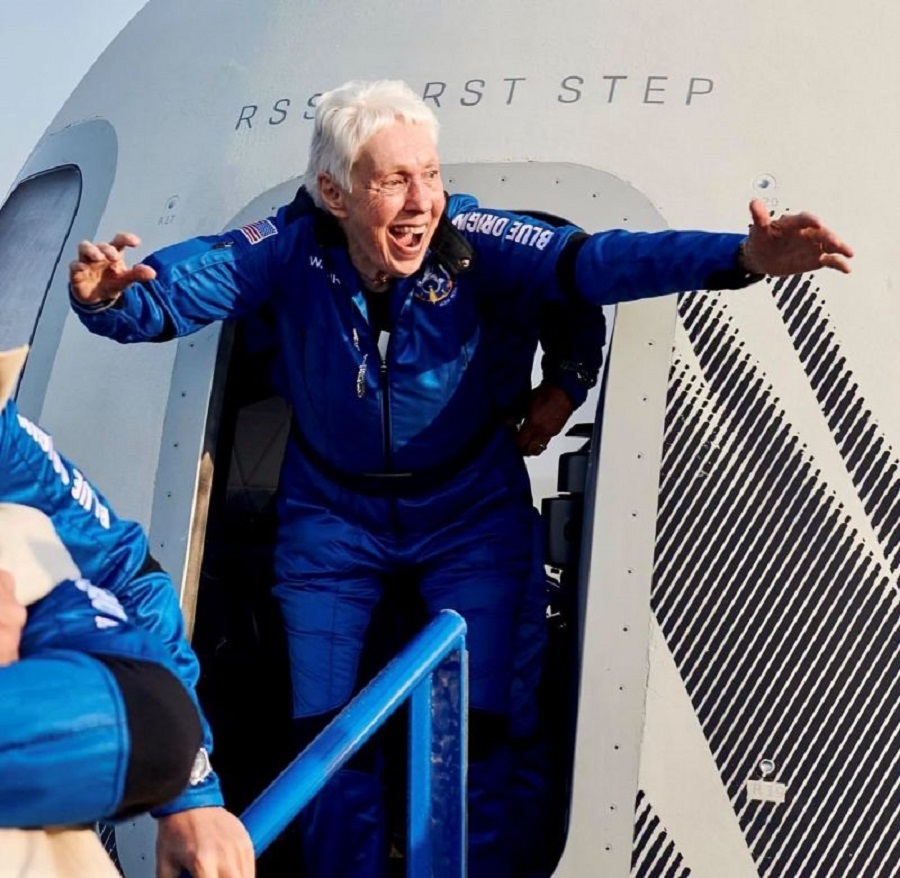
Wally Funk, a pioneering aviator who endured the dashed hopes of the Mercury 13 program in the 1960s only to fulfill her dream of spaceflight nearly six decades later as the oldest woman to travel into space, died on Wednesday at her home in Grapevine, Texas. She was 87.
The City of Grapevine, a Dallas suburb where she lived in recent years, announced her death. She died peacefully, surrounded by loved ones, officials said.
“Wally Funk’s unwavering determination proves that dreams have no expiration date,” said Grapevine City Councilwoman Duff O’Dell. “Her courage, resilience, and groundbreaking achievements continue to inspire young people—especially girls—to pursue careers in science, aviation, and space exploration. Grapevine is honored to call Wally Funk one of our own.”
Wally Funk Breaks Barriers
Mary Wallace “Wally” Funk was born Feb. 1, 1939, in Las Vegas, New Mexico. She spent part of her childhood in Taos. From an early age, flight captivated her imagination. At age 8, she jumped off her parents’ roof wearing a Superman cape in an attempt to fly. She took her first formal flying lesson at 9, earned her pilot’s license at 17 and went on to log more than 19,600 flight hours while training about 3,000 pilots.
Funk, a New Mexico native whose family operated five-and-dime stores, went to Stephens College in Missouri and Oklahoma State University. She recovered from a serious skiing accident in her teens that doctors feared might leave her unable to walk, using flying as a therapy and a passion. By her early 20s, she broke barriers as the first female civilian flight instructor at a U.S. military base, Fort Sill, Oklahoma.
Famous Chapter
Her most notable chapter began in 1961, when, at 21 — younger than the typical age range — she volunteered for a privately funded “Women in Space” program led by physician William Randolph Lovelace II. The initiative, which had no official NASA backing, put qualified female pilots through the same rigorous physical and psychological tests as the Mercury 7 astronauts. Funk passed along with other 13 women.
Dubbed the Mercury 13, a name popularized later, they outperformed many male counterparts on certain assessments. Funk excelled in several areas, even surpassing John Glenn in some tests. But NASA abruptly canceled the program, and the federal space agency continued to bar women from the astronaut corps for years. The Mercury 13 never flew. Funk became the last surviving member of the group — and the only one to eventually reach space.
Funk, undeterred, built a distinguished career as the first female inspector for the Federal Aviation Administration and the first woman air safety investigator for the National Transportation Safety Board. She remained a tireless advocate for women in aviation and space, never giving up her astronaut aspirations.
That persistence paid off on July 20, 2021. At 82, Funk flew aboard Blue Origin’s New Shepard rocket on its first crewed suborbital mission, alongside Jeff Bezos, his brother Mark and 18-year-old Oliver Daemen. The roughly 10-minute flight made her the oldest woman — and, at the time, the oldest person — to travel to space, a record later broken by William Shatner.
‘Trailblazer’
“Wally is a trailblazer,” Bezos said at the time, praising her joy and fearlessness. More than just a trailblazer, Funk considered the brief journey into space past the Kármán line as the culmination of a lifetime of determination. “I’ve been waiting 60 years,” she remarked. “I’m the happiest I’ve been in a long time.”
Funk spent her later years in Texas, where she continued speaking to audiences about perseverance and breaking barriers. Multiple tributes poured in after her death from NASA, Blue Origin and aviation organizations, highlighting her life as an inspiration to generations of pilots and aspiring astronauts.
Her extended family and a vast network of former students and admirers survived Funk. Funeral arrangements were pending.
Funk’s career spanned from the early jet age to the dawn of commercial spaceflight. She embodied a simple credo: Never stop reaching higher. Her life marked a bridge between the gender barriers of the dawn of the Space Age and the more inclusive era of private space travel — a reminder that some dreams, no matter how long deferred, are worth chasing.

