

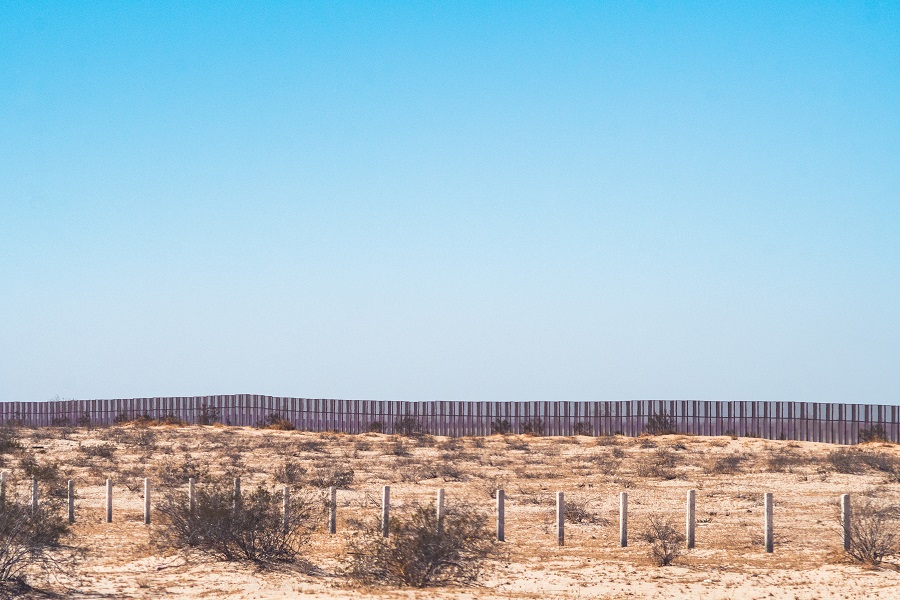
U.S. Customs and Border Protection has ordered contractors to pause the installation of new groundwater wells along the U.S.-Mexico border after New Mexico regulators threatened to revoke drilling licenses over unpermitted water extraction.
The order was issued amid a growing dispute between federal agencies, state officials, and local ranchers over state authority and water rights in the region. Residents in the area feared that the border wall construction could deplete the state aquifers.
Regulators say the contractors have installed no less than eight wells and pumped groundwater to mix cement, build roads, and suppress dust. They claimed the activities were without authority from the state. “Our permitting process exists to protect the groundwater New Mexico families and farmers depend on, and we enforce it rigorously,” State Engineer Elizabeth Anderson said.
In southern New Mexico last month, local ranchers spotted new wells appearing on private and nearby lands along the 8-mile stretch of the border.
One of the local ranchers, Russell Johnson, said the high-volume pumping is a threat to livestock and regional water supplies. “These wells that they’re drilling for border wall construction, they’re talking about trying to attain 300-plus gallons a minute, and it’s going to pump us dry,” Johnson, who is also a former Border Patrol agent, said. “When you have livestock you’ve got to water, they can’t wait. You can’t haul enough water to keep them in good supply, so it becomes an immediate disaster.”
U.S. Rep. Gabe Vasquez (D-N.M.) brought the issue on the House floor. He accused the federal government of usurping state water resources. Half of New Mexico’s water supply comes from underground aquifers.
The federal agency took cognizance of New Mexico’s concerns. It emphasized a commitment to collaboration. “CBP is committed to working collaboratively with local landowners to ensure that construction activities do not adversely impact their water needs,” the agency said.
Johnson said the order to temporarily pause drilling does not address existing wells. “It’s like you caught your kid with their hand in the cookie jar, but they’re still eating the cookie,” he said. “Those wells are still on the table if they decided they wanted to use them.”
Environmentalists and residents said the previous large-volume water extraction near the border had impacted local habitats. The extraction dried up ponds at the San Bernardino National Wildlife Refuge in Arizona.
The contractors had erected a 30-foot border wall and were installing a sensor-equipped “smart wall” system supported by nearly $47 billion in federal funding.
The wells are inside the 60-foot strip of federal property within the Roosevelt Reservation along the US-Mexico border. In April, CBP sent a letter to the state engineer’s office, arguing that federal authority exempts the project from state groundwater permitting laws.
State regulators countered Tuesday, however, saying drilling companies failed to comply with the requirements of proper well construction and plugging standards. They threatened contractors with potential license revocation if they fail to correct their violations within 30 days.
Drilling project subcontractors said they were assured that federal authority superseded state rules. “I was just a subcontractor on the job doing what the contractor told me to do,” said Vinnie Wyatt of Wyatt Drilling Arizona. “Now the state wants to take my driller’s license away because of it. I am just a little guy in the middle of all this. They assured me I wasn’t doing anything wrong.”

