Tomasita’s in Albuquerque remains closed Thursday following a fire on Wednesday night that damaged the establishment. The restaurant has yet to announce when it will reopen or provide further details.
On September 30, at around 8:13 p.m., Albuquerque Fire Rescue responded to the establishment along I-25 after reports of a fire. AFR said when they arrived, they found smoke and flames showing from the roof at the building’s northeast corner.
“The fire presented in offensive conditions,” AFR said in a social media post.
The department said engine 15 crews ran a hose line to the roof to control the fire. Other crews coordinated an interior search and worked to contain the flames.
Authorities declared the fire under control in 19 minutes.
Meanwhile, the restaurant said its staff safely evacuated everyone inside after the fire broke out.
According to AFR, fire damaged the roof and some interior areas below it. The department’s fire investigations division responded to identify the fire’s point of origin and determine its cause.
Brant.One will continue updating this article as more information becomes available, helping readers stay informed about the latest developments.
Albuquerque smashed its monthly rainfall record, with Santa Fe recording the highest reported totals in the latest round of late-September storms, bringing relief to New Mexico after months of droughts.
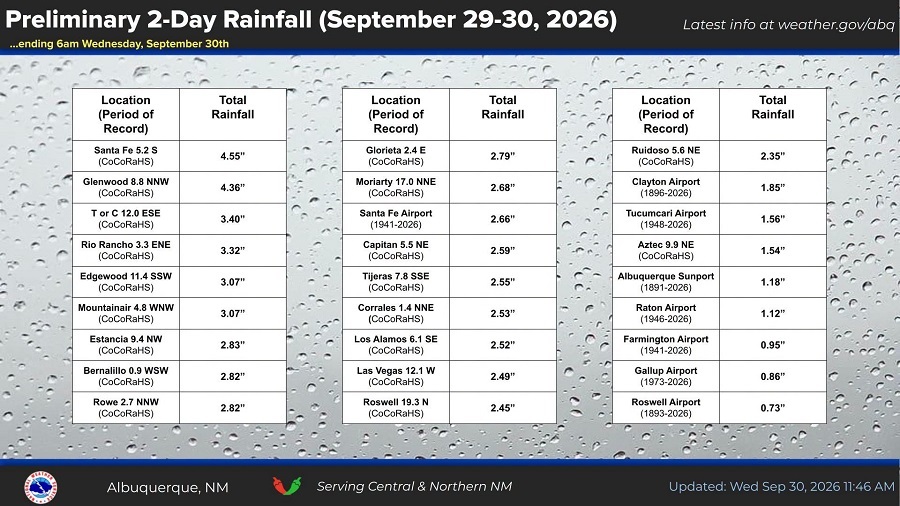
According to reports published September 30, the Albuquerque International Sunport recorded a total of 4.49 inches of rain in September, surpassing the previous September record of 3.97 inches set in 2013. Over the course of Tuesday and Wednesday alone, the airport has recorded 1.18-inch rain.
Santa Fe among hardest-hit communities
Santa Fe recorded 4.55 inches of rainfall in reports covering the recent storm, topping the state’s reported totals. Glenwood followed with 4.36 inches, Truth or Consequences received 3.4 inches, Rio Rancho recorded 3.32 inches, while Edgewood and Mountainair each received 3.07 inches of rainfall.
Other communities also experienced significant rainfall: Los Alamos recorded 2.52 inches; Las Vegas, 2.49 inches; Roswell, 2.45 inches; and Ruidoso, 2.35 inches. Rainfall varied considerably across the state, with some locations recording less than an inch.
The totals show how storms can unevenly affect New Mexico, where communities separated by relatively short distances can experience varying amounts of rainfall.
Graphics courtesy of US National Weather Service Albuquerque New Mexico
Heavy rain brings new flood risks
The rainfall has immediate challenges as well as potential benefits. For instance, storms in early September triggered flooding and water rescues across parts of New Mexico. Some locations received more than five inches of rain in a day, according to reports.
Heavy rainfall can overwhelm drainage systems, flood roads, and threaten homes, particularly in parts where runoff collects quickly. Areas affected by wildfires face additional risks as burned hillsides may have difficulty absorbing water, allowing rain to rush downhill and carry sediment and debris.
Authorities urged residents to follow local emergency alerts, avoid flooded roads, and never attempt to drive through moving floodwater.
Tennessee’s attempt to execute Christa Gail Pike descended into a medical and procedural crisis Wednesday night after the death-row inmate remained alive following two rounds of lethal-injection drugs.
Pike, 50, was administered two doses of pentobarbital at Riverbend Maximum Security Institution in Nashville. But she remained alive hours after the procedure began, according to her attorneys and multiple media witnesses.
She was eventually taken by ambulance to a hospital for treatment. Her lawyers said they had not been told of her condition.
The Tennessee Department of Correction said Pike was transported to a medical facility to receive medical care, but maintained that officials had followed the state’s established execution protocol.
Following the failed execution, Gov. Bill Lee announced that no further executions will take place in Tennessee for the remainder of 2026. He said an independent third party review will look into the incident.
The decision came after a day of legal turmoil that had already placed Pike’s execution in doubt.
Pike survived two doses
Pike’s execution began at about 7:27 p.m. CDT. The curtain to the execution chamber was opened for media witnesses.
The death-row inmate was strapped to a gurney. According to accounts from witnesses, she remained conscious during parts of the procedure. At one point she raised her head and asked prison officials whether her arm was supposed to feel the way it did.
The second dose of pentobarbital was administered at about 8:26 p.m., according to witnesses. But Pike did not die.
Witnesses heard Pike still snoring behind a curtain that blocked their view of the execution chamber.
At 8:53 p.m., the microphone was cut off and the media witnesses were ordered to leave. They were unable to see what was happening inside the chamber during crucial portions of the procedure.
“We have not been informed as to her condition,” Pike’s attorneys said after she was taken to the hospital.
An execution already delayed by the courts
Pike’s execution had originally been scheduled for 10 a.m. Wednesday. But about an hour before the scheduled execution, the 6th U.S. Circuit Court of Appeals issued a stay while it considered whether evidence concerning Pike’s childhood sexual abuse and other circumstances had been adequately considered when she was sentenced to death.
The state appealed the stay. And the U.S. Supreme Court later overturned the stay, clearing the way for Tennessee to proceed with the execution.
Pike’s lawyers subsequently filed emergency motions seeking to stop the execution after she remained alive following the injections.
Second failed execution this year
The Pike episode is the second failed Tennessee execution in 2026. In May, officials abandoned the execution of Tony Von Carruthers after medical personnel were unable to establish the required intravenous access. Gov. Lee subsequently granted Carruthers a one-year reprieve.
The state had already revised its lethal-injection protocol following an earlier independent review ordered by Lee. The revised protocol adopted single-drug pentobarbital for executions.
With that as the backdrop, the Pike failure will now face scrutiny beyond the question of what happened inside the execution chamber.
Meanwhile, Pike remains alive and under medical care. Her immediate medical condition has not been publicly disclosed.
If you’re wondering whether your child has access to nutritious meals at school, a recent report offers some insights. New Mexico posted strong numbers for its school meal efforts. The 2026 State of School Lunch Report from ProCare Therapy ranked the state second in the nation.
All eligible New Mexico schools participate in the Community Eligibility Provision (CEP). That’s the highest CEP adoption rate in the country.
CEP lets eligible schools serve free breakfast and lunch to every student. Families don’t have to fill out meal applications. This way, your child doesn’t have to worry about different payment or eligibility categories in the cafeteria. New Mexico also offers free school meals statewide through its Healthy School Meals for All policy.
The school meal system also focuses on local food. The report found that 75.8% of schools represented by responding school food authorities serve locally sourced foods.
New Mexico has about 68.8 breakfast participants for every 100 lunch participants, giving it the third-highest ratio nationally. About 62.3 participate in school lunch for every 100 school-age residents.
For APS, those numbers highlight its ongoing efforts to improve school meals.
Meals Made From Scratch
If your child is studying under APS, you may already have an idea about the scratch-cooking initiative of the Food and Nutrition Services. The team is preparing more meals from basic ingredients instead of relying mainly on highly processed, pre-prepared products.
The district said the approach brings more fresh ingredients into school meals. It also creates room for foods that represent Albuquerque’s diverse cultures and traditions.
APS already prepares about half of its meal components from scratch. The district is also expanding efforts to bring more locally sourced foods into cafeterias.
APS said this strategy connects the work in the kitchen with what students experience in classrooms and communities.
Food Cafeteria Scraps to Community Gardens
Meanwhile, APS recently launched an initiative to keep food scraps out of landfills and put them to use in the community. Three weeks into the program, the district has diverted nearly 1,700 pounds of organic waste from its Central Kitchen.
Here’s how the process comes full circle:
APS collects food prep scraps from its Central Kitchen each week.
Soilutions processes the waste at its South Valley facility and turns it into nutrient-rich compost.
Students use the compost returns in local school and community gardens. It gives them hands-on opportunities to learn, grow food, and connect with nature.
According to APS, the initiative gives your child a practical way to see environmental stewardship in action. Plus, diverting organic waste keeps more material out of landfills and helps build healthier soil.
For the district, New Mexico’s 100% CEP adoption and 75.8% local-food rate highlight what schools can achieve when they make access to meals a priority. They also show how connecting schools with local food can support students beyond the cafeteria.
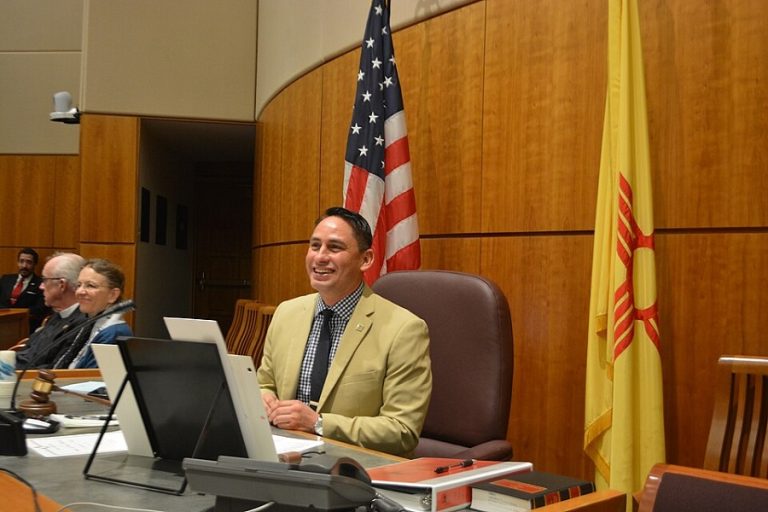
Acting Governor Howie Morales issued five emergency measures to help different communities in New Mexico following heavy rain which had damaged the infrastructure and disrupted transportation.
Morales signed the orders on Wednesday as acting governor because Governor Michelle Lujan Grisham was traveling outside the state.
The state is supporting each county, city, and village as it works day and night to keep their neighbors safe, Morales said.
Five orders, $750,000 each
Executive Orders 2026-073 to 2026-077 instruct the Department of Finance and Administration to make $750,000 available to the Department of Homeland Security and Emergency Management (DHSEM).
The funds can be used to pay for emergency resources and services to reduce physical or economic damage, such as temporary accommodation, shelter, health care, food, and transportation.
This allows authorities to address the most urgent problems caused by floodwater, such as removing people from their homes or cutting communities off from essential services.
Why the state money matters
It takes a community a long time to work out the costs of flooding before it can assess the full scale of the damage.
Emergency repairs might be needed, residents might need a place to sleep, people might need medical attention, food, or transport, and public agencies might also have to relocate personnel and equipment while trying to supply essential services.
The emergency orders enable DHSEM to help communities meet those costs when their own resources are not enough.
Local authorities that want assistance must show that the cost of the response exceeds their resources and submit a request through DHSEM.
The National Guard is also on standby
The orders also tell the Adjutant General to send the New Mexico National Guard whenever necessary to help civil authorities.
This gives state officials another means of responding if local emergencies overwhelm resources or create a need for additional personnel and logistical support.
In reality, the orders provide funding for urgent response needs, as well as state resources that can be deployed when local agencies require extra help.
The governor’s office said more rain was expected.
Flooding threatened agricultural areas, for example, in New Mexico and the Rio Grande Valley, because the Rio Grande had been high after a period of severe dryness.
What residents should know
The executive orders do not mean that all residents affected by flooding will automatically receive cash; rather, they give government agencies the resources they need to handle the emergency and provide essential services in areas where local capacity has been exhausted.
The governor’s office requested that people follow officials’ directions, leave if instructed to do so, and never drive, walk, or swim in floodwater.
New Mexico’s criminal justice system places great reliance on machinery in forensic laboratories to discover what a piece of evidence contains. Some of these machinery, however, are nearing the end of their useful lives.
The Forensic Laboratory of the New Mexico Department of Public Safety is asking for $1.4 million in funds from the federal government to replace the outdated scientific equipment at its Santa Fe, Hobbs and Las Cruces facilities.
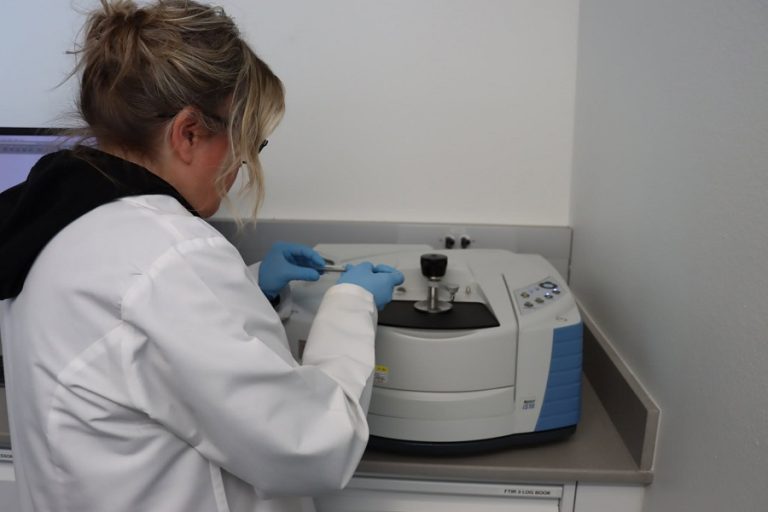
The request consists of six new gas chromatography-mass spectrometry (GC-MS) instruments, four high-performance liquid chromatography systems, and six Fourier-transform infrared spectrometers (FTIRs). This equipment is part of the scientific chain that connects physical evidence to investigations, prosecutions and court proceedings.
Dr. William Watson, who is the laboratory’s quality assurance manager, pointed out that even though certain basic forensic technologies have not changed much over the years, those machines do not last indefinitely, some of them going back as far as 2008.
Because of their technical knowledge, laboratory scientists have been able to get the older equipment to function. Still, Watson pointed out that there is a stage when extending an instrument’s economic life amounts to a false economy. “We must never compromise quality for the sake of economy,” Watson said. “That would be false economics.”
When the machine can no longer be trusted
GC-MS machines are essential in the field of forensic chemistry since they are capable of identifying and analysing substances by separating out the chemical compounds and studying their molecular signatures.
As alternatives other than these there are high-performance liquid chromatography systems, which are used for analysing chemical composition and purity, and FTIR instruments that identify materials by the way in which they absorb infrared light.
Some existing FTIR equipment still works. But discontinued manufacturer support creates another problem: an instrument can remain functional while becoming increasingly difficult to repair, maintain, or validate.
That is important since forensic laboratories are subject to strict accreditation requirements.
Just because an instrument is old does not mean that it is automatically unreliable. It can stay in service as long as it keeps producing technically valid results and meets the required performance standards.
Once the laboratory can no longer show that the instrument is working properly — or if the important components and support from the manufacturer cease to be available — it becomes more and more difficult to justify having the instrument kept in casework.
It is there that a malfunction of equipment can turn into an issue for the justice system.
A failed machine can mean more than a repair bill
Forensic evidence is never found by itself.
The police investigators could be waiting for the laboratory results. The prosecutors might need those results before bringing their case. The defence attorneys might also need access to the same scientific evidence. Finally, the courts rely on the reliability of the testing which underpins the evidence presented at trial.
Consequently, a sudden failure of equipment can cause delays that go well beyond the laboratory itself.
By replacing the instruments before they fail, the laboratory is able to install, verify and test the new equipment while the older machines are still available as a safety backup.
It’s not that simple just to unpack a new machine and plug it in.
Before they are used in actual cases, new instruments have to be installed and thoroughly validated. It may be necessary to amend the laboratory procedures and employees might need further training.
The time required for that preparation is another reason why officials would like to replace the equipment before a crisis makes them have to make the decision.
DNA equipment faces an even faster clock
The DNA technology used in the laboratory poses a different challenge.
In the field of thermal cyclers, quantitative PCR instruments and genetic analyzers, technological developments change more quickly; after manufacturer support has ended, the equipment still has to satisfy the demanding performance requirements.
If it can’t, then it has to be taken out of service.
The investment that has been proposed is therefore not merely a matter of obtaining newer versions of the machinery that is already in the laboratory; it is about preserving a scientific infrastructure which is able to produce defensible results over the long term.
Even hydrogen is part of the upgrade
The laboratory is also examining ways to improve safety.
GC-MS equipment needs a carrier gas; since stopping the use of helium the laboratory has employed pressurised hydrogen tanks.
The authorities are experimenting with a different method: using hydrogen generators that produce the gas only when it is required, rather than depending on large pressurized cylinders.
A test generator is already operating in Las Cruces without reported problems.
It would therefore decrease the laboratory’s need for stored hydrogen while at the same time modernising another section of the equipment system.
The cost of waiting
The main point of the laboratory is simply that the replacement of equipment is inevitable. Failing to carry out the replacement does not cause the cost to vanish; it might instead transform a planned investment into one that has to be made urgently.
Forensic laboratories also have a rather special duty, since their role is to provide evidence which is scientifically valid and capable of withstanding examination by all the parties taking part in the justice process. It means that the laboratory should be able to justify its instruments, its methods and its results.
The fact that $1.4 million is being proposed is really concerned with that chain of trust; even though a crime laboratory works mostly out of sight, its work can affect whether evidence is admitted, the way a case is investigated and what a jury is eventually asked to believe.
It is therefore more a question of protecting the scientific basis underlying the state’s justice system than it is about purchasing new, impressive machines for those laboratories.
A neighborhood dispute Monday night led authorities to arrest a man in Santa Fe. Police said the suspect allegedly punched his neighbor before firing a rifle at him.
Santa Fe Police Department identified the suspect as 37-year-old Adrian Martinez.
At around 6:48 p.m., a caller reported to the Santa Fe Regional Communications Center about a physical altercation between two men. Officers then responded to the 5200 block of Via Del Sol.
According to police, the victim went to retrieve his dog after it ran into a neighbor’s yard. Martinez came out of his residence and allegedly punched the victim in the face.
Martinez allegedly threatened the victim and pointed a gun at him, authorities said. The victim went back inside, but when he later attempted to leave, Martinez allegedly fired at him but missed.
Police said they surrounded Martinez’s home and ordered him to come outside. He eventually opened the door and officers arrested him.
The Crime Scene Unit processed the scene for evidence. Officers also seized several firearms, ammunition, and an expended projectile.
Police took Martinez to the Santa Fe County Adult Detention Center. He faces two counts of aggravated assault with a deadly weapon, shooting at a dwelling or occupied building without great bodily harm, and battery.
Doña Ana County lifted evacuation orders for most agricultural communities of Hatch Valley late Tuesday evening after storms passed. Only Rincon has remained under evacuation orders as of early Wednesday.
Residents of Hatch, Placitas, Salem, and Garfield were allowed to return. However, officials urged caution due to debris, damaged roads, and residual flooding in the area.
Heavy thunderstorms from moisture left behind by Hurricane Polo dumped heavy rain across northern Doña Ana County on Tuesday.
The National Weather Service reported rates as high as 2 to 4 inches per hour in the Hatch and Rincon Valley, prompting a flash flood emergency after dam operators reported signs of potential failure at McLeod Dam, also known locally as Garfield Dam, on the McLeod Arroyo.
County officials initially ordered evacuations for the agricultural communities of Salem, Garfield and Rincon. The order later expanded Tuesday to include the village of Hatch, with a population of about 1,500 to 1,600, and the smaller community of Placitas.
“Residents in the affected areas are strongly encouraged to evacuate now and move to a safe location before conditions worsen,” county officials said in alerts. They directed residents to use Interstate 25 and told them to take needed medications, identification, important documents, supplies, and items for children and pets.
Two shelters opened, including the Radium Springs Community Resource Center at 12060 Lindbeck Road and the Doña Ana Community Resource Center at 5745 Ledesma Drive. The American Red Cross assisted at the Radium Springs site.
The New Mexico Department of Transportation closed several roads because of flooding and debris, including stretches of New Mexico Highway 187 between Salem and Garfield, New Mexico Highway 185, and New Mexico Highway 140 as they are impassable and dangerous.
County spokesperson Ariana Parra said a small piping failure at McLeod Dam had been mitigated and no water was exiting the structure.
Because roads were impassable, transportation was limited, and flooding was widespread, Hatch Valley Public Schools canceled classes on Wednesday. “We made this decision to keep our students safe while giving flooded or muddy roads time to dry out,” the district said in a statement.
But flood watches are still in effect for parts of New Mexico into Wednesday as soils stay saturated.
A federal appellate court has ordered the stay of execution by lethal injection of Christa Gail Pike one hour before the scheduled execution at 10 a.m. on Wednesday at Riverbend Maximum Security Institution in Nashville.
“The court has stayed this recognizing the serious concerns about Christa’s scheduled execution,” Stephen Ferrell of the Federal Defenders Services of Eastern Tennessee said.
Pike, a student at the Knoxville Job Corps Center, was 18 years old when she, together with two other teenagers, tortured and killed Colleen Slemmer on January 12, 1995 in Knoxville.
Before the killing, she thought that 19-year-old Slemmer was interested in her boyfriend, Tadaryl Shipp, who was 17 then.
Pike and Shipp with the help of another teenager lured Slemmer, who was 19, into a wooded area near the University of Tennessee campus. Slemmer was beaten and stabbed. A pentagram was cut into her chest, and Pike later showed classmates a piece of Slemmer’s skull that she kept as a trophy.
Slemmer’s body was found the next day.
Pike was convicted of first-degree murder and sentenced to death in 1996. Her boyfriend, Shipp, got a life sentence and is now eligible for parole. Shadolla Peterson, who was also involved and testified against Pike and Shipp, received probation.
The childhood her lawyers say the jury never heard
Almost thirty years later, Pike’s lawyers question whether the 18-year-old who committed the crime should be judged without considering the trauma that shaped her life. Her lawyers describe Pike’s childhood filled with repeated sexual abuse, rape, and neglect.
Pike’s legal team also say she was later diagnosed with bipolar disorder and post-traumatic stress disorder. Her lawyers argued that during the original sentencing her young age and lack of maturity were not fully considered.
The defense points out that Pike is the only person in Tennessee’s modern death penalty era to face execution for a crime committed at age 18. Records from the Death Penalty Information Center show the death sentences of the other seven Tennessee defendants who were 18 at the time of their crimes have been overturned.
Her attorneys say the legal system did not fully consider the effects of her childhood trauma and mental illness. They also argue that our understanding of how the adolescent brain develops has changed a lot since Pike was sentenced in 1996.
The state, however, has maintained her death sentence.
The final legal fight
Pike’s lawyers have mounted several last-minute challenges to Tennessee’s execution procedures, challenging the state’s lethal-injection protocol. They claimed that Pike’s medical and psychological conditions could expose her to severe suffering during the process.
Her attorneys have argued that her complex PTSD creates a risk of severe retraumatization.
A group of trauma experts has warned that restraints, invasive procedures, loss of control over one’s body, and other parts of an execution could trigger traumatic flashbacks for survivors of sexual violence.
The Tennessee Supreme Court denied Pike’s request for a certificate of commutation and set September 30 as the execution date.
Governor Bill Lee also rejected her clemency request on Monday.
A mother who has waited 30 years
May Martinez, Slemmer’s mother, said she wants to witness it so she can finally feel that her daughter is gone and that she no longer has to fear Pike appearing somewhere in her life.
The two sides of this case are very different. Pike’s defenders point to the abuse and trauma they say shaped the teenager who committed the crime. Slemmer’s family points to the 19-year-old woman whose life was violently taken.
A rare case for a woman on death row
Currently, the state’s Department of Correction listed 45 people on death row. Pike is the only woman in the list. Across the country, there are 45 women on death row, but they make up only a small part of death row prisoners and executions.
Since the U.S. Supreme Court reinstated the death penalty in 1976, only 18 women have been executed nationwide, compared with more than 1,600 men, according to the Death Penalty Information Center.
Pike’s case is peculiar because of her age when the crime happened. If the execution proceeds, she will be the only person in the state’s modern era to be executed for a crime committed at age 18.
Keep it True, New Mexico. That’s the call from the New Mexico Tourism Department (NMTD), which urges businesses and the public to preserve authenticity in tourism. The department launched the campaign to push back against the growing use of artificial intelligence in tourism advertising. NMTD wants you to be part of the campaign and help drive change and progress.
With AI becoming more popular, you can see tourism and destination businesses using it in their advertising almost everywhere. You’ll find it in social media posts and in the ads you encounter around you. Some businesses use generative AI to create flyers, while others use it to produce videos. Many New Mexicans have voiced their disagreement with the trend. Others, however, support the use of AI in advertising.
On National AI Day, July 16, NMTD unveiled its Keep it True campaign through a social media post. The department said the occasion gave it an opportunity to reiterate its position on generative AI and tourism promotion. NMTD said it will not use the tool to create artificial versions of people, places, or experiences found in the state. Instead, the department vowed to stick to “what’s tried and true” and work only with real creatives to tell New Mexico’s stories.
“Destination promotion has existed as a visual-first endeavor for decades, which is why it is more important now than ever to depict our destination authentically and accurately.
We’ve taken a pledge to Keep it True, and now we’re inviting you to take the pledge with us. If you are a destination, experience or amenity who believes in the importance of promoting New Mexico through the use of real authentic imagery, we encourage you to sign our pledge to Keep it True,” NMTD said.
The new initiative quickly caught the attention of New Mexicans. Two months after its launch, our team looked into the story behind Keep it True so you can better understand what the campaign is really about.
How does the Keep it True campaign work?
The Keep it True campaign urges tourism industry operators to feature only real subjects and landscapes in their destination advertising. It also encourages advertisers to work with human creative professionals instead of relying on generative AI for their campaigns. Businesses can contract, commission, or hire creatives to produce their advertising materials.
NMTD is inviting tourism operators to join the campaign and help keep tourism advertising authentic.
“When it comes to the use of generative AI for destination marketing and promotion, our position is clear: the New Mexico Tourism Department will not use generative AI to fabricate the people, places and experiences found in the Land of Enchantment. At a time when the tourism industry seems to be experimenting with generative AI for scale and efficiency in creative production, we will stick to what’s tried and true: working with real creatives to tell real stories about the Land of Enchantment. Destination promotion has existed as a visual-first endeavor for decades. This is why it is more important now than ever to depict our destination authentically and accurately,” NMTD wrote on the pledge.
Photo from: NMTD | Facebook
Through the campaign, the department wants to show what makes New Mexico genuine and unique. It also said people want to see and hear stories created and told by real people.
Why does NMTD discourage AI in tourism advertising?
Acting Tourism Secretary Lancing Adams said the spirit of authenticity has been, and will remain, foundational to the New Mexico True brand. “Relying on people and landscapes fabricated through the use of generative AI violates that spirit of authenticity, so we’re proud to take a position in defense of truth and reality in destination advertising.”
Gallup Tourism & Marketing Manager Matt Robinson also said generative AI may continue to advance, but it can’t replicate the state’s enriching experiences and vibrant cultures.
At the same time, there are also some who see practical benefits. While 47% believe AI can speed up customer service, 38% say it can help employees perform their jobs. Another 35% believe it can generate more creative advertising. Meanwhile, 32% expect companies to pass AI-driven savings on to consumers, while the same percentage sees opportunities for greater product innovation.
But these benefits come with some serious concerns, too.
The human touch isn’t the only concern. Some 57% of consumers point to potential job losses, while another 57% worry about fewer chances to speak with a real person. They also have concerns about privacy and security. Some 43% worry about vulnerabilities, while 40.5% say AI could mislead consumers.
How many have already pledged to Keep it True?
Since the initiative was introduced in July, NMTD said a number of tourism-related businesses and organizations have taken it.
These include destination marketing organizations/entities:
TOURISM Santa Fe
Visit Grants
Taos Ski Valley Chamber of Commerce
Discover Ruidoso
McKinley County
Visit Gallup
Visit Alamogordo
Visit Las Cruces
Santa Fe County Tourism & Marketing
These tourism-related businesses and supporting organizations have also joined:
Once you’re on the site, check the boxes next to the statements that reflect support for NMTD’s initiative. The statements are:
I pledge to not use generative AI to fabricate imagery of the people or places of New Mexico when I promote my destination/experience/amenity.
I pledge to work with a real creative professional to produce multimedia materials to promote my destination/experience/amenity.
I pledge to uplift and celebrate other destinations/experiences/amenities when they share promotional materials produced by creative professionals.
NMTD will also ask if you want your business or organization’s name added to its list of pledge supporters. Next, enter your name, destination/business/organization, and email address.
What local and online reactions followed the Keep it True launch?
Many news outlets reported on the campaign’s latest updates. In the comments section, New Mexicans share their thoughts about the initiative. Most of the reactions our team found are positive. Many said New Mexico doesn’t need AI to advertise its destinations because the state is already beautiful enough to capture the attention of locals and tourists.
“No one needs to use AI. [N]ew Mexico has enough real beauty to show. If you think something needs AI improvement [,] just improve it in real life instead,” a netizen said.
Others lauded NMTD’s initiative, calling it a smart move. One commenter even joked that he learned about the campaign after seeing AI generated images at the state fair.
Meanwhile, another discussion began after a netizen said there is nothing wrong with using AI when people use it properly. He compared AI to a tool like Adobe Photoshop. Some disagreed.
“Tell that to the artists it plagiarizes and the environment it’s killing,” a social media user replied.
“It’s wrong to use it deceptively,” another commenter said.
What do consumers think about businesses using AI in advertising?
Most Americans say they have recently seen ads from brands that clearly appear to use AI. Overall, consumers perceive businesses’ use of AI in advertising more negatively than positively, with young adults expressing the most criticism. Here’s what a recent study found.
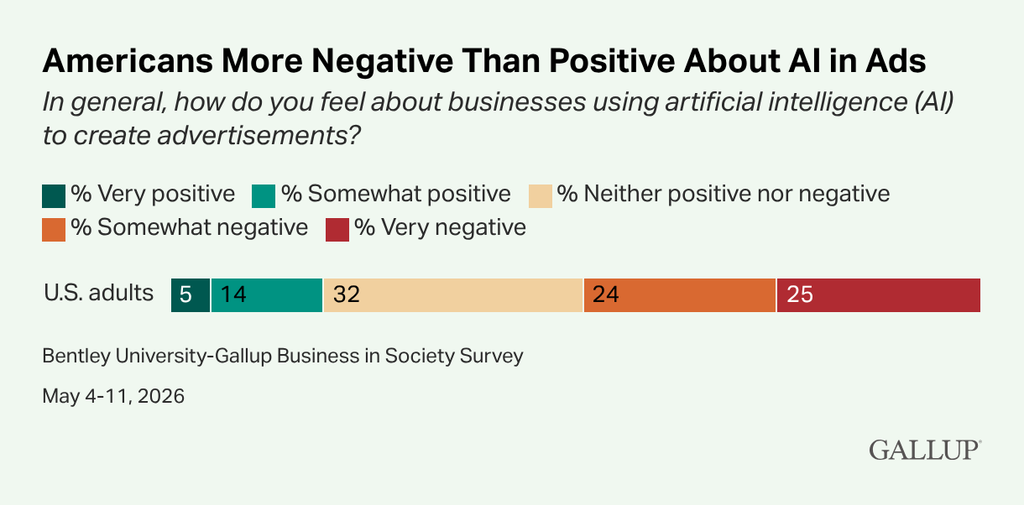
According to the 2026 Bentley University-Gallup Business in Society survey, nearly half of Americans (49%) view businesses’ use of AI to create advertisements negatively. In comparison, 19% view it positively, while 32% have a neutral view.
Image from: Gallup
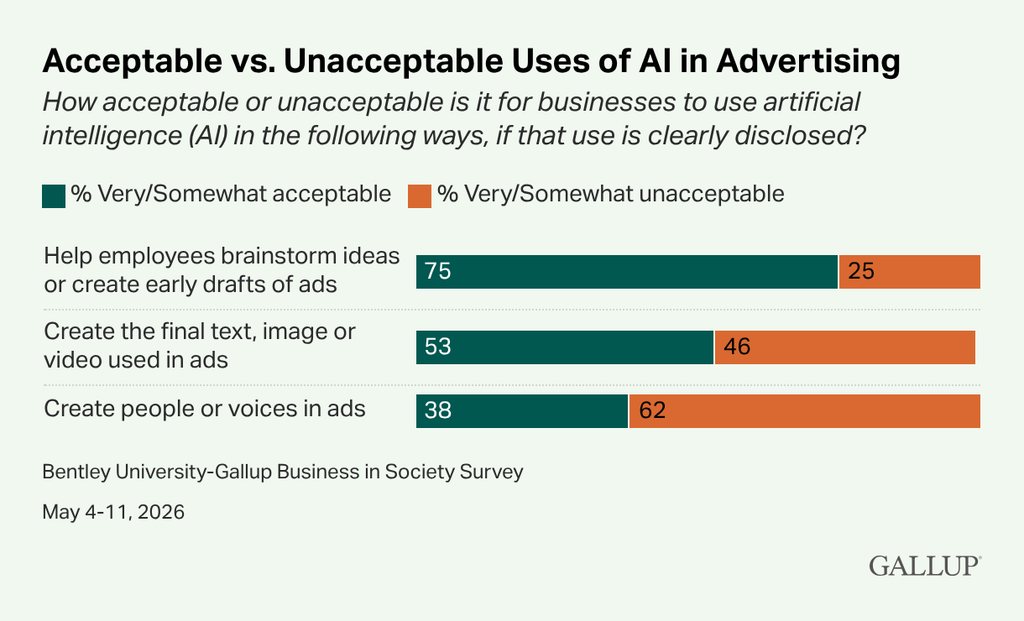
Consumers don’t respond to every use of the technology in advertising the same way. They tend to be more accepting when businesses utilize AI to create ads than when it replaces real people’s images and voices.
Three in four U.S. adults (75%) say businesses can use AI to help employees brainstorm ideas or create early drafts, as long as they are upfront about it. Meanwhile, 53% say brands can use AI to create the final text, images, or videos for their advertisements.
Americans are much less accepting when businesses turn to AI to create people or voices for ads. Nearly two in three (62%) say this practice is unacceptable, even with clear disclosure.
Image from: Gallup
Young adults are also less accepting than older Americans of AI use in advertising. Two-thirds (66%) in the 18 to 29 age group express negative views. That compares with 51% of adults ages 30 to 44, 38% of those ages 45 to 59, and 46% of those 60 and older.
Among 18- to 29-year-olds, 73% find creating people or voices with AI for ads unacceptable. That’s, by far, the highest share among all age groups.
Image from: Gallup
The study found that consumers are open to AI as a creative tool. However, they feel less comfortable when it replaces people’s images and voices. As businesses expand AI use in advertising, the findings suggest their approach may influence consumers’ opinions of their brands.