According to provisional data from the New Mexico Department of Health, the state’s suicide rate dropped by 19 percent between 2024 and 2025.
The drop, according to NMDOH, may show that years of suicide education, prevention initiatives, and heightened public awareness have paid off. Still, health officials warn that this improvement does not mean the crisis is over for a state that has long faced one of the highest suicide rates in the country.
Suicide is still the ninth leading cause of death among New Mexicans in 2025. It was also the second leading cause of death among young people ages 12 to 17, according to NMDOH.
Most suicide deaths in 2025 involved a firearm, officials said.
While the drop in the suicide rate is significant, health officials caution that the suicide crisis is far from over.
Suicide is still a leading cause of death in New Mexico, especially for young people. State data also show big differences in suicide rates among different groups and counties.
NMDOH Secretary Gina DeBlassie said, “Suicide is preventable, and you can help save a life by learning the warning signs.” She added, “Talking openly about suicide can help reduce stigma and suicidal ideation while letting people know you care.”
The state’s health department data show that suicide prevention requires more than just mental health treatment. Lower suicide risk is also linked to social connections, higher education, and housing security.
NMDOH released the data on suicide rate as New Mexico marks National Suicide Prevention Awareness Month in September. World Suicide Prevention Day is on September 10.
If you know someone who is in immediate danger or thinking about suicide, call or text 988 in the United States to reach the Suicide & Crisis Lifeline.
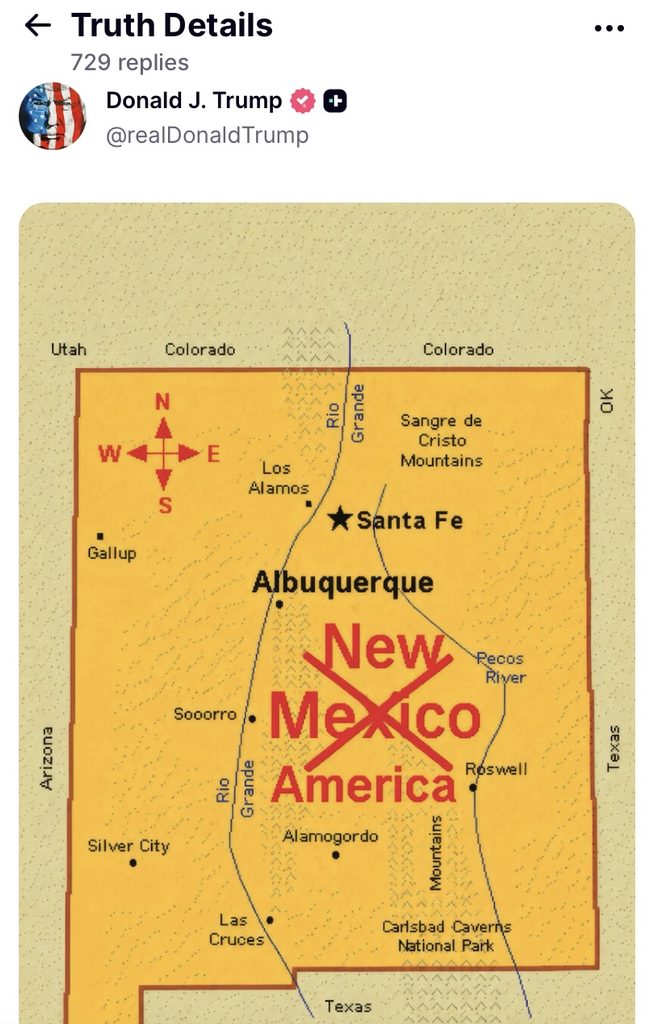
President Donald Trump drew attention online over the weekend after posting about a possible name change for New Mexico. On September 6, he shared a map of the state on Truth Social that crossed out the word “Mexico” and replaced it with “America.”
Screenshot from: @realDonaldTrump | Truth Social
Later that day, the White House’s X account shared a screenshot of Trump’s post. While some citizens supported the idea, others, including state leaders, criticized the move.
Governor Michelle Lujan Grisham made clear that New Mexico’s name is not up for debate. She posted on Facebook:
“New Mexico’s name isn’t up for debate — it’s been ours since before the United States existed. You know what is up for debate? Who’s showing up for working families.
While the President tries to distract Americans from his disastrous war in Iran, gas prices keep soaring. Americans are also spending more at the grocery store, losing access to health care and wondering if they’ll ever be able to afford a home.
Under Democratic leadership here in New Mexico, we’re providing families with free childcare and college, protecting access to health care and investing in housing. While the White House wastes time coloring on maps, Nuevo México is busy doing the work.”
But can New Mexico’s name actually be changed? Our team examined the facts and the legal process surrounding the issue after Trump’s social media post sparked discussion.
QUESTION #1: Where did the issue start?
WHAT’S TRUE: A viral post proposing that New Mexico be renamed “New America” appeared on Trump’s verified Truth Social account. He even repeated the idea in a series of posts on the platform. One post reads:
“Many people suggested changing the name of New Mexico, one of the great vote cheating states of all time, to NEW AMERICA. So much more prestigious and beautiful for the people of that potentially incredible State. Wow, I Love It!!!”
Video from: @realDonaldTrump | Truth Social
QUESTION #2: Is there an executive order from Trump changing New Mexico’s name to “New America”?
WHAT’S TRUE: The Trump administration has not issued any formal action, including an executive order, to rename New Mexico. There are no verified reports about an official move to change the state’s name.
QUESTION #3: What are the comments from Democrats?
WHAT’S TRUE: Democrats expressed their opposition to the proposal to rename New Mexico.
Democratic Party of New Mexico spokesperson Daniel Garcia told Newsweek: “Whether it’s a weak attempt to troll or an unhinged preview of another egotistical name change, it’s clear that Trump is willing to do just about anything to distract voters from his affordability and healthcare crisis ahead of the midterms. Of course, most New Mexican Republicans are silent on Trump’s whim to unilaterally rename our home, and some are even condoning it. This is yet another example of Republicans willing to rubber stamp even the most hurtful and nonsensical parts of the MAGA president’s failed agenda.”
Former Interior Secretary Deb Haaland responded to the President’s post on X, writing: “You can’t be serious. New Mexico is not for renaming. Not up for sale.” Haaland served under the Biden administration and is the Democratic nominee to replace term-limited Lujan Grisham.
Democratic lawmakers representing the state in Congress also responded. Representative Melanie Stansbury wrote on X: “Oh hell no! Our state’s name carries generations of history, culture, and family—and it belongs to us. We’re New Mexicans. Period.”
Senator Martin Heinrich wrote: “Three things I will always call by their actual names…The Gulf of Mexico. Lake Ontario. New Mexico.”
Representative Gabe Vasquez wrote: “You don’t get to erase New Mexico. Not our name. Not our history. Not our culture. The president may want to call us ‘New America,’ but we know who we are.”
QUESTION #4: Can the state’s name be unilaterally changed, and does the Constitution authorize the federal government to rename an existing state?
WHAT’S TRUE: Unlike geographic landmarks and bodies of water, the renaming of the state requires action by the state itself. Therefore, Trump cannot, on his own, change New Mexico to New America.
New Mexico’s state Constitution addresses the state’s name in Article I, titled “Name and Boundaries.” The provision states, “The name of this state is New Mexico,” and defines its territorial boundaries. Changing that would require the state to amend its own Constitution. Voters would then have to approve the amendment.
Under Article XIX, a proposed amendment must receive support from a majority of all elected members in both chambers of the New Mexico Legislature. The proposal then goes before voters. A majority of those voting on it must approve the measure before it becomes part of the constitution.
This puts a state name change beyond the President’s unilateral authority.
QUESTION #5: What are the responses from the Republicans? Did the majority express support for the “New America” proposal?
WHAT’S TRUE: While the New Mexico Democrats slammed the proposed name change, Republicans in the state remained mostly mum on the matter. However, a few of them shared their comments on the issue.
Republican gubernatorial nominee Gregg Hull denounced the proposed name change. The former mayor of Rio Rancho said in a statement to the Albuquerque Journal, “New Mexico does not need a new name.”
“This state carries the history of Native nations and Spanish explorers who named this land nearly 500 years ago, and generations of families who built New Mexico into what it is today. That identity is not up for negotiation.”
Senator and Minority Whip Pat Woods, a Republican, supports several of Trump’s actions, including deportations of people he considers lawless. However, Woods opposes the idea of renaming New Mexico. When asked about Trump’s post, Woods told Newsweek, “about renaming the great state of New Mexico I will have to disagree with him.”
Woods emphasized the state’s deep history, noting that Spanish settlements and Indigenous civilizations existed before the United States was founded. Archaeological discoveries also indicate that humans lived in the region thousands of years ago.
Woods also highlighted New Mexico’s role in the Civil War and its centuries-old trading history. He argued that the state has a rich and extensive history and culture. “We are proud Americans, but we are also very proud New Mexican,” he said.
QUESTION #6: Did the Trump administration take any steps to pursue the proposed name change for New Mexico?
WHAT’S TRUE: Beyond Trump’s Truth Social posts, the administration has made no announcements about efforts to rename New Mexico. For now, “New America” remains a proposal promoted by the President, not an official name change. No constitutional amendment to rename New Mexico is currently underway.
QUESTION #7: How are New Mexicans reacting?
Some New Mexicans described Trump’s suggestion to rename the Democratic-run state “New America” as an attempt to erase history and culture. In a September 9 article, Reuters gathered reactions from more than a dozen New Mexicans.
“Trump you are crazy, you will not take nothing from us,” said Ethel Yazza, 67. She is a potter and member of New Mexico’s Santa Clara and Picuris Indigenous communities. Yazza lives at Picuris Pueblo, about 40 miles (64 km) northeast of the state capital Santa Fe.
Yazza’s Puebloan people were among the first to live in the area that Spanish explorers named La Nueva Mexico in the 1560s, said State Historian Rob Martinez.
“New Mexico is a beautiful name, it’s historic, it sounds beautiful, and New America does not,” said Martinez. His family has Spanish, Mexican, and Indigenous roots that span generations in northern New Mexico.
Mexican American Jesus Trevizo Martinez viewed Trump’s “New America” proposal as an attack on people of Mexican ancestry. New Mexico has the highest proportion of Hispanic and Latino residents among U.S. states, accounting for about 49% of its population.
“He’s doing it out of pure racism,” said the painter and roofer.
Meanwhile, some New Mexicans have expressed support for Trump’s proposal. Lujan Grisham’s latest Facebook post on the issue drew mixed reactions from netizens.
“New Mexicans decide? Okay, I vote New America,” a netizen commented.
“If mothers can be called ‘birthing people,’ then I see no problem with New America,” another wrote in the comment section.
“Most people in the US skipped history class and think New Mexico is in Mexico. So New America has a much nicer ring to it,” another netizen said.
“Keep New Mexico! That fits perfectly!” another citizen commented, echoing the views expressed by other New Mexicans.
In her post, Lujan Grisham said:
“New Mexicans decide what New Mexico is called.
Our name represents more than 400 years of history. The Spanish colony of Nuevo México dates to the late 1500s, and Santa Fe was established as its capital in 1610. Today, Santa Fe is the oldest state capital in the United States.
Changing our name isn’t supposed to be easy. Our Constitution was designed so that amending it requires more than one person — or one government — deciding they want something different.
To change New Mexico’s name, a constitutional amendment would first have to receive the required approval in both chambers of the New Mexico Legislature. Then it would have to go before New Mexico voters. A majority of New Mexicans voting on the amendment would have to approve it.
Our name carries centuries of history, culture and identity. And if anyone wants to change it, New Mexicans get the final say.”
The White House has not publicly responded to the criticism so far.
Brant.One will continue updating this article as more information becomes available, helping readers stay informed about the latest developments.
An investigation is ongoing into the death of a 1-year-old child at the New Mexico Early Learning Academy in Tijeras.
The Bernalillo County Sheriff’s Office said they went to the daycare after receiving a report that a child was “unconscious and not breathing” on Wednesday at about 12:11 p.m.
“The child was transported to a local hospital, where the child later died,” the sheriff’s office said in a statement. Although they have ruled out foul play for now, the investigation is ongoing.
In a statement sent to families, the New Mexico Early Learning Academy officials said the “staff immediately initiated established emergency response protocols,” but to no avail.
“Our deepest condolences are with the child’s family, and our priority is supporting them,” the daycare said.
The academy has closed for the rest of the week as the school community deals with this tragedy. Counselors and grief support will be available to staff and families who need help during this time. “We know this is an incredibly difficult and emotional situation for our school community,” the academy said.
While the investigation is ongoing, the school also urged parents and others to refrain from speculating about what happened or from sharing unverified information.
Facebook is on trial in New Mexico again to determine Meta’s liability in the Cambridge Analytica scandal. This time, the lawsuit puts Facebook’s parent company under examination over allegations that it misled users on how their personal information was collected, shared, and used.
“Facebook’s data breach didn’t just expose private information,” New Mexico Attorney General Raul Torrez said in a statement. “It revealed a pattern of misrepresentation about how user data was collected, shared, and exploited.”
He said the trial seeks to hold Meta accountable for what the state describes as violations of the trust that New Mexicans and global users place in the company.
The proceedings in New Mexico’s First Judicial District Court on Wednesday are expected to last about four weeks. During the trial, New Mexico is planning to present expert testimony on corporate practices and video depositions from some of Meta’s most senior executives, including CEO Mark Zuckerberg, and its former chief operating officer, Sheryl Sandberg, accused of her role in monetizing user data.
The state originally filed the lawsuit in 2021 for violating New Mexico’s Unfair Practices Act, which prohibits deceptive business conduct.
The lawsuit centers on the Cambridge Analytica scandal, which erupted in 2018 after it was revealed that data from tens of millions of Facebook accounts had been harvested without users’ proper authorization and used to build voter profiles and target political advertising during the 2016 U.S. presidential election and the Brexit campaign.
New Mexico argues that Meta misled Facebook users about the extent to which their personal information was protected and how it could be accessed and exploited. It alleges that the data of some 350,000 New Mexicans was exposed.
The state is seeking court orders designed to prevent future privacy violations. It also seeks the maximum civil penalties available under the Unfair Practices Act for each violation.
The trial comes after a separate court decision ordering Meta to pay $567 million in connection with what the court found to be harms to young people’s mental health linked to its social media platforms.
The latest trial represents another legal battle for Meta over whether it did enough to protect the people whose personal data helped build its empire.
Apple has unveiled iPhone Duo at its biggest launch event of the year, alongside the iPhone 18 Pro, AirPods 5 and Apple Watch Series 12, as new CEO John Ternus took center stage for his first major iPhone launch.
The company’s first-ever foldable iPhone was revealed Wednesday. It comes, however, with a luxury price tag.
The Duo represents one of the biggest changes to the iPhone formula since Apple introduced larger-screen models. Instead of choosing between a compact phone and a tablet-sized device, the foldable design will give users both in a single device.
Apple has entered the market considerably later than rivals that have already released multiple generations of foldable smartphones. That makes the Duo an important test of whether Apple’s
approach can persuade consumers to pay a premium for technology they can already buy elsewhere.
The iPhone Duo starts at $1,999, while the iPhone 18 Pro and Pro Max are each $100 more expensive than their predecessors.
At $1,999, Apple is positioning the Duo as a high-end product rather than a mainstream replacement for the regular iPhone.
A colorful makeover
The foldable stole the spotlight, but Apple’s standard iPhone 18 lineup is introducing glacier and burgundy finishes, following the apparent success of last year’s striking Cosmic Orange.
Color has become an increasingly important part of the annual iPhone refresh, giving existing customers another reason to upgrade even when the phone’s basic shape remains familiar.
But this year’s launch also stings in the wallet. The iPhone 18 Pro and Pro Max are $100 more expensive than last year’s comparable models.
That follows the price increases Apple introduced for Macs and iPads over the summer as the cost of memory and storage climbed.
Apple’s C2 modem: The hidden star
The Duo also marks another important step in Apple’s effort to control more of the technology inside its devices, unveiling the C2, its second-generation in-house cellular modem, which will power connectivity inside the foldable iPhone. Apple has historically relied heavily on Qualcomm for cellular modem technology.
According to Apple chief hardware officer Johny Srouji, the C2 design is part of Apple’s broader hardware-and-software integration strategy.
The company says the modem is 50 percent faster than its previous-generation modem while consuming 15 percent less energy. In the U.S., it also adds support for 5G millimeter-wave (mmWave).
Apple bets AI can make your signal better
The company claims C2 is not simply about speed. It says its integrated approach allows it to use AI algorithms to improve cellular reliability, including helping an iPhone reconnect more quickly when it moves into an area with weak coverage.
That could resonate with everyday users more than raw modem speeds.
A faster modem makes the spec sheet impressive. And a phone that reconnects more reliably when you lose signal in a dead zone is something users actually notice.
Qualcomm’s days inside the iPhone could be numbered
The C2 may also be another step toward Apple cutting Qualcomm out of the iPhone altogether.
Chip analyst Ben Bajarin told CNBC that Apple could eliminate Qualcomm chips completely from the iPhone 19 lineup next year, marking a major shift in the smartphone industry if that happens.
Apple would have far greater control over one of the most important components of a smartphone, the technology that connects it to cellular networks. That could allow better integration of its modem with its processors, software, and AI systems while reducing its dependence on an external supplier.
Is the Duo worth $1,999?
Is the Duo worth its pricey tag? This question may ultimately determine whether Apple’s boldest iPhone gamble succeeds.
The company is asking consumers to pay nearly $2,000 for a device that combines the convenience of a phone with the larger display of a foldable.
And Apple is attempting to justify that premium at a time when even its conventional iPhones are becoming more expensive.
The Duo, therefore, has to convince consumers that foldable phones are finally worth owning and that Apple’s version is worth paying considerably more for.
The company’s late entry could actually work in its favor if Apple has spent years refining the technology as its rivals dealt with the initial problems of foldable displays and hinges.
But at $1,999, there will be little room for disappointment. Apple may have finally folded the iPhone. But it has to convince people to open their wallets.
iPhone Duo iPhone 18 Pro and iPhone 18 Pro Max Apple Watch Series 12 and Apple Watch Ultra 4 AirPods 5
A Las Cruces equine therapist, who masterminded a nearly $1 million Medicaid fraud, was sentenced to five years in prison and ordered to return the money she stole.
On Tuesday, the judge in the Third Judicial District Court ordered Nancy Marshall to repay $970,000. Marshall was taken straight to prison after she did not show up for her sentencing and the money she was supposed to return.
The judge accepted a plea agreement on Tuesday in which Marshall pleaded guilty to defrauding the state healthcare system by inventing fake diagnoses, forging records, and even stealing the identities of staff and young patients, including children.
Marshall is the owner of the Equine Assisted Program. She also runs a therapy program in Las Cruces that uses farm animals in treatment.
Attorney General Raúl Torrez said, “Medicaid is a lifeline for New Mexicans who depend on these services, and every dollar stolen from the program is a dollar taken away from patients who need care.”
“This defendant abused the trust placed in her by patients, families, and the State, even going so far as to steal identities and fabricate records to line her own pockets.”
What you need to know
Investigators accused Marshall, who ran the fraudulent scheme for about two and a half years, of collecting payments from Medicaid for counseling sessions she never conducted, claiming to have treated children who were actually sitting in school classrooms at the exact times she said they were with the horses, and using other therapists’ professional ID numbers to push through the fake claims.
Marshall’s two former key staff members exposed the fraudulent scheme. They warned officials about the dodgy practices they saw.
When Marshall failed to produce the required portion of the restitution at sentencing, the court wasted no time locking her up.
Officials from the New Mexico Department of Justice’s Medicaid Fraud and Elder Abuse Bureau spent months investigating the case.
Torrez vowed to continue hunting down anyone who puts “personal profit ahead of the people they are entrusted to serve.”
As the school year gets back into swing, now is the perfect time for teachers to apply for grants to support their classrooms.
New Mexico teachers can apply for a share of $20,000 in grants ranging from $500 to $2,500 for their schools and classrooms. U.S. Eagle Federal Credit Union’s ARNIA Foundation offers the funding through its EnrichEd Classroom Grant Program.
Executive Director Nadine Buerger said the initiative began in 2019 to enhance the classroom experience. She said teachers often have creative ideas for their classrooms and want to use them to engage students and improve attendance.
“Unfortunately, as we all know, oftentimes they’re lacking the funding. So that’s why we’re trying to jump in and help out,” Buerger told KOB 4.
Teachers can apply through the EnrichEd Classroom Grant Program website. They simply need to provide their budget and explain how they plan to use the funds before submitting their application.
Buerger said this year’s theme focuses on financial wellness and financial literacy. She said teachers can cover everything from the real cost of living to paying for college. They can also get creative and find other ways to help students build financial skills.
“We had some food truck battles in the past where students had to price out their menu, the budget for the food, how much they’ll be selling it for. That was a winner in the past. So really they can be creative but it has to revolve around financial wellness,” she said.
Applications are open until September 27. Organizers will announce the grant recipients in October.
An Albuquerque company is helping more people turn the idea of home gardening into a reality. But growing your own food takes work, and Albuquerque Foodscaping Company aims to help you build the infrastructure you need.
National survey data show that nearly 43 percent of people now grow some type of food at home, up from 35 percent just a few years ago. A Purdue University survey found that saving money is a major motivator, but so are improving overall health and a love of gardening.
“We’re on a mission to build a healthier and more sustainable Albuquerque one yard at a time,” founder Alex Perrin told KOB 4. “As long as it involves food production or food waste reduction at your property, we build it.”
After more than a decade as a nurse practitioner, Perrin founded Albuquerque Foodscaping Company in early 2025
“Not to be doom and gloom, but as a health care provider who’s traveled the world, like we’re not in the greatest of health states within the United States. There’s an appetite for change and it starts at home. It starts with what we eat,” he said.
From Home Garden to Foodscaping Business
Perrin built his own home garden, and a co-worker soon asked him to build one, too. That experience showed him how many aspiring gardeners needed help.
“Some people, they don’t have the body that’ll let them do this. Maybe they don’t have the time but we’re here to be that one-stop shop. If you have a dream to build healthier infrastructure at your property, we’re going to make that happen,” Perrin said.
Their work ranges from hand-built planter boxes and composting systems to chicken coops, small orchards, and even vineyards.
“It’s a tremendous amount of work to get everything built and done right,” client Kathy Robinson said. “I’d rather have someone that comes in, knows what they’re doing, get me set up and then I can have the fun of gardening forward.”
Perrin said he’s not the only one seeing the demand.
“We’re booked out through the year so there’s no waiting list,” he said. “It was kind of a leap of faith, to be fair and the community has really rewarded that. I’m quite inspired by it.”
Perrin still works three days a week at the hospital. He spends the other two days on what he calls edible landscaping projects. He’s already working with North Valley homeowners to build a mini vineyard and blackberry field.
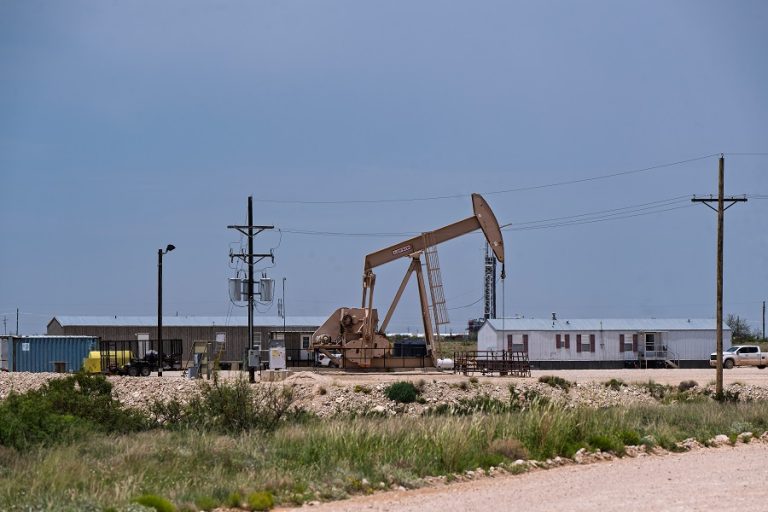
Two new studies have found that the air in Loving, southeastern New Mexico, showed intermittent spikes in radiation, with readings sometimes reaching about five times the site’s normal background level.
The findings backed up what the residents have complained about for years: that something seemed wrong with the air. They have reported unusual odors, a brown haze, and a persistent sense that the pollution around them was more than a nuisance.
Now, these two new studies suggest those concerns may have a scientific basis.
In the ozone study, researchers reported detecting higher levels of ground-level ozone, a pollutant linked to oil and gas emissions and known as a lung irritant.
The findings, published this month in two scientific papers, do not identify any one well or facility as the source. But people living in one of the country’s busiest oilfields say the studies confirm what they have seen and smelled for years.
“It’s pollution,” said Loving resident Jackie Onsurez, a former Democratic primary candidate for lieutenant governor. “You don’t have to be a scientist to wake up and see it’s brown and it’s not dirt.”
Scientists monitored the air in the area continuously from May 2023 to May 2024. They measured radon, radon decay products, ozone, and other pollutants.
The radiation study, published in the journal Elementa, found that airborne radiation levels varied with wind direction. At their peak, readings were about five times higher than the usual background level at the site. That finding indicates temporary increases above normal conditions, though not necessarily levels five times higher than any government health or safety limit.
Researchers said the results suggest that emissions associated with nearby oil and gas activity could be contributing to the spikes.
The research, however, has limitations. One of these is the collection of data at only one site. That means the study does not establish that any particular well, drilling site, or processing plant caused the radiation spikes.
Researchers said a larger network of monitoring stations and more studies are needed to determine and nail down the source of the emissions. That process, known as source apportionment, could help identify which facilities or activities are causing the pollution.
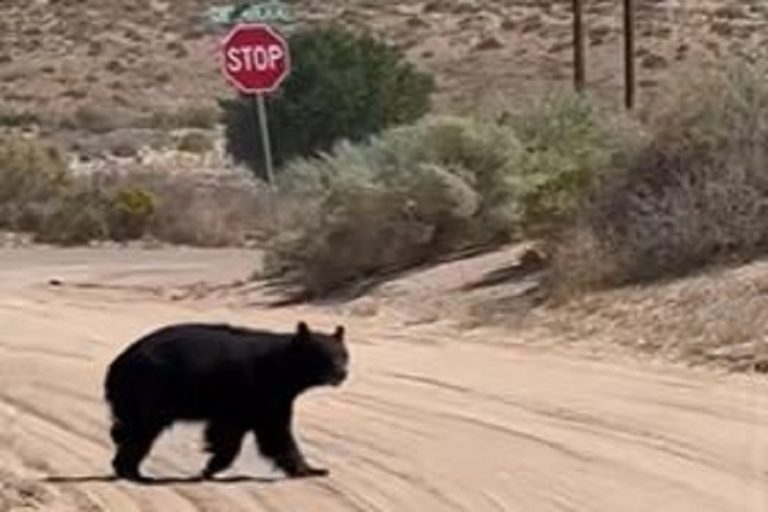
Interstate 25 near Bernalillo has become a deadly crossing for black bears. In just two weeks, four bears have been struck and killed by vehicles, prompting authorities to call on drivers to watch out for bears as they traverse one of the state’s busiest highways.
Wildlife officials confirmed that in just two weeks, four black bears have been killed by vehicles. They fear that hunger may have driven bears closer to roads and communities amid intensifying drought, heat, and food scarcity.
Wildlife officials urged drivers to keep their eyes glued to the road in anticipation of bears crossing the road at any time of the day.
These deaths occur as bears enter hyperphagia, the time before winter, when bears increase their food intake and scramble to build enough fat reserves to survive the winter.
The I-25 bear deaths were not the first this year. In late July, two adults and two cubs were found dead between La Bajada and La Cienega, south of Santa Fe.
One of the adult bears was found on an overpass above a creek. It is possible that these bears were drawn to one of the few available water sources. Officials believe a single vehicle strike may have killed all four animals.
The deaths come as more bears are being drawn to neighborhoods where unsecured rubbish, pet food left outdoors, and fallen fruit have turned suburban areas into tempting feeding grounds.
Officials of the New Mexico Department of Transportation also warned motorists that highways traverse wildlife corridors. Drivers are advised to slow down, particularly at dawn and dusk, watch the road shoulders, and always anticipate an animal suddenly crossing.
Officials say drivers should brake firmly and stay in their lane when a bear or other animal appears in the roadway.
While black bears are still roaming the Sandias, the Manzanos, and the state’s high country, some of them may be forced to take increasingly risky journeys across roads and into populated areas.
Officials urged anyone who encounters an injured bear to keep a safe distance. They should instead contact wildlife authorities immediately.