
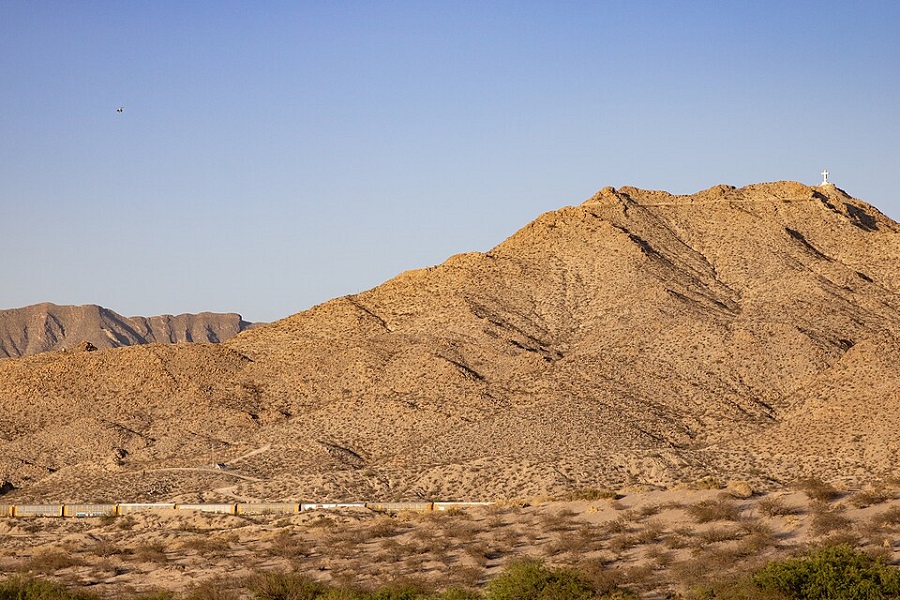
A federal judge has allowed the government to deposit $183,071 into the court registry as it seeks to acquire 14.259 acres owned by the Catholic Church at the base of Mount Cristo Rey. The land would be used for fencing, surveillance cameras, and security lighting for the planned U.S.-Mexico border wall.
But Church leaders disputed the ruling. They insist it is not only about compensation, arguing Mount Cristo Rey is not merely property. It is sacred.
Pilgrims have climbed Mount Cristo Rey in prayer, tracing their path on steep stairs below the towering limestone statue of Jesus Christ overlooking New Mexico, Texas, and Mexico. Catholics from Las Cruces, El Paso, and Ciudad Juárez consider the mountain to be a place where borders seem to vanish. To the Trump administration, however, the land surrounding the sacred mountain has become a strategic location for border wall.
That clash of meanings became the center of a legal fight between the federal government and the Diocese of Las Cruces. “The erection of a border wall through or along this holy site could irreparably damage its religious and cultural sanctity, obstruct pilgrimage routes, and transfer sacred space into a symbol of division,” the Diocese said in court filings.
Catholics regard the mountain as a special place in the spiritual life of the borderlands. The church acquired the land from New Mexico and built the first cross there in 1933. Six years later, the church erected the current monument. Every year, particularly during Holy Week, thousands of Catholics make the steep ascent in acts of devotion.
The Diocese argues that taking the land violates its First Amendment rights. It will also threaten a site that becomes a symbol of unity across national boundaries.
But federal officials disagree. They say access to Mount Cristo Rey will remain open as long as visitors enter from the American side. Court documents show no direct obstruction of the main pathway to the summit. One road, however, appears to be designated for access to border facilities.
In a June 15 order, Chief U.S. District Judge Kenneth J. Gonzales rejected the contention that the court had no discretion over the deposit request. He concluded that depositing the money in the court registry would still allow the Church to pursue the case. “Defendants may raise any defenses and objections to the condemnation in their answer to the complaint,” Gonzales wrote.
Gonzales ruled that the $183,071 will remain in an interest-bearing account until the court issues further notice.
Both sides are to present further arguments during a hearing scheduled for July 23. A larger question, however, still awaits resolution. Can one of the Southwest’s most cherished sacred mountains coexist with a border wall? For many of the pilgrims who climb Mount Cristo Rey every year, the case is about more than land; it is about what the mountain, where the towering statue of Christ stands, represents.
Editor’s Note: This article is an update of the previous story. Click here for the previous story.