

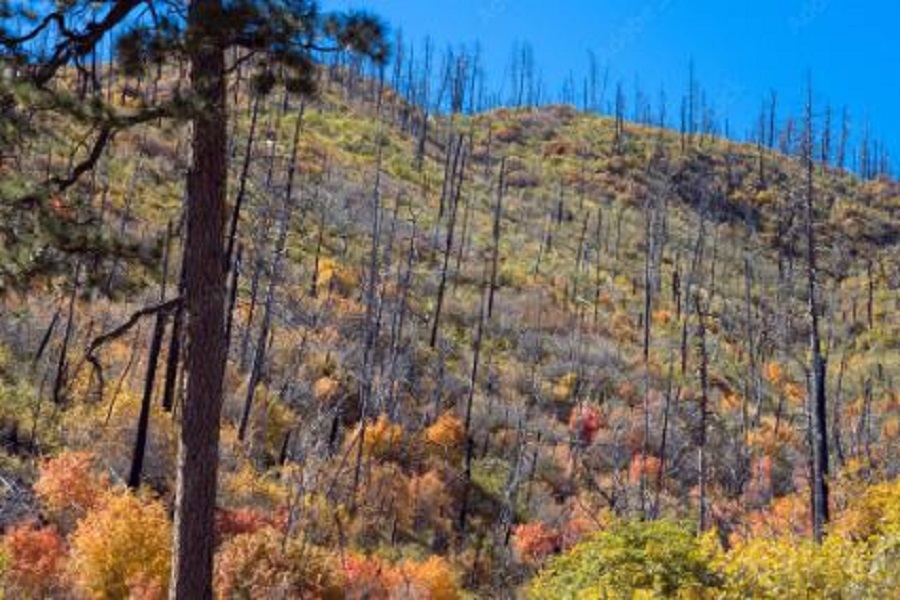
Fire has been part of the rhythm of the land in the high desert, which is partly why New Mexico burns easily. That rhythm, however, has accelerated into something more relentless in recent years. This spring and early summer, dozens of wildfires have already scorched tens of thousands of acres, many sparked by dry lightning that delivered bolts but little rain.
New Mexico burns more readily and more frequently. It is not simply a single bad season. It is the convergence of a naturally fire-prone land, a drying climate, accumulated fuels, and human presence in what seems to be a flammable world.
Statistics tell the story, according to an in-depth guide by the Western Fire Chiefs Association. While the number of acres burned by fire changes from year to year — 2022 was catastrophic, with major fires burning hundreds of thousands of acres amid extreme drought — the underlying conditions have shifted. Fire season, once peaking in late spring and early summer, now stretches longer. Once a periodic visitor, it has become a year-round threat in many parts of New Mexico.
New Mexico’s vulnerability is its climate. Much of the state is arid or semi-arid, with rainfall varying wildly year to year. Increasing average temperatures intensify evaporation from soil, streams, and vegetation, deepening drought even when rain arrives. Low snowpack in the mountains — a persistent issue — means less water runoff into spring and summer, leaving dry forests and grasslands by May.
“Hot, dry, and windy conditions create the perfect environment for a wildland fire,” according to the Wildland and Fire Action Guide. Strong winds, which are becoming common across the high plains and mountain passes, can turn a small spark into a blazing fire in just minutes.
Then add dry lightning — thunderstorms that thunder across the eastern plains or the mountains without rain — and the landscape becomes a matchstick waiting for a spark. In the early months of 2026, lightning is linked to a significant share of ignitions, burning tens of thousands of acres before containment.
NM Burns Easily in a Landscape Shaped by Suppression and Change
Fire is not new in much of the state. Indigenous peoples and early settlers long viewed periodic burns as part of the ecology, clearing underbrush, and renewing grasslands. But hundreds of years of aggressive fire suppression, with overgrazing and logging in the late 19th and early 20th centuries, altered that cycle. Forests grew thicker, and dead wood and understory accumulated. When fire finally returns, it burns hotter and more uncontrollably.
Scientists expect New Mexico’s forests to continue shifting in the coming years. Some areas will transition from conifer stands toward shrublands as periodic high-intensity fires take their toll. Invasive grasses in desert and grassland ecosystems can further drive more frequent burns.
Climate change is amplifying these trends, according to the U.S. Environmental Protection Agency. Higher temperatures exacerbate vapor pressure deficits — leading to more pulling of moisture from plants and soil. Droughts will become more severe and persistent. Climate researchers suggest that larger burned areas will increase in the Southwest in the future.
The 2022 season is a grim preview. Multiple massive fires, including the Hermits Peak-Calf Canyon complex, which is one of the largest in state history, burned through forests and communities. That blaze burned more than 340,000 acres, began with escaped prescribed burns but was driven by drought, low humidity, and wind.
Human Factor
Despite the lightning, humans remain the main ignition source. About 90 percent of wildfires can be traced back to people. Human factors such as campfires not fully extinguished, cigarettes tossed from car windows, sparks from off-road vehicles or equipment, debris burning, or fireworks, largely ignited fires.
New Mexico’s burgeoning population has a wildland-urban interface, where homes press against forests and grasslands. One unexpected spark on a hot, windy day can threaten entire communities, as residents in places like the Jemez Mountains or near Santa Fe know all too well.
Prescribed burns, designed to reduce fuels and restore healthy fire regimes, sometimes escape control — as they did in 2022. Fire managers walk on a tightrope: burn to prevent disaster, but contend with changing weather.
What Comes Next
New Mexico’s challenge is emblematic of wider Western trends. But its arid nature and elevation gradients give it a distinct profile. Unlike California’s chaparral-driven megafires or the Northern Rockies’ vast timber fires, New Mexico is facing everything from desert grasslands to high-elevation forests, each of which has its own fire-climate dynamics.
But adaptations are underway. Officials encouraged homeowners to develop defensible space, using fire-resistant landscaping and clearing vegetation near structures. Fire authorities emphasize prevention messaging such as “One less spark. One less wildfire.” Better forecasting, improved coordination across agencies, and public vigilance are great help. But as conditions warm and dry, the baseline risk rises.
The question for residents is no longer whether fire will come. They are looking more at how to coexist with it. New Mexico remains a place of stark beauty — red rock canyons, expansive skies, and generational forests. But that beauty has now become a vulnerability. Understanding why New Mexico burns easily is the first step toward learning to live with its flames.

