
Home Blog Page 16

Smoking Rates are Falling, Vaping is Rising: Why New Mexico’s Anti-Smoking Victory Comes With a New Public Health Warning

0

Health officials measured progress in the campaign against tobacco by a single metric: fewer people smoking. By that metric, New Mexico is winning, as the percentage of adult cigarette smokers in the state has sharply declined from 15 percent in 2022 to 11.7 percent in 2024, according to the New Mexico Department of Health.

The decline is one of the most promising public health trends in recent years. It reflects progress in anti-smoking campaigns, greater awareness of tobacco-related diseases, and broader access to cessation programs. But a more complicated reality lurks beneath that success.

Cigarette smoking is decreasing, but nicotine use is not disappearing. It is changing form, instead. State health officials say more New Mexicans are increasingly shifting to electronic cigarettes. The shift is reshaping the state’s tobacco control challenge. Adult e-cigarette use rose from 7.3 percent in 2022 to 8.2 percent in 2024, suggesting that many users may be replacing cigarettes with vaping devices instead of abandoning nicotine altogether.

The trend has prompted health officials to use this year’s World No Tobacco Day. They warned that a reduction in smoking does not necessarily mean a reduction in health risks. “New Mexicans have made progress quitting smoking, but it remains a significant public health problem,” said Anthony Garcia, director of the Department of Health’s Nicotine Use Prevention and Control Office. “More people are vaping, especially youth, because it’s sold as a safer choice to cigarettes, but e-cigarettes contain toxic chemicals linked to cancer along with brain, cardiovascular, and respiratory harm.”

The shift mirrors a wider national pattern in which vaping products are gaining popularity. E-cigarettes have attracted smokers seeking to quit smoking cigarettes, as well as younger users who prefer vapes over traditional cigarettes.

Health experts, however, warn that “safer” does not mean safe. Vaping generally exposes users to fewer toxic substances than smoking cigarettes; e-cigarettes still deliver nicotine, a highly habit-forming drug that can affect brain development in adolescents and cause harm to the heart and lungs. Researchers said the long-term health consequences of prolonged e-cigarette use remain under study, according to Johns Hopkins Bloomberg School of Public Health.

The stakes are still high in New Mexico. According to the Campaign for Tobacco-Free Kids, tobacco use kills approximately 2,600 New Mexicans each year. It is responsible for nearly one-fourth of all cancer deaths statewide.

At the same time, recent data reveal that prevention initiatives among young people may be producing results. High school cigarette smoking declined from 8.3 percent in 2019 to 3.3 percent in 2023. During the same period, high school e-cigarette use fell from 33.4 percent to 18.8 percent. Among middle school students, vaping fell from 15.1 percent to a record low of 10.4 percent.

The declines suggest that vigorous public health messaging, school-based prevention initiatives, and increasing awareness of vaping risks may have helped curb nicotine use among younger users. Still, officials caution that the battle is far from over.

The core challenge facing public health agencies today is not convincing people to stop smoking. But it is helping them stop nicotine addiction in all its forms. To that end, the NMDOH is urging residents who use cigarettes, e-cigarettes, or other nicotine products to seek free services through state-supported cessation programs. Resources are also available at QuitNowNM.org or DejeloYaNM.org for people struggling with vaping addiction.

The declining numbers tell a story of progress—but also of adaptation. Nicotine is finding new ways to stay as cigarettes lose ground. Public health officials are confronting a question that goes beyond smoking itself: how to end addiction when the product keeps changing form.

‘Every Role at APS Is Vital’: Superintendent Blakey Honors Staff as School Year Closes

0

Another school year has come to a close. Students, together with their families and friends, celebrate achievements in academics, athletics, and the arts. Beyond the awards and recognitions earned by learners, schools should also honor the dedication and hard work of their staff. Albuquerque Public Schools (APS) Superintendent Gabriella Blakey emphasized this message in her weekly address.

“We’ve wrapped up another school year, and I want to take a moment to acknowledge all you did for our students and thank you for your hard work,” Blakey told APS workers.

She said APS launched about 4,600 graduates into the next chapter of their lives this year. She said the district anticipates welcoming new preschoolers this fall, illustrating the continuous cycle of growth and learning in schools. 

Blakey, however, said this continuous cycle is grounded in the reality that every student’s year is unrepeatable. This means they get one chance at kindergarten, one at sixth grade, and one at their senior year.

“The work we do as educators is vital, and I’m not just referring to our role in helping students learn to read and do math at grade level and preparing them for college or the workforce. We build up their confidence, teach them to work around the roadblocks they encounter, and encourage them to reach for the stars,” she said. 

Every Staff Member Contributes to Student Success

The superintendent added APS serves as a safety net, providing students free meals, caring adults to talk to, and more.

Blakey congratulated APS employees on completing another school year and thanked them for supporting students throughout the period. 

“At the center of all this work are our amazing teachers, aides, counselors, school nurses, principals and the many other individuals who work at each of our schools. They are making a difference in our students’ lives,” Blakey said.

“As I’ve said many times, every role at APS is vital to our students’ success – from our bus drivers and cooks to our accountants, custodians and plumbers,” she said. 

“I see the fruits of your labor during my visits to schools.”

Blakey said she was amazed by the confidence she observed in students at Coronado Dual Language Magnet School. Months after her visit, she continued to recall the precocious student who guided them on a tour of the school.

She added that the poise of Cleveland Middle School eighth-graders during portfolio presentations was also inspiring. They stand before a room of family members, teachers, and other school personnel. They discuss how much they have grown over the last three years and thank those who helped them along the way.

More Strategies Planned for Next Year

Blakey said the district made a concerted effort this year to focus on high-dosage tutoring, and deeper learning through Genius Hour for elementary students. She also said APS prioritized fostering a sense of belonging among our sixth graders and establishing freshman academies at several of high schools. 

She said the freshman academies provide smaller cohorts for ninth graders. The initiative encourages students to explore different career options and focus on work-based and real-world learning.

She said she looks forward to continuing to build on these strategies next school year. 

“In the meantime, I hope those of you who are off this summer have the opportunity to rest, relax and explore, and that you’re ready to come back with renewed energy in August. For those of you who work through the summer, I hope you can also carve out time to rest and recharge,” Blakey said.

“Come August, we all need to be ready to give our students our best. Because they will never get another chance in that grade,” she said.

Albuquerque Police Release Video of Deadly Shooting Involving a 23-Year-Old Man

Editor’s note: This article is an update about this article.

Albuquerque police released video that shows 23-year old Jose Armad firing and shattering a patrol car windshield before police shot him.

According to them, this happened Tuesday evening near Eighth Street and Bellamah Avenue after officers responded to a call about Armas threatening to take his own life.

Police said officers shot back and killed Armas. In the released body camera video, gunshots ring out, glass shattered, and officer take cover.

“Cops could have and should have stopped him from ever going back over here but they let him and scared him back into the house, prompting him to get a weapon,” said Elier Ramirez, Armas’ brother.

APD Chief Cecily Barker said two officers suffered shrapnel injuries when the gunfire hit the patrol unit, but they are fine.

Meanwhile, police said a multi-agency task force and the department’s Internal Affairs Force division will investigate the shooting to determine whether officers followed protocol.

Victims who struggle with mental health tend to see this kind of situation as overwhelming, prompting them to act violent. However, it is also the duty of the officers to understand the situation.

However, when things escalate, officers’ lives are at stake. It is relatively crucial how they would take charge. This is where the line between compassion and duty lies.

Questions Still Remain Over What Really Happened in a Deadly Police Shooting

Editor’s note: This article is the follow-up of this article.

The man has been identified as 23 year old Jose Armas. The family of the man said police could have done more before any any shots were fired.

The family called 911 because he threatened to take his own life.

Elier Ramirez, Armas’ brother, said Armas has been struggling recently, and on Tuesday night the family called the police in hopes of getting help for his mental health, not protection.

“My brother was suicidal; he needed help, and we called the cops for help. Not for protection, but for help for his mentality, and that’s all he needed, and we let the cops know that firsthand,” said Ramirez.

The family said officers could have handled the situation better before gunfire started. Albuquerque police shot and killed Armas after police said he fired his gun.

In times that families no longer know what to do, they seek rescue to the officials. This is where the crucial part of officials’ job has to be careful and be vigilant.

“He came out not armed at first, and that’s why we, we think that they could have done way better. He was unarmed and he showed that to them by pulling down his pants and showing them that they all, that he didn’t have a gun,” said Ramirez.

“My mom was there telling them he just needed help. And we were there to help him. But they decided to use more force than they needed to, and they could have stopped it, and we saw that,” said Ramirez.

Why the Police and Not Community Safety?

Question lingers as to why the officers responded instead of Albuquerque Community Safety who often handles behavioral health calls. APD said then officers responded because Armas was threatening to take his own life with a firearm.

Both Police and Community Safety could have arrive on the scene instead of Police alone. What could have been if Community Safety is also involved?

Ramirez said he is more frustrated over how their family found out his brother had been shot to death.

“Everyone and the public was able to know more than the family did. We didn’t get asked questions, we were there from the beginning, and yet we were treated like some pedestrians,” said Ramirez. “We had to work our way around it to even find out that he died,” said Ramirez.

“More Heart, Less of Hurting Someone”

Ramirez has one message for APD:

“I would say that you guys should look at a situation with more heart, and with less want to hurt someone. Or just to stop a situation completely, and putting it to an immediate end. My brother deserved to get help. And it’s really hard to get help at this time. And they shouldn’t have pushed him to the edge like that.”

APD said an extensive investigation will determine whether anyone will file charges

Officers can be strict and ruthless for most of the time, but in matters such as this, a little compassion and empathy are needed in order to do their job right and save lives as mandated by their duty.

Mental health is a serious matter that should be handled with emotions not with violence.

Shooting in NW Albuquerque Leaves to 2 Officers, Suspect Dead

A suspect died after a shootout which left two police officers injured on Tuesday night in northwest Albuquerque.

Police identified the suspect as a man in his 20s who had a gun. A shootout resulted with the officers and a suspect, who died at the scene.

Shrapnel and shattered glass injured two officers were fired at vehicles bet they’re expected to be fine.

Dispatch officers were immediately deployed to the area of the Eight Street and Bellamah Avenue about a family member who said a man was having suicidal thoughts Tuesday evening.

They arrived at the scene and heard someone yelling from a grou of people, including the man.

After getting the family out of the home, the man stayed inside. Police tried convincing him to come out, saying they wanted to help him. When he exited the home, they used “less lethal” force but he went back inside when it didn’t work.

According to the Police, they heard gunshot from inside of the home, hitting an officer’s vehicle and injuring the two officers. Then, the suspect came back outside with the gun, prompting the shootout.

A drone confirmed the suspect when inside the home, where he died.

Albuquerque Police District Chief Cecily Barker didn’t specifically say if an officer’s gunshots led to the man’s death. The Multi-Agency Task Force is investigating.

What New Mexico Farmers and Ranchers Need to Know About Federal Drought Relief

0

The U.S. Department of Agriculture declared all 33 counties in New Mexico as drought disaster areas. It confirmed what many across the state had suspected: drought is no longer a seasonal burden — it is now an official disaster.

In designating these areas as drought disasters on Tuesday, the USDA has opened the door for struggling agricultural producers to avail emergency low-interest loans as they face one of the state’s driest and most dangerous years in recent memory.

The designation comes as almost the entire state is suffering some stage of drought, according to the U.S. Drought Monitor. New Mexico has placed vast stretches under “severe” or “extreme” drought conditions. Low winter snowpack, rising temperatures, and growing wildfire threats have intensified pressure on an industry already reeling from thin margins.

Federal drought relief

Eligible farmers and ranchers, according to the USDA, may apply for emergency loans of up to $500,000 through the federal Farm Service Agency. According to USDA fact sheet, the loans have lower-than-market interest rates — including operating loans currently set at 4.75 percent. These loans can be used to cover production losses, livestock-related expenses, essential living costs, farm reorganization, and to refinance certain debts. The deadline to apply is Dec. 24, 2026.

The aid comes at a critical moment for New Mexico’s agricultural economy. An industry report said that the state’s food and agriculture sectors generated over $50 billion in economic activity in 2025, creating about 146,000 jobs and producing $5.9 billion in wages.

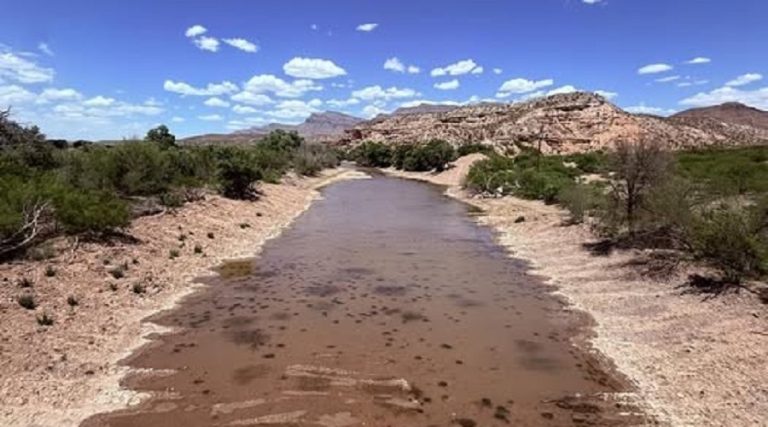
Across rural New Mexico, however, the impact of drought is already visible. Reservoirs are drying up. Grazing conditions have deteriorated. And ranchers in some counties have been forced to reduce herds early as forage shrank amid escalating feed costs.

A lifeline and a warning

Gov. Michelle Lujan Grisham declared a state drought and wildfire emergency on May 20. She directed agencies to coordinate assistance for local governments confronting worsening fire risks and water shortages. State officials also launched a new Drought Information Portal that compiled drought forecasts, wildfire conditions, and state and federal aid resources.

Agricultural experts advised producers to act quickly in documenting losses and contact local Farm Service Agency offices immediately. The federal designation is not only a financial lifeline for rural New Mexico. It is also a warning about the realities of drought in the American West due to the worsening climate crisis.

After 13 Years of Water War, New Mexico Secures a Rare Victory on the Rio Grande

The 13-year water war over the Rio Grande threatened to become one of the most costly legal and environmental defeats in New Mexico history. Instead, state leaders this week emerged from the U.S. Supreme Court with a negotiated victory for the drought-stricken American West.

In a brief order, the Supreme Court formally accepted a settlement ending the 13-year legal battle among New Mexico, Texas, and the federal government over the management of the Rio Grande. The case carried billion-dollar risks. It matched New Mexico farmers against neighboring states and exposed the instability of water in the sweltering heat of the Southwest.

Reached after years of legal skirmishes and political brinkmanship, the settlement gives New Mexico farmers a majority share of irrigation water in the contested stretch below Elephant Butte Reservoir. It avoided what officials feared could have become catastrophic financial penalties.

Lujan Grisham: Turning point

Gov. Michelle Lujan Grisham described the settlement as a turning point for southern New Mexico communities. These communities rely on the river for agriculture, drinking water, and economic survival. “Water is the foundation of New Mexico’s agricultural economy and the lifeblood of communities across the southern part of our state,” the governor said on Thursday. “This settlement means farmers in the Lower Rio Grande can plan for the future, communities have certainty about their water supply and New Mexicans aren’t on the hook for a liability that could have cost billions.”

The settlement outlines a new formula for sharing irrigation water: New Mexico users get 57 percent, and Texas users get 43 percent in the disputed lower basin region. In return, New Mexico agreed to lessen groundwater pumping over the next decade. This concession aims to preserve river flows in an era of worsening drought.

Officially known as Texas v. New Mexico and Colorado, the lawsuit became the most controversial water war in the modern Southwest. It unveiled how climate change, population growth, and century-old water agreements are colliding across the region.

Roots of water war

The roots of the dispute hark back to the early 2000s. At the time, prolonged drought reduced flows along the Rio Grande and heightened tensions among irrigation districts, municipalities, and federal water managers. It began as local grievances, which eventually escalated into a Supreme Court skirmish. Texas sued New Mexico in 2013, alleging that groundwater pumping in southern New Mexico violated the 1938 Rio Grande Compact and deprived farmers of water down the streams legally owed to them. At one point, the damages sought against New Mexico could reach $1 billion.

Several observers believed New Mexico was losing ground. But the settlement arrived after 13 years settles everything.

“It’s a good settlement and a remarkable one for the state of New Mexico, given how the litigation was going in the early stages — not very well for New Mexico,” said Burke Griggs, a water law expert at Washburn University School of Law. “But New Mexico was able to recover and I think it’s achieved a lasting and durable settlement.”

The road to resolution was not easy. Last year, the Supreme Court voted 5-4 to reject an earlier settlement proposal after the federal government contended it ignored federal obligations and reservoir operations tied to the Rio Grande Project. The Supreme Court decision sent negotiators back to the table.

The modified four-part agreement completed in 2025 resolved overlapping disputes between the states and the federal Bureau of Reclamation. In the same way, the revised agreement gives New Mexico more flexibility to comply with groundwater reductions.

Under the agreement, the state must reduce groundwater pumping in the Lower Rio Grande over the next 10 years. To implement the settlement, the state Legislature approved $22.5 million for conservation projects, decommissioning of irrigated farmland, and enhanced water monitoring programs.

Practical roadmap

State Engineer Elizabeth Anderson said the settlement is a pragmatic pathway for balancing legal obligations with the economics of farming communities. “This agreement gives New Mexico the tools, flexibility and time needed to meet our legal obligations while continuing to support agriculture, economic activity and responsible water management across the region,” Anderson said.

State officials view the settlement as more than the end of a lawsuit. But it is a rare moment of stability as water has become both increasingly scarce and politically explosive.

States across the West are preparing for a water war as rivers shrink and aquifers dry up. But for now, New Mexico has prevented what could be a devastating loss, and, at the same time, it secured time to adapt to a drier future.

The Disappearance of Insects is no Longer Subtle — and Scientists Warn the Collapse Could Unravel Ecosystems Humans Depend On

0

The New Mexico desert used to be humming a soundtrack. Crickets chirped from grasses by the roadside. Grasshoppers sprang drunkenly through the heat. Monarch butterflies floated above fields in flashes of orange and black. Insects splattered windshields after long drives were once so common.

Now, scientists say, the silence itself has become obvious.

Across the state — and increasingly around the globe — insects are vanishing at an alarming rate. These tiny creatures are becoming victims of intensifying heat, prolonged drought, pesticide use, and disappearing habitat. Researchers once described the declines as isolated. But they now recognize the declines as part of a broader ecological crisis with consequences far beyond the bugs themselves.

Insects as tiny labor force

The disappearance is not only about artistry. It is about the biological machinery that sustains life. “Insects are the backbone of ecosystems,” said David Lightfoot, a research associate professor in biology at the University of New Mexico. He studied grasshopper populations for over three decades. Scientists say that without insects, food webs begin to break down, pollination weakens, and birds disappear. Without them, soil health deteriorates, and fish populations suffer. The entire ecosystem loses the tiny labor force that quietly keeps it functioning.

Worldwide, the decline has become so obvious. Entomologists now describe their vanishing population as a form of ecological erosion — incremental, relentless, and unnoticeable until collapse becomes visible. “What people are reporting globally is, in fact, happening right here in New Mexico,” Lightfoot said. “More than half of the species we’re evaluating are threatened with extinction, endangered, or critically endangered based on recent declines.”

That finding unsettled researchers because New Mexico has no sprawling urban development usually associated with ecological destruction elsewhere. The state still contains vast swathes of open land. But across the state, the insects are vanishing. Scientists frame the causes as cumulative: temperatures are getting hotter, water supplies are shrinking, herbicides, pesticides, invasive species, and habitat fragmentation combine into what one researcher called “death by a thousand cuts.”

The case of butterflies

The losses are not occurring to obscure or rarely seen species. The Monarch butterfly — perhaps North America’s most recognizable insect — has suffered one of the sharpest collapses.

Kevin Burls, an endangered species conservation biologist with the Xerces Society for Invertebrate Conservation, estimates that western Monarch populations are now “99 percent smaller than populations in the 1980s.” “We’re losing common things in large numbers where they’re having cascading effects in other animal communities,” said Burls. “If you talk to any songbird person in the West,” he added, “they’ll tell you the decline in insects is responsible for fewer birds.”

Bird researchers across North America have increasingly connected diminishing bird populations to dwindling insect abundance. Many migratory birds rely almost entirely on insects to feed their hatchlings. That being said, fewer insects mean fewer chicks survive.

The consequences ripple throughout in ways most people never see. Approximately three-fourths of wild flowering plants rely on insects for reproduction. About a third of food crops also rely on pollinators. These tiny laborers decompose waste, recycle nutrients, and naturally act as pesticides. Scientists say that ecosystems begin losing resilience without insects.

But because insects are small, their population decline unfolds invisibly. “There’s no headline when you lose beetles,” Burls remarked. “People notice when forests burn. They don’t notice when ecosystems slowly stop functioning.”

The case of butterflies is different because they are extensively monitored. Butterflies have become one of the clearest signs of ecological stress. A 2025 study analyzing more than 76,000 butterfly surveys found that butterfly populations declined 22 percent between 2000 and 2020. Shrinking populations outnumbered growing populations by 13 to 1.

The sharpest declines occurred in the American Southwest — including New Mexico, Arizona, Texas and Oklahoma. The overall butterfly abundance in these regions dropped by nearly 4 in 10.

No longer theoretical

The changes are no longer theoretical. Simon Doneski, a doctoral candidate at the University of New Mexico who studies butterflies, said this year’s extreme heat and dry winter spells triggered something unprecedented: butterflies came out from their chrysalises weeks earlier than normal. He recorded nearly two dozen species appearing about a month ahead of established patterns. “We’re in uncharted territory,” Doneski said. “This hasn’t happened in at least 100 years.”

Early emergence of butterflies might sound harmless. Scientists, however, say it is not. Butterflies rely on precise timing between temperature, flowering plants, and caterpillar food sources. If butterflies emerge before flowers bloom, they will have no food. Caterpillars born too early may face deadly summer heat before they reach maturity.

Climate change, according to a study, is causing havoc to environmental calendars that evolved over thousands of years. Increasing temperatures are becoming dangerous to insects’ life cycles: eggs dry out, vegetation withers, streams disappear, and heat waves push fragile species beyond survival thresholds.

Growing tensions

The crisis has also revealed growing tensions between agriculture, public health, and conservation policy. Pesticides and herbicides are still widely used on farms, in suburbs, and on public lands, even as studies associate them with pollinator declines. Experts argue that there is a lack of political urgency to protect insects because they have few defenders compared with industries backed by powerful lobbying groups. “Involvement with local politics and state legislatures is hugely important,” Burls said. “Other interests have really good lobby support, lots of advocates, but insects don’t always have that — so every voice counts.”

New Mexico lawmakers overhauled the state Department of Wildlife. Scientists say the move could help improve conservation efforts. But they warn that funding for insect monitoring and protection remains inadequate. “Before we protect them, we have to learn about them,” Lightfoot said.

Meanwhile, ordinary people still have meaningful ways to help to stave off the crisis. Residents can plant native pollinator species, reduce pesticide use, and preserve habitat in gardens and neighborhoods. Many researchers, however, warn that individual actions alone cannot reverse declines occurring at a global scale. The bigger challenge, they say, is whether society can recognize the ecological worth of forgotten species.

The crisis is not only about butterflies or crickets or grasshoppers. It is about the stability of ecosystems humans depend on but often overlook — until the silence becomes difficult to ignore.

Cellicion Traditional Dance Group Brings Pueblo of Zuni Heritage to Indian Pueblo Cultural Center’s 50 for 50 Celebration

0

The 50 Years of Indian Pueblo Cultural Center – “50 for 50”: 1976-2026 Exhibit will include a performance of the Cellicion Traditional Dance Group of the Pueblo of Zuni. This performance will take place in Albuquerque, New Mexico.

This headline is important because, through music and movement, the Cellicion Dance Group conveys the essence of Pueblo culture. Moreover, the group fulfills the IPCC’s purpose to celebrate and protect Indigenous culture in celebration of their 50th Anniversary.

The performance will feature traditional Zuni dances performed by the Cellicion Dance Group. The dances will be accompanied by live drumming and singing. Consequently, this creates an immersive experience for the audience about Pueblo culture. The artistic expression of the Cellicion Dance Group illustrates the ongoing practice of Indigenous traditions. It is also a defining aspect of Pueblo identity.

Cultural preservation is an example of how the Zuni connect with and preserve their traditions. This creates an educational opportunity through exposure to authentic Indigenous performance. Furthermore, opportunities for cultural exchange and interaction are created through audience participation. There is also an opportunity for tourism to draw visitors to the Albuquerque area through unique programming with a cultural aspect.

The headline illustrates that the Cellicion Traditional Dance Group’s performance goes beyond entertainment. Instead, it is a living cultural representation of Pueblo heritage that will contribute to the IPCC milestone anniversary exhibition.

In summary, the Cellicion Traditional Dance Group’s participation in 50 for 50 will help the Indian Pueblo Cultural Center create an event that embodies authenticity, artistry, and community spirit. This event will inspire the audience and represent the Pueblo’s identity.

Indian Pueblo Cultural Center Marks 50 Years with “50 for 50” Exhibition Showcasing Pueblo Heritage

0

To celebrate its 50th anniversary, the Indian Pueblo Cultural Center has launched a year-long exhibition titled 50 for 50: 1976 – 2026. This exhibition features Pueblo pottery and imagery. It also shares stories of Pueblo culture.

This exhibition is significant because the Indian Pueblo Cultural Center has served as an essential resource for the preservation and teaching of Pueblo culture since 1976. In addition, it is a gathering place for communities. Moreover, it is a destination for international visitors.

The exhibition features 50 objects from the Indian Pueblo Cultural Center’s collections and archives, with special attention to Pueblo Pottery. Throughout the year, the Center will add gallery-based video interviews with Pueblo artists, scholars, and culture bearers. As a result, viewers will gain a deeper understanding of the traditions and viewpoints reflected in the works.

In addition, the Indian Pueblo Cultural Center will invite visitors to help celebrate its 50th anniversary. This will take place at a public reception on March 21, 2026, from 5 to 8 PM. The celebration will continue until February 15, 2027.

There are many advantages to the 50 for 50 Exhibition. These include conserving the heritage of the Pueblo People through representations of their objects and traditions across space and time. The exhibition also enriches educational opportunities through the diverse perspectives of artists and academics. Furthermore, it engages with the community at events and receptions. These gatherings give people the opportunity to learn about how traditional Pueblo culture can be connected to people outside of the Pueblo communities. It encourages tourism and access to the Pueblo peoples and culture. This is possible by enabling people to experience what the Pueblo culture is all about in Albuquerque for an entire year.

The title signifies that 50 for 50 is more than an exhibition…it is a true account of the Pueblo People’s identity and resilience. It connects art, community, and history.

In conclusion, the 50 for 50 Exhibition is a celebration of 50 years of preserving the culture of the Pueblo Peoples. This is represented through pottery, archives, and the voices of Pueblo Artists. This will continue to inspire many more future generations. It will also welcome the world to experience.