

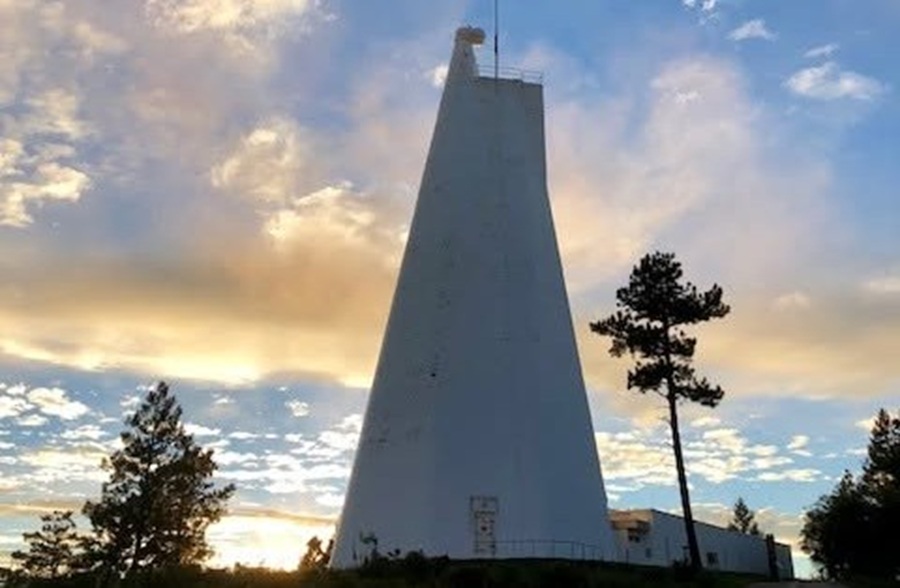
Efforts to save the historic Sunspot Solar Observatory in southern New Mexico have gained some ground, with preservation advocates getting more time to challenge plans to demolish the nearly 80-year-old complex. But federal officials say the demolition plans remain in place, and the delay does not guarantee the site’s historic buildings will be saved.
Preservation advocates seeking to save the nearly 80-year-old Sunspot Solar Observatory in New Mexico have gained more time to challenge demolition plans, though the National Science Foundation maintains its intent to demolish the site. The agency’s decision stems from mercury contamination in the Dunn Solar Telescope, but advocates argue other buildings could be preserved or repurposed.
A formal objection from an outside attorney prompted NSF to delay demolition of non-contaminated buildings until 2027, giving the group Friends of Sunspot and supporters, including state lawmakers, additional time to organize. The Forest Service is collecting proposals for alternative uses, though NSF has not withdrawn its demolition plans.
The National Science Foundation announced earlier this year that it planned to demolish the observatory in the Sacramento Mountains near Alamogordo because of a liquid mercury leak inside the aging Dunn Solar Telescope. The agency’s plans triggered a backlash from former employees, residents and state lawmakers, who argued that buildings outside the contaminated facility, including the visitor center, could be preserved, reused or turned into educational attractions.
The group Friends of Sunspot has since worked to build support across southern New Mexico, approaching city councils and elected officials to make the case for preserving the site. Among those backing the effort are Spaceport America’s executive director and the majority of the New Mexico House of Representatives.
The campaign has also drawn support from outside the state.
Rick St. Hilaire, a New Hampshire-based attorney and amateur solar observer, filed a formal objection with the National Science Foundation in September after learning about the demolition plans while considering a visit to Sunspot in November.
In his letter to the agency, St. Hilaire argued that officials should reconsider destroying the historic complex before taking irreversible action.
“The treatment of these historic properties warrants reconsideration before irreversible demolition occurs,” he wrote. “I ask that NSF not irreversibly destroy this nationally significant historic complex without the kind of reasoned decision-making that the Administrative Procedure Act sets as a standard.”
St. Hilaire declined to discuss his involvement further.
His objection sparked a response from Linnea Avallone, the NSF’s chief officer for research facilities, who wrote to him Sept. 24 that she had contacted New Mexico State Historic Preservation Officer Michelle Ensey.
According to Avallone, Ensey understood that the demolition of the Dunn Solar Telescope must proceed to address the mercury contamination. However, Ensey also asked the NSF to clarify that the other historic buildings at the site were not scheduled for demolition this fall.
Avallone said the agency would allow residents and other stakeholders to raise objections before proceeding with any demolition beyond work required to address the mercury contamination.
That distinction has given preservation advocates a chance to continue their campaign, but it has not amounted to a commitment to save the remaining buildings.
Advertisement
Stephen Hamway, a spokesperson for the New Mexico Historic Preservation Division, said that the division understood demolition of the remaining historic facilities might not happen this year but was scheduled for sometime in 2027.
The prospect of additional time has fueled optimism among supporters, particularly in online communities dedicated to preserving historic observatories. Still, the NSF has pushed back against suggestions that it has suspended or reconsidered its plans.
“NSF’s plans have not changed: the agency still intends to demolish the remaining facilities at the site,” spokesperson Cassandra Eichner said in an email. She added that the agency still welcomes objections to be heard before any further demolition occurs.
In other words, the process remains open to public input, but the agency has not withdrawn its demolition plans.
The U.S. Forest Service is also in contact with local stakeholders about possible future uses for the site, Eichner said. People with proposals can send them to [email protected].
For Dave Dooling, Sunspot’s former education officer who now leads the local effort to prevent the demolition, the additional time is an important opportunity to persuade officials that the historic buildings deserve a future.
Dooling said St. Hilaire’s objection has helped preservation advocates gain time to organize, build support and explore alternatives to tearing down the remaining facilities.
“We’re starting to get a little more traction,” he said. “It’s not a pause so much as it is further down the schedule. But that gives us some time to try and get it saved.”
However, the future of the Sunspot complex remains uncertain. The NSF says it intends to proceed with demolition, while preservation advocates are pressing officials to distinguish between the contaminated telescope that requires remediation and other historic structures they believe could continue serving the public.