

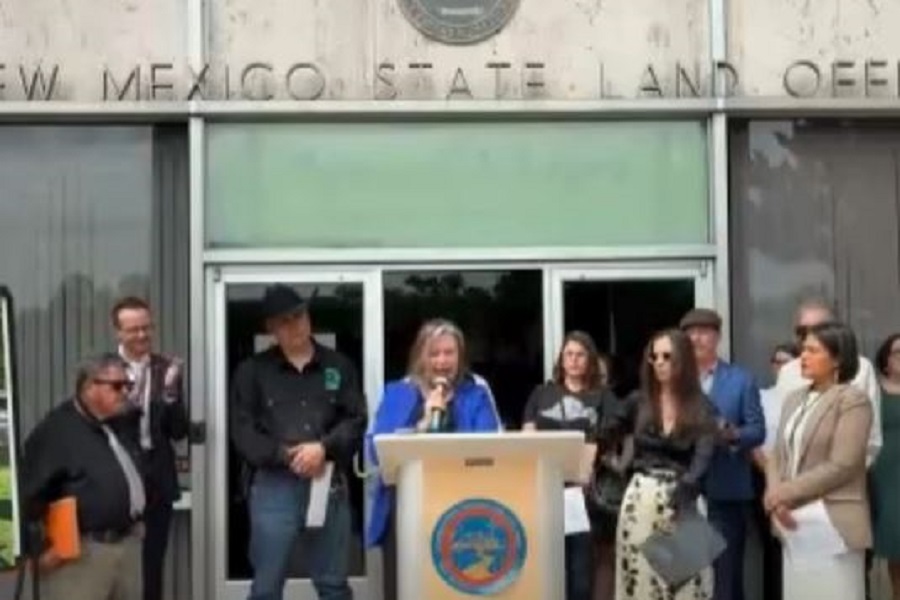
New Mexico’s land chief wants to clean up the radioactive scars left behind by decades of mining rather than dig for more uranium.
In an executive order issued on Friday, Commissioner of Public Lands Stephanie Garcia Richard bans new uranium mining leases across millions of acres of state trust land. Her bigger priority, according to Garcia Richard, is tackling the abandoned mines that dot New Mexico.
Garcia Richard said there are more than 1,000 uranium mining, drilling, and exploration sites across the state. More than 250 of them are considered abandoned.
And about 50 of those abandoned sites are on state land and currently under review by her office.
These figures underscore the need for New Mexico to address the environmental damage left by the uranium industry before allowing a new generation of mines to open. “I have not allowed any uranium mining on state lands, and today’s action solidifies this prohibition to protect our communities and our land and water,” Garcia Richard said.
The order was issued amid the Trump administration’s push to accelerate domestic uranium production, reviving interest in New Mexico’s vast deposits and putting areas around the sacred Mt. Taylor landscape back under scrutiny for potential mining.
Garcia Richard is pushing back. “The Trump administration’s push for aggressive uranium development is a low blow to these communities, and I will keep doing everything in my power to fight back,” she said.
The battle is particularly sensitive in New Mexico, where the uranium industry is inseparable from the history of Native American communities and the devastation left behind by nuclear weapons development.
New Mexico was once the center of America’s uranium industry. The state supplied some of the country’s largest domestic deposits. But the industry left a legacy of contaminated land and fears about the effects of radioactive exposure.
The scars are not only historical for the tribal communities. Many Native Americans living in uranium-producing areas became known as Downwinders, while others lived near mines and mills or worked in the industry. Some have only recently begun receiving financial compensation for damage from the uranium era.
In 1979, the Church Rock uranium mill released about 94 million gallons of radioactive material in northwest New Mexico. The spill has been described as one of the largest radioactive environmental disasters in U.S. history.
Garcia Richard’s executive order explicitly cites tribal opposition to new uranium development, including concerns raised by the All Pueblo Council of Governors about potential damage to sacred sites.
The order also points to a 2011 agreement involving the New Mexico Land Office, the Hopi Tribe, and the Pueblos of Acoma, Laguna, and Zuni concerning the Mt. Taylor landscape. That agreement recognizes the importance of the area and the need to consult tribal nations when managing lands around it.
As Washington seeks to expand domestic uranium production, the consultation has become even more urgent.
Garcia Richard said her order is a pushback against efforts by President Donald Trump’s administration to change portions of the National Historic Preservation Act. That could weaken tribal participation in decisions involving projects such as uranium mines, she said.
The ban, however, has limits. It does not cancel existing permits or business leases protected by valid existing mineral rights. It also acknowledged the federal law’s precedence over the state order in many circumstances.
Nevertheless, Garcia Richard’s order draws the line on where she believes the state should direct its attention. Instead of opening the door to more uranium extraction, she wants the Land Office focused on the mess already left behind.
The political stakes are getting bigger. Garcia Richard will remain commissioner until the end of the year. She is running for lieutenant governor in November on the Democratic ticket alongside Deb Haaland, who is seeking to be New Mexico’s first Native American governor.
However, Democrat Juan de Jesus Sanchez III, who is running for land commissioner, vowed he would keep the uranium ban in place if elected.
Garcia Richard frames the issue beyond mining policy. It is about land, water, and communities that she says have already paid the price for New Mexico’s uranium legacy.

